352 Results for "

Calcium Channel Inhibitor

" in MedChemExpress (MCE) Product Catalog:
Products (352)

352 Results for "Calcium Channel Inhibitor" in MCE Product Catalog:

Cat. No.: HY-W726101
CAS No.: 5996-06-5
Synonyms: O,O-Dimethylisoboldine hydrobromide; S-(+)-Glaucine hydrobromide; NSC 34396 hydrobromide
Glaucine hydrobromide (O,O-Dimethylisoboldine hydrobromide; S-(+)-Glaucine hydrobromide; NSC 34396 hydrobromide) is an alkaloid extracted from Glaucium flavum that possesses various activities, including cough relief, bronchodilation, anti-inflammatory effects, analgesia, antipyretic properties, and anticancer effects. Glaucine hydrobromide acts as a selective and orally active inhibitor of phosphodiesterase 4 (PDE4), with a Ki of 3.4 µM in human bronchial tissues and polymorphonuclear leukocytes. Glaucine hydrobromide induces relaxation of human isolated bronchi by antagonizing calcium channels. Additionally, Glaucine hydrobromide inhibits the activation of NF-κB, leading to a reduction in the expression of the MMP-9 gene, thereby suppressing the migration and invasion of breast cancer cells. Therefore, Glaucine hydrobromide holds potential for research in asthma and breast cancer .
loading...
    loading...
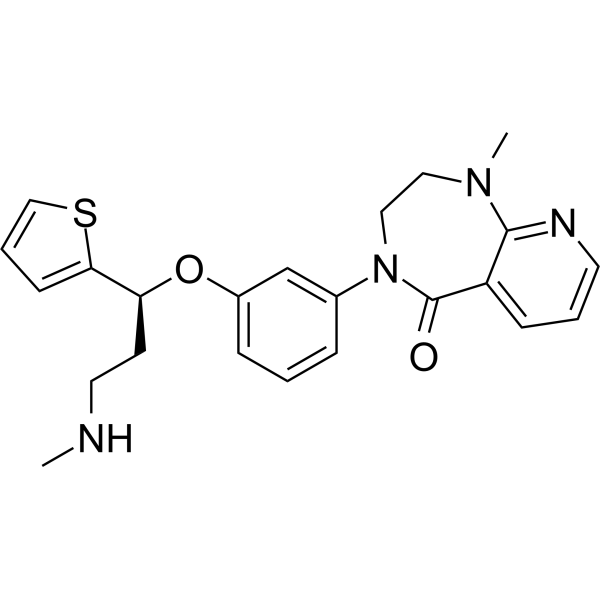
Cat. No.: HY-148862
CAS No.: 2314361-39-0
Cavα2δ1&NET-IN-1 (Compound 59S) is a dual inhibitor of the α2δ‑1 subunit of voltage-gated calcium channels (Cavα2δ-1) and the norepinephrine transporter (NET). Cavα2δ1&NET-IN-1 inhibits Cavα2δ-1 with a Ki of 112 nM. Cavα2δ1&NET-IN-1 inhibits NET with a Ki of 383 nM and IC50 of 67 nM. Cavα2δ1&NET-IN-1 can be used for research of pain .
loading...
    loading...
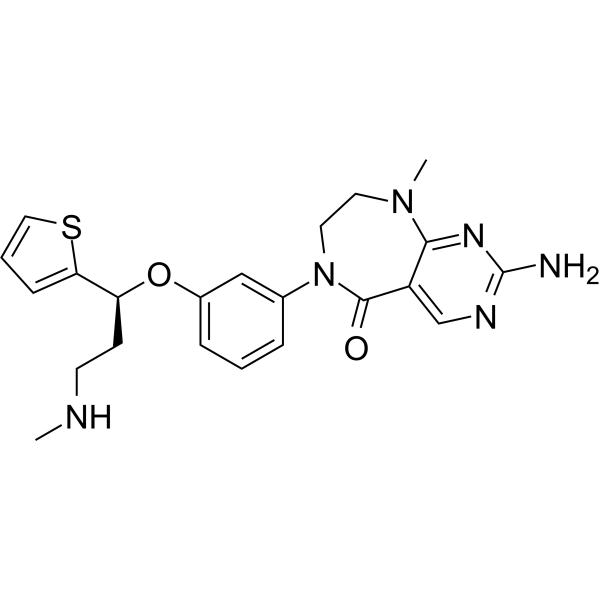
Cat. No.: HY-148863
CAS No.: 2143586-17-6
Cavα2δ1&NET-IN-2 (Compound 45CS) is a dual inhibitor of the α2δ‑1 subunit of voltage-gated calcium channels (Cavα2δ-1) and the norepinephrine transporter (NET). Cavα2δ1&NET-IN-2 inhibits Cavα2δ-1 with a Ki of 454 nM. Cavα2δ1&NET-IN-2 inhibits NET with a Ki of 59 nM and IC50 of 7 nM. Cavα2δ1&NET-IN-2 can be used for research of pain .
loading...
    loading...
Cat. No.: HY-B1239A
CAS No.: 1679-76-1
Synonyms: Cycloadiphene; Hexahydroadiphenine
Drofenine (Cycloadiphene; Hexahydroadiphenine) is an brain-penetrant antispasmodic agent. Drofenine is a Kv2.1 channel inhibitor with human IC50 of 9.53 μM. Drofenine is a butyrylcholinesterase (BChE) inhibitor with Ki of 0.003 mM, and is a TRPV3 activator. Drofenine blocks Kv2.1-dependent potassium efflux, inhibits Kv2.1/JNK/NF-κB and IkBa/NF-kB signaling, suppresses Kv2.1 mRNA/protein expression. Drofenine suppresses oligomeric Aβ-induced microglial NLRP3 inflammasome activation and neuronal Tau hyperphosphorylation, improves cognitive impairment, promotes neurite outgrowth. Drofenine induces calcium influx in keratinocytes and exert cytotoxicity against keratinocytes. Drofenine ameliorates diabetic peripheral neuropathy -like pathology. Drofenine can be used for the researches of Alzheimer's disease, diabetic peripheral neuropathy and smooth muscle spasm .
loading...
    loading...
Cat. No.: HY-142117
CAS No.: 149091-92-9
Research Areas:  

Others

Adenophostin A is an IP3 receptor (inositol 1,4,5-trisphosphate receptors) modulator and Ca 2+ releaser, with an IC50 of 1.3 nM, an EC50 of 1.4 nM, and a Ki of 0.18 nM in rats, and an IC50 of 0.95 nM in humans. Adenophostin A activates IP3 receptors, stimulates Ca 2+ release from intracellular stores and microsomes, inhibits the binding of [ 3H]IP3 to plasma membrane receptors, and activates chloride channels. Adenophostin A resists phosphorylation and dephosphorylation by IP3 metabolic enzymes to maintain its activity, and increases cytoplasmic [Ca 2+] levels via calcium mobilization from the endoplasmic reticulum of vascular smooth muscle cells. Adenophostin A is applicable to research related to hemorrhagic shock .
loading...
    loading...
Cat. No.: HY-132184S
CAS No.: 1881277-30-0
Synonyms: 5,6-EET-d11; (±)5,6-EpETrE-d11
5,6-Epoxyeicosatrienoic acid-d11 (5,6-EET-d11) is deuterium labeled 5,6-Epoxyeicosatrienoic acid. 5,6-Epoxyeicosatrienoic acid is one of the four major epoxyeicosatrienoic acid (EET) isomers metabolized from Arachidonic acid (HY-109590). 5,6-Epoxyeicosatrienoic acid induces peripheral vasodilation and lowers blood pressure by inhibiting T-type calcium channels (Cav3.2: IC50 = 0.54 μM). 5,6-Epoxyeicosatrienoic acid causes vasoconstriction in hypoxic pulmonary blood vessels via activating Rho kinase in a membrane depolarization-dependent manner. 5,6-Epoxyeicosatrienoic acid induces mechanical pain by activating TRPA1. 5,6-Epoxyeicosatrienoic acid can be used in studies related to hypoxic pulmonary vasoconstriction, mechanical hyperalgesia and hypertension.
loading...
    loading...
Cat. No.: HY-187618
CAS No.: 1508276-29-6
Target:  

TRP Channel

Research Areas:  

Metabolic Disease

GRC-17536 is a TRPA1 antagonist with selective inhibition of TRPA1-mediated calcium influx .GRC-17536 binds to TRPA1 binding site 2 to inhibit channel activity .GRC-17536 reduces irritant-induced cough responses and citric acid-induced cough responses .GRC-17536 exhibits antitussive activity .GRC-17536 has poor pharmacokinetic and bioavailability properties, leading to discontinued development after a Phase IIa study .GRC-17536 can be used for the research of painful diabetic polyneuropathy, peripheral diabetic neuropathy, asthma, and chronic cough .
loading...
    loading...
Cat. No.: HY-14744B
CAS No.: 865430-76-8
Synonyms: (S)-Amlodipine hydrochloride; Levoamlodipine hydrochloride
Target:  

Calcium Channel MMP

Research Areas:  

Cardiovascular Disease

Levamlodipine ((S)-Amlodipine; Levoamlodipin) hydrochloride is an orally active L-type calcium channel blocker and MMP-9 modulator with high permeability and retention properties. Levamlodipine hydrochloride significantly enhances plaque stability and improves lipid profiles by reducing blood pressure, decreasing systolic blood pressure variability, and inhibiting MMP-9 expression in atherosclerotic plaques. Levamlodipine hydrochloride not only alleviates cardiac and aortic hypertrophy and prevents renal atrophy, but also produces synergistic effects in blood pressure reduction and organ protection when combined with bisoprolol (HY-129029). Levamlodipine hydrochloride exerts no significant inhibitory effect on abdominal aortic intimal hyperplasia. When excessively accumulated in the epidermis, Levamlodipine hydrochloride may induce changes in keratin structure, impair the skin barrier and trigger inflammation; long-term use further exacerbates skin irritation caused by local administration. Levamlodipine hydrochloride can be used in research related to hypertension and atherosclerosis .
loading...
    loading...
Cat. No.: HY-L145
930 compounds

The majority of hypertensive patients have primary (or essential) hypertension, that is, hypertension in which secondary causes are not present. Management aims to control arterial pressure, prevent end-organ damage (cerebrovascular, cardiovascular, and renal), and reduce the risk of premature death.

Antihypertensive drugs may be divided into two broad groups, the first group being those which directly or indirectly block the renin–angiotensin system (RAS), for example, ACEIs, angiotensin receptor antagonists (ARAs), direct renin inhibitors (DRIs), and to a lesser extent β-blockers. The second group of drugs works by increasing water and sodium excretion, thereby reducing intravascular volume, or by causing vasodilatation through non-RAS pathways, for example, diuretics and calcium channel blockers (CCBs).

MCE offers a unique collection of 930 compounds with identified and potential antihypertensive activity. MCE Antihypertensive Compound Library is critical for antihypertensive drug discovery and development.

Cat. No.: HY-14744C
CAS No.: 865430-78-0
Synonyms: (S)-Amlodipine hydrobromide; Levoamlodipine hydrobromide
Target:  

Calcium Channel MMP

Research Areas:  

Cardiovascular Disease Others

Levamlodipine ((S)-Amlodipine; Levoamlodipin) hydrobromide is an orally active L-type calcium channel blocker and MMP-9 modulator with high permeability and retention properties. Levamlodipine hydrobromide significantly enhances plaque stability and improves lipid profiles by reducing blood pressure, decreasing systolic blood pressure variability, and inhibiting MMP-9 expression in atherosclerotic plaques. Levamlodipine hydrobromide not only alleviates cardiac and aortic hypertrophy and prevents renal atrophy, but also produces synergistic effects in blood pressure reduction and organ protection when combined with bisoprolol (HY-129029). Levamlodipine hydrobromide exerts no significant inhibitory effect on abdominal aortic intimal hyperplasia. When excessively accumulated in the epidermis, Levamlodipine hydrobromide may induce changes in keratin structure, impair the skin barrier and trigger inflammation; long-term use further exacerbates skin irritation caused by local administration. Levamlodipine hydrobromide can be used in research related to hypertension and atherosclerosis .
loading...
    loading...
Cat. No.: HY-14744D
CAS No.: 884648-62-8
Levamlodipine besylate Hemipentahydrate is an orally active L-type calcium channel blocker and MMP-9 modulator with high permeability and retention properties. Levamlodipine besylate Hemipentahydrate significantly enhances plaque stability and improves lipid profiles by reducing blood pressure, decreasing systolic blood pressure variability, and inhibiting MMP-9 expression in atherosclerotic plaques. Levamlodipine besylate Hemipentahydrate not only alleviates cardiac and aortic hypertrophy and prevents renal atrophy, but also produces synergistic effects in blood pressure reduction and organ protection when combined with bisoprolol (HY-129029). Levamlodipine besylate Hemipentahydrate exerts no significant inhibitory effect on abdominal aortic intimal hyperplasia. When excessively accumulated in the epidermis, Levamlodipine besylate Hemipentahydrate may induce changes in keratin structure, impair the skin barrier and trigger inflammation; long-term use further exacerbates skin irritation caused by local administration. Levamlodipine besylate Hemipentahydrate can be used in research related to hypertension and atherosclerosis .
loading...
    loading...
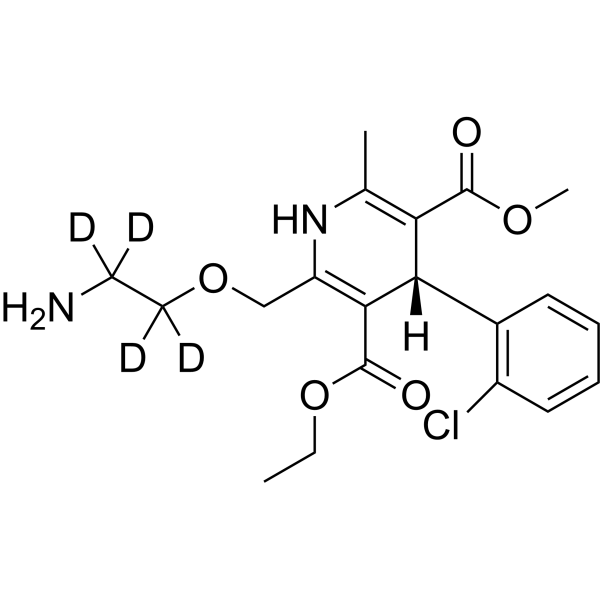
Cat. No.: HY-14744S
CAS No.: 1346617-19-3
Purity:  99.74%
Synonyms: (S)-Amlodipine-d4; Levoamlodipine-d4
Levamlodipine-d4 is the deuterium labeled Levamlodipine. Levamlodipine ((S)-Amlodipine; Levoamlodipin) is an orally active L-type calcium channel blocker and MMP-9 modulator with high permeability and retention properties. Levamlodipine significantly enhances plaque stability and improves lipid profiles by reducing blood pressure, decreasing systolic blood pressure variability, and inhibiting MMP-9 expression in atherosclerotic plaques. Levamlodipine not only alleviates cardiac and aortic hypertrophy and prevents renal atrophy, but also produces synergistic effects in blood pressure reduction and organ protection when combined with bisoprolol (HY-129029). Levamlodipine exerts no significant inhibitory effect on abdominal aortic intimal hyperplasia. When excessively accumulated in the epidermis, Levamlodipine may induce changes in keratin structure, impair the skin barrier and trigger inflammation; long-term use further exacerbates skin irritation caused by local administration. Levamlodipine can be used in research related to hypertension and atherosclerosis .
loading...
    loading...

