31 Results for "

Octreotide

" in MedChemExpress (MCE) Product Catalog:
Products (31)

31 Results for "Octreotide" in MCE Product Catalog:

Cat. No.: HY-P5085
CAS No.: 83795-61-3
Target:  

Inhibitory Antibodies

Research Areas:  

Others

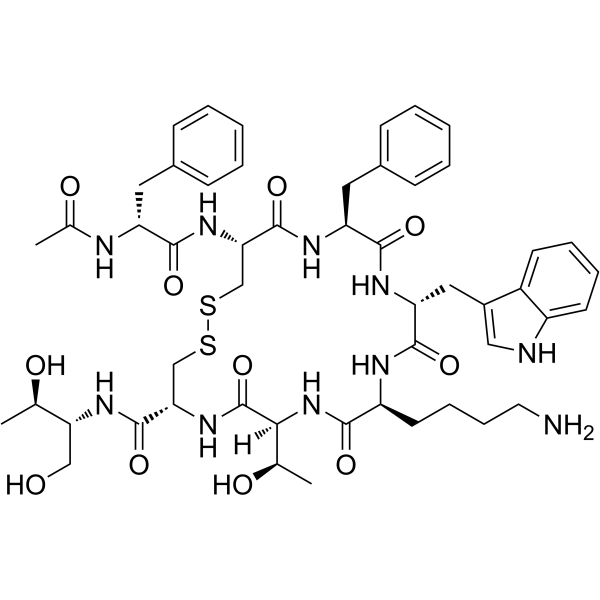
Acetyl-octreotide is a reduced linear peptide. Acetyl-octreotide can synthesize Re(V)-cyclized peptides in aqueous methanol solutions with low Sst receptor binding affinities .
loading...
    loading...
Cat. No.: HY-P4100
Target:  

Somatostatin Receptor

Research Areas:  

Others

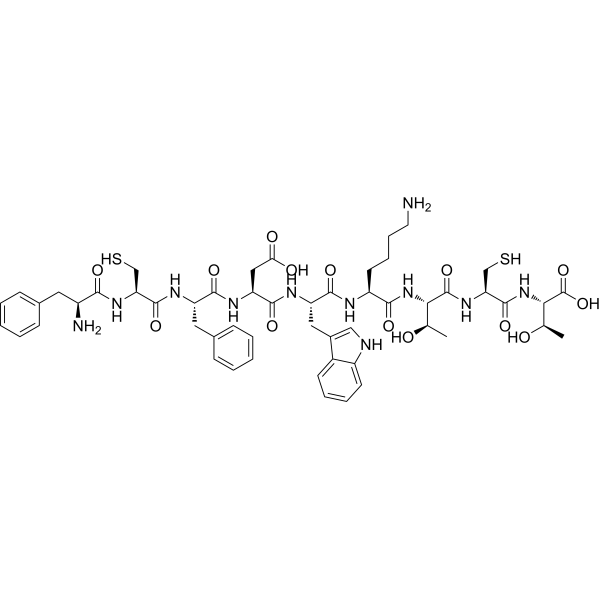
Cyclic SSTR agonist octreotide is a Octreotide (HY-P0036), serving as the cyclic Somatostatin Receptor SSTR agonist .
loading...
    loading...
Cat. No.: HY-P0036S2
CAS No.: 1240797-41-4
Synonyms: SMS 201-995-d8
Octreotide-d8 (SMS 201-995-d8) is deuterium labeled Octreotide. Octreotide (SMS 201-995) is a somatostatin receptor agonist and synthetic octapeptide endogenous somatostatin analogue. Octreotide (SMS 201-995) can bind to the somatostatin receptor and mainly subtypes 2, 3, and 5, increases Gi activity, and reduces intracellular cAMP production. Octreotide (SMS 201-995) has antitumor activity, mediates apoptosis and may also be used in disease studies in acromegaly .
loading...
    loading...
Cat. No.: HY-P0036S3
Synonyms: SMS 201-995-13C9,15N
Octreotide- 13C9, 15N (SMS 201-995- 13C9, 15N) is 13C and 15N labeled Octreotide. Octreotide (SMS 201-995) is a somatostatin receptor agonist and synthetic octapeptide endogenous somatostatin analogue. Octreotide (SMS 201-995) can bind to the somatostatin receptor and mainly subtypes 2, 3, and 5, increases Gi activity, and reduces intracellular cAMP production. Octreotide (SMS 201-995) has antitumor activity, mediates apoptosis and may also be used in disease studies in acromegaly .
loading...
    loading...
Cat. No.: HY-172280
Target:  

Liposome

Research Areas:  

Cancer

DSPE-PEG1000-Octreotide is a PEG compound which composed of DSPE and a Octreotide (HY-P0036). Octreotide is a somatostatin receptor agonist. Octreotide has antitumor activity, mediates apoptosis and may also be used in disease studies in acromegaly. DSPE-PEG1000-Octreotide can be used for drug delivery .
loading...
    loading...
Cat. No.: HY-P0036D
CAS No.: 1427427-01-7
NOTA‑Octreotide is a selective SSTR2‑targeting PET tracer. NOTA‑Octreotide binds specifically to SSTR2 and accumulates in SSTR2‑expressing tissues. NOTA‑Octreotide enables effective imaging of somatostatin receptor‑positive tumors in mice and shows high specific uptake in SSTR2‑expressing organs in healthy rats. NOTA-Octreotide can be used for PET imaging investigation of neuroendocrine tumors. .
loading...
    loading...
Cat. No.: HY-W035399S1
CAS No.: 2708340-91-2
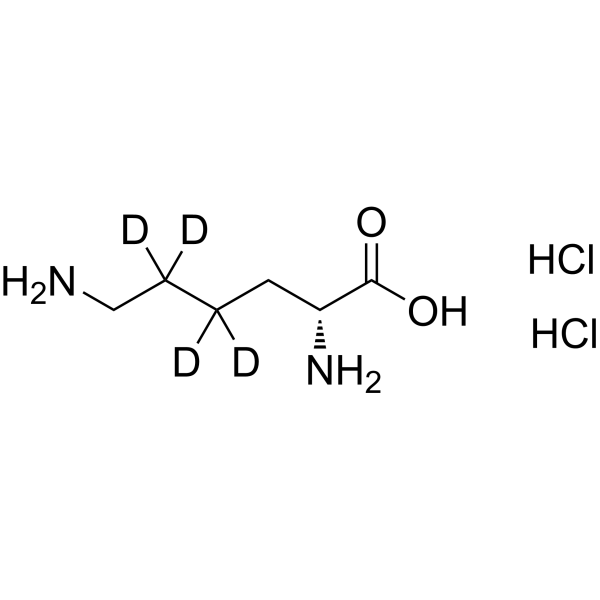
D-Lysine-d4 dihydrochloride is the d4-labeled D-Lysine (HY-Y1091). D-Lysine is the D-enantiomer of L-Lysine (HY-N0469). D-Lysine is metabolically inert and not utilized for protein synthesis by mammalian ribosomes. D-Lysine blocks renal uptake of 111In/ 90Y-Octreotide (HY-P0036)-based probes without inhibiting uptake by tumor/receptor tissues, and thus acts as a renoprotective agent in diagnostic imaging and peptide receptor radionuclide therapy (PRRT). D-Lysine specifically inhibits the early steps of non-enzymatic glycation by competing with glucose via its free amino group, theoretically, it can serve as a glycation competitor that "does not interfere with protein synthesis" under chronic hyperglycemia in diabetes. D-Lysine can be used in research related to cancer and diabetes .
loading...
    loading...
Cat. No.: HY-Y1804S
CAS No.: 2714413-18-8
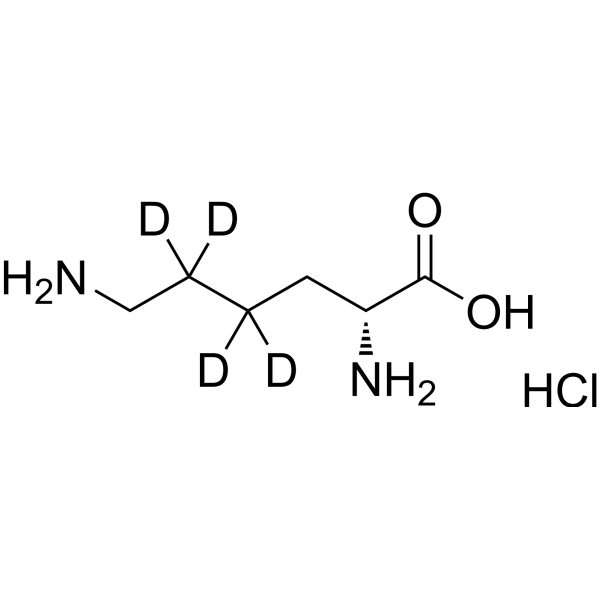
D-Lysine-d4 monohydrochloride is the d4 D-Lysine monohydrochloride (HY-Y1804). D-Lysine monohydrochloride is the D-enantiomer of L-Lysine (HY-N0469). D-Lysine monohydrochloride is metabolically inert and not utilized for protein synthesis by mammalian ribosomes. D-Lysine monohydrochloride blocks renal uptake of 111In/ 90Y-Octreotide (HY-P0036)-based probes without inhibiting uptake by tumor/receptor tissues, and thus acts as a renoprotective agent in diagnostic imaging and peptide receptor radionuclide therapy (PRRT). D-Lysine monohydrochloride specifically inhibits the early steps of non-enzymatic glycation by competing with glucose via its free amino group, theoretically, it can serve as a glycation competitor that "does not interfere with protein synthesis" under chronic hyperglycemia in diabetes. D-Lysine monohydrochloride can be used in research related to cancer and diabetes .
loading...
    loading...
Cat. No.: HY-P11463
CAS No.: 160841-00-9
Target:  

Somatostatin Receptor

Research Areas:  

Metabolic Disease

Des-threoninol-octreotide (Compound 13) is a Somatostatin analog. Des-threoninol-octreotide inhibits cloned somatostatin receptors with IC50 values of 13.62 nM, 10.63 nM, 10.95 nM for mSSTR2b, rSSTR5 and hSSTR5, respectively .
loading...
    loading...
Cat. No.: HY-P0036S
Synonyms: SMS 201-995-d8 TFA
Octreotide-d8 (SMS 201-995-d8) TFA is the deuterium labeled Octreotide TFA. Octreotide (SMS 201-995) is a somatostatin receptor agonist and synthetic octapeptide endogenous somatostatin analogue. Octreotide (SMS 201-995) can bind to the somatostatin receptor and mainly subtypes 2, 3, and 5, increases Gi activity, and reduces intracellular cAMP production. Octreotide (SMS 201-995) has antitumor activity, mediates apoptosis and may also be used in disease studies in acromegaly.
loading...
    loading...
Cat. No.: HY-Y1804R
CAS No.: 7274-88-6
D-Lysine monohydrochloride (Standard) is the analytical standard of D-Lysine monohydrochloride (HY-Y1804). This product is intended for research and analytical applications. D-Lysine monohydrochloride is the D-enantiomer of L-Lysine (HY-N0469). D-Lysine monohydrochloride is metabolically inert and not utilized for protein synthesis by mammalian ribosomes. D-Lysine monohydrochloride blocks renal uptake of 111In/ 90Y-Octreotide (HY-P0036)-based probes without inhibiting uptake by tumor/receptor tissues, and thus acts as a renoprotective agent in diagnostic imaging and peptide receptor radionuclide therapy (PRRT). D-Lysine monohydrochloride specifically inhibits the early steps of non-enzymatic glycation by competing with glucose via its free amino group, theoretically, it can serve as a glycation competitor that "does not interfere with protein synthesis" under chronic hyperglycemia in diabetes. D-Lysine monohydrochloride can be used in research related to cancer and diabetes .
loading...
    loading...

