35 Results for "

neurodevelopmental

" in MedChemExpress (MCE) Product Catalog:
Products (35)

35 Results for "neurodevelopmental" in MCE Product Catalog:

Cat. No.: HY-106769B
CAS No.: 105182-47-6
Synonyms: (3aR,9aR)-GR50360
Target:  

Adrenergic Receptor

Research Areas:  

Neurological Disease

(3aR,9aR)-Fluparoxan ((3aR,9aR)-GR50360) is a highly selective and potent α2B adrenaline receptor antagonist with the activity of preventing, improving or inhibiting neurodevelopmental disorders and neurodegenerative diseases. As an α2B receptor antagonist, (3aR,9aR)-Fluparoxan can promote the recovery of neurological function. The mechanism of action of (3aR,9aR)-Fluparoxan makes it have important application potential in neuroscience research .
loading...
    loading...
Cat. No.: HY-104044A
CAS No.: 2086689-94-1
Synonyms: BGB-290 maleate
Target:  

Apoptosis

Research Areas:  

Neurological Disease

Pamiparib maleate (BGB-290 maleate) is a highly potent and selective PARP inhibitor with neurotoxicity-inducing activity. Pamiparib maleate can effectively penetrate the blood-brain barrier and cause cerebral hemorrhage, brain atrophy, and movement disorders in zebrafish embryos exposed. Pamiparib maleate exposure downregulates the activities of acetylcholinesterase (AChE) and adenosine triphosphatase (ATPase) and leads to upregulation of oxidative stress, which triggers apoptosis and interferes with the expression of neurodevelopment-related genes. The use of pamiparib maleate is also accompanied by downregulation of the Notch signaling pathway, while activation of the Notch signaling pathway can partially rescue neurodevelopmental toxicity. Therefore, pamiparib maleate provides a reference for evaluating its potential neurotoxicity during embryonic development .
loading...
    loading...
Cat. No.: HY-119976S
CAS No.: 2468796-76-9
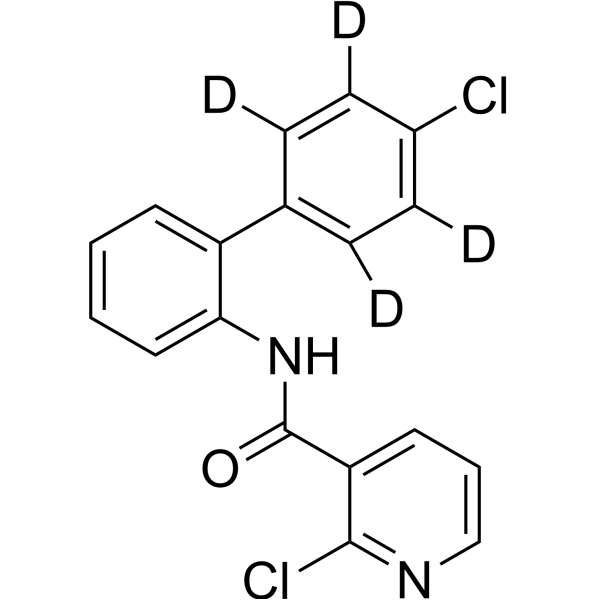
Boscalid-d4 is the deuterium labeled Boscalid. Boscalid is a succinate dehydrogenase (SDHI) inhibitor with antifungal activity. Boscalid binds to the ubiquinone-binding site of fungal mitochondrial complex II, blocks ATP production and aerobic respiration, exhibits good control efficacy against a variety of plant fungal diseases including gray mold, sclerotinia rot and powdery mildew, and is widely used for disease control in agriculture. Boscalid induces apoptosis, altered lipid metabolism, mitochondrial dysfunction, respiratory impairment, oxidative stress, ROS accumulation and neurodevelopmental disorders in zebrafish. Boscalid reduces foraging ability, shortens median death time and causes chronic toxicity in exposed honeybees. Boscalid also possesses genotoxicity, cytotoxicity, elevated mitochondrial superoxide levels and early-stage apoptosis .
loading...
    loading...
Cat. No.: HY-119976R
CAS No.: 188425-85-6
Boscalid (Standard) is the analytical standard of Boscalid. This product is intended for research and analytical applications. Boscalid is a succinate dehydrogenase (SDHI) inhibitor with antifungal activity. Boscalid binds to the ubiquinone-binding site of fungal mitochondrial complex II, blocks ATP production and aerobic respiration, exhibits good control efficacy against a variety of plant fungal diseases including gray mold, sclerotinia rot and powdery mildew, and is widely used for disease control in agriculture. Boscalid induces apoptosis, altered lipid metabolism, mitochondrial dysfunction, respiratory impairment, oxidative stress, ROS accumulation and neurodevelopmental disorders in zebrafish. Boscalid reduces foraging ability, shortens median death time and causes chronic toxicity in exposed honeybees. Boscalid also possesses genotoxicity, cytotoxicity, elevated mitochondrial superoxide levels and early-stage apoptosis .
loading...
    loading...
Cat. No.: HY-B1120R
CAS No.: 3383-96-8
Synonyms: Temefos (Standard)
Temephos (Standard) is the analytical standard of Temephos. This product is intended for research and analytical applications. Temephos (Temefos) is an orally active, blood-brain barrier-permeable organophosphate insecticide and AChE inhibitor. By irreversibly inhibiting AChE to induce cholinergic overactivation, Temephos effectively blocks larval development of Aedes aegypti (yellow fever mosquito) and Aedes albopictus (Asian tiger mosquito), and is commonly used in studies related to Dengue Virus, Zika Virus and other relevant pathogens. Temephos exhibits genotoxicity and neurodevelopmental toxicity, and may also cause liver injury, reproductive system abnormalities and cholinergic poisoning symptoms in mammals. Temephos tends to accumulate in adipose tissues and aquatic organisms, and is excreted via feces after metabolism through oxidation and hydrolysis. Note that CYP-mediated metabolic detoxification may reduce the actual larvicidal efficacy of Temephos against some mosquito species. Temephos can be used in research related to dengue fever, Zika virus disease, chikungunya and dracunculiasis .
loading...
    loading...
Cat. No.: HY-B1120S
CAS No.: 1219795-39-7
Synonyms: Temefos-d12
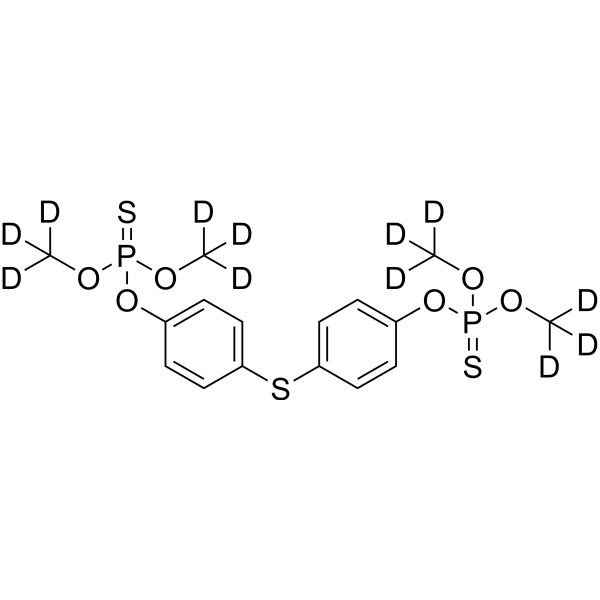
Temephos-d12 is the deuterium labeled Temephos. Temephos (Temefos) is an orally active, blood-brain barrier-permeable organophosphate insecticide and AChE inhibitor. By irreversibly inhibiting AChE to induce cholinergic overactivation, Temephos effectively blocks larval development of Aedes aegypti (yellow fever mosquito) and Aedes albopictus (Asian tiger mosquito), and is commonly used in studies related to Dengue Virus, Zika Virus and other relevant pathogens. Temephos exhibits genotoxicity and neurodevelopmental toxicity, and may also cause liver injury, reproductive system abnormalities and cholinergic poisoning symptoms in mammals. Temephos tends to accumulate in adipose tissues and aquatic organisms, and is excreted via feces after metabolism through oxidation and hydrolysis. Note that CYP-mediated metabolic detoxification may reduce the actual larvicidal efficacy of Temephos against some mosquito species. Temephos can be used in research related to dengue fever, Zika virus disease, chikungunya and dracunculiasis .
loading...
    loading...
Cat. No.: HY-181280
Target:  

Ser/Thr Protease

Research Areas:  

Neurological Disease

VU6083859 is a blood-brain barrier-permeable TAOK1 inhibitor with an IC50 of 158 nM. VU6083859 selectively inhibits TAOK1, exhibits only weak or no activity against TAOK2 and TAOK3, and shows high selectivity for a variety of other kinases. VU6083859 is applicable to research related to neurodevelopmental disorders and tauopathies.
loading...
    loading...
Cat. No.: HY-110325R
CAS No.: 1480833-70-2
Research Areas:  

Neurological Disease

PF-04885614 (Standard) is the analytical standard of PF-04885614 (HY-110325). This product is intended for research and analytical applications. PF-04885614 is a potent NaV1.8 inhibitor, extracted from patent US2018328915. PF-04885614 has potential for neurological and neurodevelopmental diseases treatment .
loading...
    loading...
Cat. No.: HY-135450
CAS No.: 271241-14-6
Dimefluthrin is an insecticide. Dimefluthrin exhibits contact toxicity against large red imported fire ant workers. Dimefluthrin undergoes horizontal transfer among red imported fire ant workers, causing secondary mortality in recipient workers. Dimefluthrin is a neurodevelopmental toxicant, which can reduces acetylcholinesterase activity, impairing neurotransmitter .
loading...
    loading...
Cat. No.: HY-181281
Target:  

Ser/Thr Kinase

Research Areas:  

Neurological Disease Cancer

VU6080195 is a blood-brain barrier-permeable pan-TAOK activator. VU6080195 shows the highest potency against TAOK1 (EC50 = 270 nM), followed by TAOK3 (EC50 = 503 nM) and TAOK2 (EC50 = 1,376 nM). VU6080195 can be used for the research of diseases such as neurodevelopmental disorders, tauopathies and breast cancer .
loading...
    loading...
Cat. No.: HY-110152R
CAS No.: 1401031-52-4
Research Areas:  

Neurological Disease

LSN2463359 (Standard) is the analytical standard of LSN2463359 (HY-110152). This product is intended for research and analytical applications. LSN2463359 is positive allosteric modulator of metabotropic glutamate 5 (mGlu5). LSN2463359 attenuates aspects of the behavioral response to administration of the competitive NMDA receptor antagonist. LSN2463359 selectively attenuates reversal learning deficits observed in the neurodevelopmental MAM E17 model . LSN2463359 is a click chemistry reagent, it contains an Alkyne group and can undergo copper-catalyzed azide-alkyne cycloaddition (CuAAc) with molecules containing Azide groups.
loading...
    loading...
Cat. No.: HY-181552
Target:  

GABA Receptor

Research Areas:  

Neurological Disease

GABAA receptor modulator-13 is an orally active, blood-brain barrier-permeable α4β1δ GABAA receptor modulator (IC50 = 9.02 μM). GABAA receptor modulator-13 reduces GABA-induced currents, impairs the stability of the transmembrane domain M2-M3 loop of α4β1δ GABAA receptors, and exhibits selectivity for γ2-containing GABAA receptor subtypes and α6β3δ GABAA receptor subtypes. GABAA receptor modulator-13 is applicable to the research of nervous system diseases with altered tonic inhibition, such as neurodevelopmental disorders and epilepsy .
loading...
    loading...
Cat. No.: HY-W014937S
CAS No.: 93496-64-1
Synonyms: 4HBP-d4
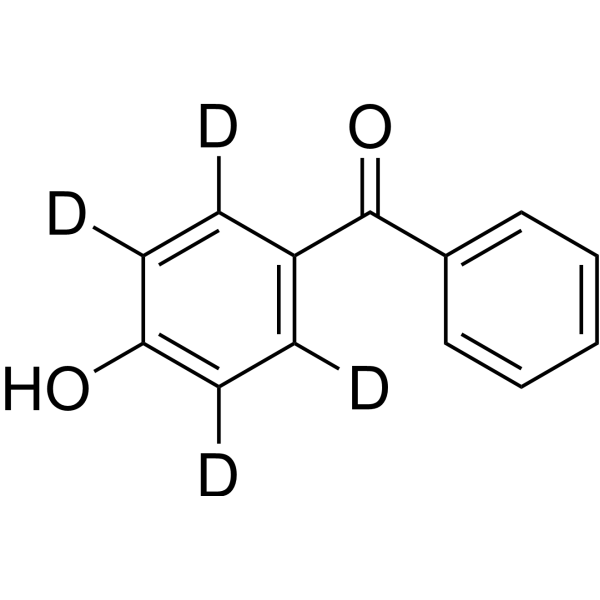
4-Hydroxybenzophenone-d4 (4HBP-d4) is the deuterated-labeled 4-Hydroxybenzophenone (HY-W014937). 4‑Hydroxybenzophenone (4HBP) is a major metabolite of Benzophenone (HY-Y0546) and is orally active. 4-Hydroxybenzophenone triggers endoplasmic reticulum stress and activates the PERK-eIF2α-ATF4-CHOP and IRE1α-XBP1s pathways, and inhibits IκB translation. 4-Hydroxybenzophenone induces endoplasmic reticulum stress, unfolded protein response activation, protein homeostasis imbalance, protein aggregation, oxidative stress, ROS accumulation, mitochondrial membrane potential decrease, ATP depletion, and cytotoxicity. 4-Hydroxybenzophenone induces neural stem cell apoptosis (apoptosis) and affects neuronal differentiation. 4-Hydroxybenzophenone promotes malignant proliferation of hepatocellular carcinoma cells and xenograft tumor growth in nude mice. 4-Hydroxybenzophenone can be used in research related to neurodevelopmental toxicity and hepatocellular carcinoma .
loading...
    loading...
Cat. No.: HY-138830B
CAS No.: 1818252-52-6
Target:  

Histone Demethylase

Research Areas:  

Neurological Disease

TAK-418 free base is an orally active, blood-brain barrier-penetrant LSD1 inhibitor with a human IC50 of 2.9 nM. TAK-418 free base irreversibly inhibits LSD1 by forming a compact flavin-FAD adduct with the catalytic domain FAD, blocking the demethylation of H3K4me1/2 and H3K9me1/2 without disrupting the LSD1-GFI1B interaction. TAK-418 free base restores normally dysregulated brain gene expression and DNA methylation, increases H3K4me1/2/3 and H3K9me2 at the Ucp2 locus, and induces Ucp2 mRNA expression. TAK-418 free base rescues defective H3K4 histone modifications, normalizes adult neurogenesis, and improves recognition memory, social behavior, and cognition in rodent models. TAK-418 free base can be used in research related to neurodevelopmental disorders, Alzheimer's disease, and autism spectrum disorders .
loading...
    loading...

