566 Results for "

DA

" in MedChemExpress (MCE) Product Catalog:
Products (566)

566 Results for "DA" in MCE Product Catalog:

  • Categories Recommended:
    More
Cat. No.: HY-187240C
Research Areas:  

Cancer

DMG-PEG5000-GE11 is a functionalized PEGylated lipid conjugate composed of three modular components: dimyristoylglycerol (DMG) as the lipid anchoring group, a polyethylene glycol (PEG) spacer arm with a molecular weight of 5000 Da, and GE11 peptide (YHWYGYTPQNVI) (HY-P10128) as the terminal targeting/functional ligand. DMG-PEG5000-GE11 can be incorporated into liposomes, lipid nanoparticles (LNPs), or other nanocarriers to confer ligand-directed targeting capability against EGFR (HER1) on the surface of various epithelial tumor cells (lung cancer, breast cancer, colorectal cancer, head and neck cancer).
loading...
    loading...
Cat. No.: HY-187312
Research Areas:  

Cancer

DOPE-PEG1000-GE11 is a functionalized PEGylated lipid conjugate composed of three modular components: dioleoylphosphatidylethanolamine (DOPE) as the lipid anchoring group, a polyethylene glycol (PEG) spacer arm with a molecular weight of 1000 Da, and GE11 peptide (YHWYGYTPQNVI) (HY-P10128) as the terminal targeting/functional ligand. DSG-PEG2000-GE11 can be incorporated into liposomes, lipid nanoparticles (LNPs), or other nanocarriers to confer ligand-directed targeting capability against EGFR (HER1) on the surface of various epithelial tumor cells (lung cancer, breast cancer, colorectal cancer, head and neck cancer).
loading...
    loading...
Cat. No.: HY-187312A
Research Areas:  

Cancer

DOPE-PEG2000-GE11 is a functionalized PEGylated lipid conjugate composed of three modular components: dioleoylphosphatidylethanolamine (DOPE) as the lipid anchoring group, a polyethylene glycol (PEG) spacer arm with a molecular weight of 2000 Da, and GE11 peptide (YHWYGYTPQNVI) (HY-P10128) as the terminal targeting/functional ligand. DOPE-PEG2000-GE11 can be incorporated into liposomes, lipid nanoparticles (LNPs), or other nanocarriers to confer ligand-directed targeting capability against EGFR (HER1) on the surface of various epithelial tumor cells (lung cancer, breast cancer, colorectal cancer, head and neck cancer).
loading...
    loading...
Cat. No.: HY-187312B
Research Areas:  

Cancer

DOPE-PEG3400-GE11 is a functionalized PEGylated lipid conjugate composed of three modular components: dioleoylphosphatidylethanolamine (DOPE) as the lipid anchoring group, a polyethylene glycol (PEG) spacer arm with a molecular weight of 3400 Da, and GE11 peptide (YHWYGYTPQNVI) (HY-P10128) as the terminal targeting/functional ligand. DOPE-PEG3400-GE11 can be incorporated into liposomes, lipid nanoparticles (LNPs), or other nanocarriers to confer ligand-directed targeting capability against EGFR (HER1) on the surface of various epithelial tumor cells (lung cancer, breast cancer, colorectal cancer, head and neck cancer).
loading...
    loading...
Cat. No.: HY-187312C
Research Areas:  

Cancer

DOPE-PEG5000-GE11 is a functionalized PEGylated lipid conjugate composed of three modular components: dioleoylphosphatidylethanolamine (DOPE) as the lipid anchoring group, a polyethylene glycol (PEG) spacer arm with a molecular weight of 5000 Da, and GE11 peptide (YHWYGYTPQNVI) (HY-P10128) as the terminal targeting/functional ligand. DOPE-PEG5000-GE11 can be incorporated into liposomes, lipid nanoparticles (LNPs), or other nanocarriers to confer ligand-directed targeting capability against EGFR (HER1) on the surface of various epithelial tumor cells (lung cancer, breast cancer, colorectal cancer, head and neck cancer).
loading...
    loading...
Cat. No.: HY-187313A
Research Areas:  

Cancer

DPPE-PEG2000-GE11 is a functionalized PEGylated lipid conjugate composed of three modular components: dipalmitoylphosphatidylethanolamine (DPPE) as the lipid anchoring group, a polyethylene glycol (PEG) spacer arm with a molecular weight of 2000 Da, and GE11 peptide (YHWYGYTPQNVI) (HY-P10128) as the terminal targeting/functional ligand. DPPE-PEG2000-GE11 can be incorporated into liposomes, lipid nanoparticles (LNPs), or other nanocarriers to confer ligand-directed targeting capability against EGFR (HER1) on the surface of various epithelial tumor cells (lung cancer, breast cancer, colorectal cancer, head and neck cancer).
loading...
    loading...
Cat. No.: HY-187750A
Synonyms: DPPE-PEG2000-Mal-Cys-RRRRRRHHHH
Research Areas:  

Cancer

DPPE-PEG2000-R6H4 (DPPE-PEG2000-Mal-Cys-RRRRRRHHHH) is a functionalized PEGylated phospholipid conjugate composed of three modular components: 1,2-dipalmitoyl-sn-glycerol-3-phosphate ethanolamine (DPPE) as a lipid anchoring group, a polyethylene glycol (PEG) spacer arm with a molecular weight of 2000 Da, and an R6H4 peptide as a terminal targeting/functional ligand. DPPE-PEG2000-R6H4 can be used in studies such as pH-responsive tumor-targeting drug delivery .
loading...
    loading...
Cat. No.: HY-W380450
CAS No.: 46817-91-8
Synonyms: Viloxazin; Emovit
Target:  

5-HT Receptor

Research Areas:  

Neurological Disease

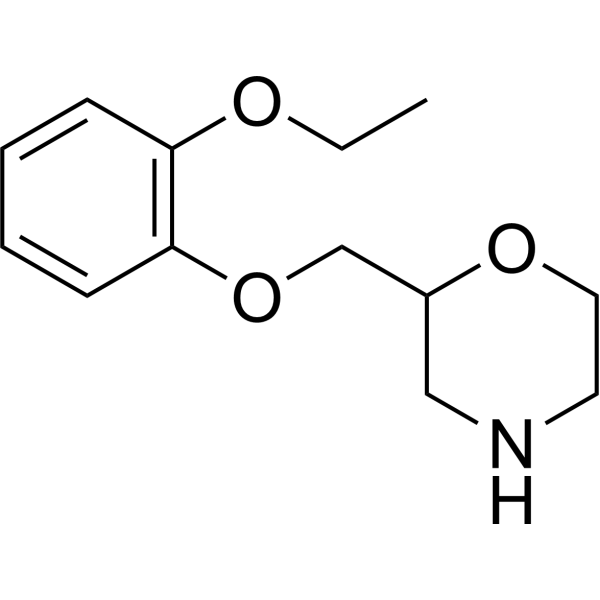
Viloxazine is a non-brain-penetrant, selective norepinephrine transporter (NET) inhibitor (IC50= 0.26 μM) and 5-HT receptor modulator. Viloxazine antagonizes 5-HT2B receptors (Ki=4.2 μM) and agonizes 5-HT2C receptors (EC50= 32 μM), respectively, and enhances 5-HT neurotransmission by modulating 5-HT2B/C receptors. Viloxazine also competitively inhibits NET from increasing NE and DA levels in the synaptic cleft, and can be used in the study of attention deficit hyperactivity disorder (ADHD) .
loading...
    loading...
Cat. No.: HY-W380450R
CAS No.: 46817-91-8
Synonyms: Viloxazin (StanDArd); Emovit (StanDArd)
Research Areas:  

Neurological Disease

Viloxazine is a non-brain-penetrant, selective norepinephrine transporter (NET) inhibitor (IC50= 0.26 μM) and 5-HT receptor modulator. Viloxazine antagonizes 5-HT2B receptors (Ki=4.2 μM) and agonizes 5-HT2C receptors (EC50= 32 μM), respectively, and enhances 5-HT neurotransmission by modulating 5-HT2B/C receptors. Viloxazine also competitively inhibits NET from increasing NE and DA levels in the synaptic cleft, and can be used in the study of attention deficit hyperactivity disorder (ADHD) .
loading...
    loading...
Cat. No.: HY-125784
CAS No.: 35604-67-2
Purity:  98.94%
Synonyms: Viloxazin hydrochloride; Emovit hydrochloride
Target:  

5-HT Receptor

Research Areas:  

Neurological Disease

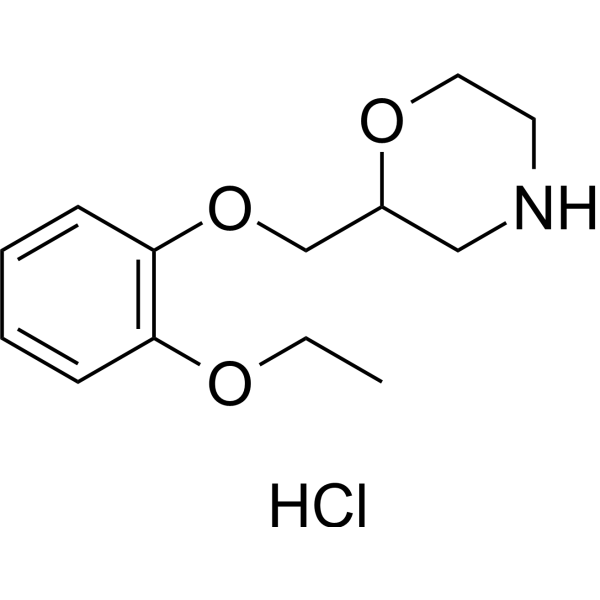
Viloxazine hydrochloride is a non-brain-penetrant, selective norepinephrine transporter (NET) inhibitor (IC50=0.26 μM) and 5-HT receptor modulator. Viloxazine antagonizes 5-HT2B receptors (Ki=4.2 μM) and agonizes 5-HT2C receptors (EC50=32 μM), respectively, and enhances 5-HT neurotransmission by modulating 5-HT2B/C receptors. Viloxazine also competitively inhibits NET from increasing NE and DA levels in the synaptic cleft, and can be used in the study of attention deficit hyperactivity disorder (ADHD) .
loading...
    loading...
Cat. No.: HY-172723
Research Areas:  

Neurological Disease Cancer

DSPE-PEG2000-T7 is a PEGylated compound composed of DSPE and peptideT7. T7 (HAIYPRH) specifically binds to TfR. DSPE-PEG2000-T7 can be used to prepare T7-modified liposomes, where liposomes modified with both T7 and DA7R peptides can effectively co-deliver Doxorubicin (HY-15142A) and Vincristine (HY-N0488A) to gliomas. DSPE-PEG2000-T7 can also be used to prepare nanomodulators that mediate the co-delivery of tyrosine hydroxylase mRNA and interferon gene stimulator antagonists for synergistic intervention in Parkinson's disease .
loading...
    loading...
Cat. No.: HY-P991223

Research Areas:  

Cancer

NC762 is a humanized IgG1κ monoclonal antibody that targets human B7-H4 (B7 homolog 4). NC762 has enhanced binding to CD16a (FcγRIIIa) after being Fc engineered with three point mutations (S239D/A330L/I332E; DLE) and demonstrate increased antibody-dependent cellular cytotoxicity (ADCC) activity. NC762 inhibits tumor growth in vivo through binding to tumor-expressing B7-H4. NC762 can be studies in research on cancer such as advanced or metastatic solid tumors .
loading...
    loading...
Cat. No.: HY-L187
2,196 compounds

Fragment-based drug development (FBDD) is a strategy for drug discovery that can be applied both academically and commercially to enhance the identification of some non-drug targets. Fragment-based drug development has identified low molecular weight molecules (<300 Da) capable of binding to related macromolecules. These fragments can cover a wide chemical space and are easy to optimize later. Currently, several fragment-based drugs have entered clinical trials, of which two drugs, Vemurafenib and Venetoclax, have been approved for marketing.

Based on Tanimoto coefficient, MCE uses similarity algorithm to carefully select 2,196 high-structurally diverse 'RO3' compliant fragment molecules from large-scale fragment molecules, which can be applied to fragment based drug development.

Cat. No.: HY-P705526
Purity:  ≥ 85%, as determined by reducing SDS-PAGE.
Synonyms: PPP1R15A; Myeloid Differentiation Primary Response Protein MyD116 Homolog; Protein Phosphatase 1 Regulatory Subunit 15A; Protein Phosphatase 1, Regulatory (Inhibitor) Subunit 15A; GADD34; Growth Arrest And DNA-DAmage-Inducible 34; Growth Arrest And DNA DA
Species:  
Human
Source:  
E. coli
loading...
    loading...
Cat. No.: HY-L085
2,199 compounds

Parkinson’s disease (PD), the second most common age-associated neurodegenerative disorder, is characterized by the loss of dopaminergic (DA) neurons and the presence of α-synuclein-containing aggregates in the substantia nigra pars compacta (SNpc). Motor features such as tremor, rigidity, bradykinesia and postural instability are common traits of PD. To date, there is no treatment to stop or at least slow down the progression of the disease. The etiology and pathogenesis of PD is still elusive, however, a large body of evidence suggests a prominent role of oxidative stress, inflammation, apoptosis, mitochondrial dysfunction and proteasome dysfunction in the pathogenesis of PD.

MCE offers a unique collection of 2,199 compounds with anti- Parkinson’s Disease activities or targeting the unique targets of PD. MCE Anti- Parkinson's Disease Compound Library is a useful tool for exploring the mechanism of PD and discovering new drugs for PD.

Cat. No.: HY-P86855
Synonyms: DA transporter antibody; DAT 1 antibody; DAT antibody; DAT1 antibody; Dopamine transporter 1 antibody; Dopamine transporter antibody; PKDYS antibody; SC6A3_HUMAN antibody; SLC6A3 antibody; Sodium dependent dopamine transporter antibody; DA transporter antibody; DAT 1 antibody; DAT antibody; DAT1 antibody; Dopamine transporter 1 antibody; Dopamine transporter antibody; PKDYS antibody; SC6A3_HUMAN antibody; SLC6A3 antibody; Sodium dependent dopamine transporter antibody; Sodium-dependent dopamine transporter antibody; Solute carrier family 6 (neurotransmitter transporter dopamine), member 3 antibody; Solute carrier family 6 (neurotransmitter transporter), member 3 antibody; Solute carrier family 6 member 3 antibody; Variable number tandem repeat (VNTR) antibody;

Host:  

Rat

Application:  

IHC-F, IHC-P, WB

Reactivity:  

Mouse, Rat

loading...
    loading...
Cat. No.: HY-P86856
Synonyms: DA transporter antibody; DAT 1 antibody; DAT antibody; DAT1 antibody; Dopamine transporter 1 antibody; Dopamine transporter antibody; PKDYS antibody; SC6A3_HUMAN antibody; SLC6A3 antibody; Sodium dependent dopamine transporter antibody; DA transporter antibody; DAT 1 antibody; DAT antibody; DAT1 antibody; Dopamine transporter 1 antibody; Dopamine transporter antibody; PKDYS antibody; SC6A3_HUMAN antibody; SLC6A3 antibody; Sodium dependent dopamine transporter antibody; Sodium-dependent dopamine transporter antibody; Solute carrier family 6 (neurotransmitter transporter dopamine), member 3 antibody; Solute carrier family 6 (neurotransmitter transporter), member 3 antibody; Solute carrier family 6 member 3 antibody; Variable number tandem repeat (VNTR) antibody;

Host:  

Rabbit

Application:  

WB, IHC-F, IHC-P

Reactivity:  

Mouse, Rat

loading...
    loading...
Cat. No.: HY-L152
5,077 compounds

19F-NMR has proved to be a detection mode in fragment-based drug discovery (FBDD) for studies of protein structure and interactions. 19F shows high sensitivity for NMR detection, and the exquisite sensitivity of 19F chemical shifts and linewidths to ligand binding all make it a valuable approach in FBDD.F (Fluorine) -Fragments can be used for 19F-NMR detection after binding to target proteins, and can be used as an effective 19F-NMR tool for FBDD.

MCE designs a unique collection of 5,077 F-fragments, all of which obey a heuristic rule called the “Rule of Three (RO3)”, in which molecular weight ≤300 Da, the number of hydrogen bond donors (H-donors) ≤3, the number of hydrogen bond acceptors (H-acceptors) is ≤3 and cLogP is ≤3. This F-fragments library is an important source of lead-like drugs.

Cat. No.: HY-L236
20,065 compounds

Fragment-based drug discovery (FBDD) offers a strategic advantage by categorizing fragment hits according to their functional groups. This approach facilitates both the further optimization of these hits and the rational design of larger compounds through fragment combination. The amine functional group plays a vital role in drug development, as evidenced by its presence in many marketed drugs like Galantamine, Tacrine, and Rivastigmine. It is instrumental in enhancing solubility, improving bioavailability, and ensuring shelf-life stability—all critical factors for drug efficacy.

MCE offers a collection of 20,065 amine fragments for drug discovery. All of these compounds adhere to the Rule of Three (RO3) criteria for drug-likeness, which MCE offers a collection of 20,065 amine fragments for drug discovery, all of which stipulates a molecular weight ≤ 300 Da, ≤ 3 hydrogen bond donors, ≤ 3 hydrogen bond acceptors, and a cLogP ≤ 3.

Cat. No.: HY-L032
41,368 compounds

Fragment-based drug discovery (FBDD) is well suited for discovering both drug leads and chemical probes of protein function; it can cover broad swaths of chemical space and allows the use of creative chemistry. Fragment-based drug discovery is well-established in industry and has resulted in a variety of drugs entering clinical trials, with two, vemurafenib and venetoclax, already approved. FBDD also has key attractions for academia. Notably, it is able to tackle difficult or novel targets for which no chemical matter may be found in existing HTS collections.

MCE designs a unique collection of 41,368 fragment compounds, all of which obey a heuristic rule called the “Rule of Three (RO3) ”, in which molecular weight ≤300 Da, the number of hydrogen bond donors (H-donors) ≤3, the number of hydrogen bond acceptors (H-acceptors) is ≤3 and cLogP is ≤3. This library is an important source of lead-like drugs.

