213 Results for "

hydrogel

" in MedChemExpress (MCE) Product Catalog:
Products (213)

213 Results for "hydrogel" in MCE Product Catalog:

Cat. No.: HY-138130
CAS No.: 26578-09-6
Purity:  ≥98.0%
Research Areas:  

Infection Cancer

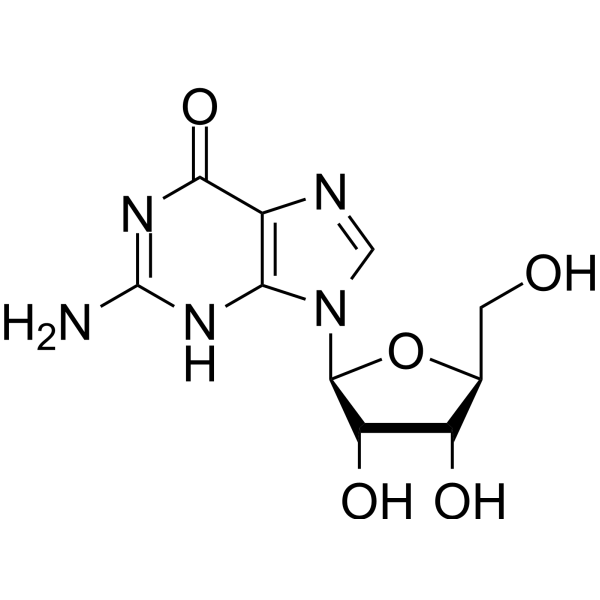
L-Guanosine is the L-configuration of Guanosine (HY-N0097). L-Guanosine is a purine nucleoside with anti-herpesvirus activity. L-Guanosine can be used to prepare supramolecular hydrogel .
loading...
    loading...
Cat. No.: HY-158220A
Synonyms: HAMA (MW 150 kDa)
Hyaluronic acid Methacryloyl (HAMA) MW 150 kDa is methacrylated hyaluronic acid that is biocompatible. Hyaluronic acid Methacryloyl is also used as a 3D printing hydrogel ink, which has the characteristics of fast photosensitive response, fast gelation speed and stable hydrogel performance. Hyaluronic acid Methacryloyl can quickly induce gelation with lithium phenyl-2,4,6-trimethylbenzoylphosphinate (LAP) under UV irradiation. The combination of Hyaluronic acid Methacryloyl and tissue-specific extracellular matrix (ECM) materials (such as pancreatic extracellular matrix (pECM)) will become an important source material for organoid culture .
loading...
    loading...
Cat. No.: HY-158220
Synonyms: HAMA (MW 400 kDa)
Hyaluronic acid Methacryloyl (MW 400 kDa) (HAMA (MW 400 kDa)) is a methacrylated hyaluronic acid with biocompatibility. Hyaluronic acid Methacryloyl (MW 400 kDa) also serves as a 3D printing hydrogel ink, featuring rapid photoresponsiveness, fast gelation speed and stable hydrogel performance. Hyaluronic acid Methacryloyl (MW 400 kDa) can rapidly initiate gelation with lithium phenyl-2,4,6-trimethylbenzoylphosphinate (LAP) under ultraviolet irradiation. Moreover, the combination of Hyaluronic acid Methacryloyl with tissue-specific extracellular matrix (ECM) materials (such as pancreatic extracellular matrix (pECM)) acts as an important source material for organoid culture .
loading...
    loading...
Cat. No.: HY-P1771A
Research Areas:  

Inflammation/Immunology

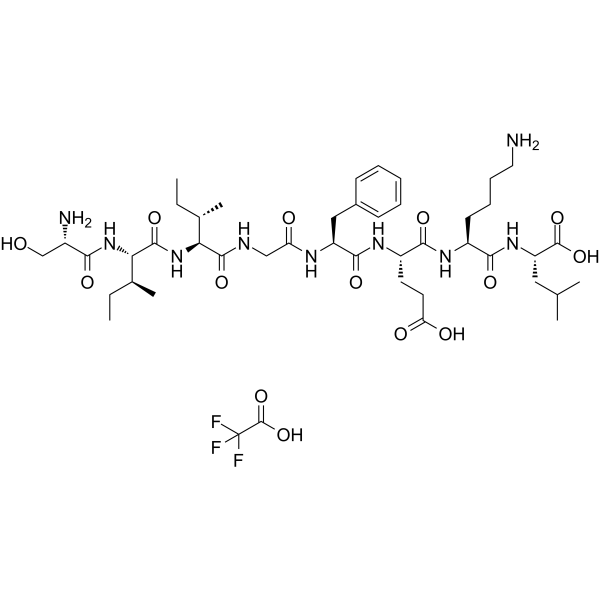
OVA G4 peptide TFA is a variant of the agonist ovalbumin (OVA) peptide SIINFEKL (257-264). SIINFEKL is routinely used to stimulate ovalbumin-specific T cells and to test new vaccine adjuvants can form a stable hydrogel .
loading...
    loading...
Cat. No.: HY-145941
CAS No.: 44992-01-0
Synonyms: 2-Acryloxyethyltrimethylammonium chloride
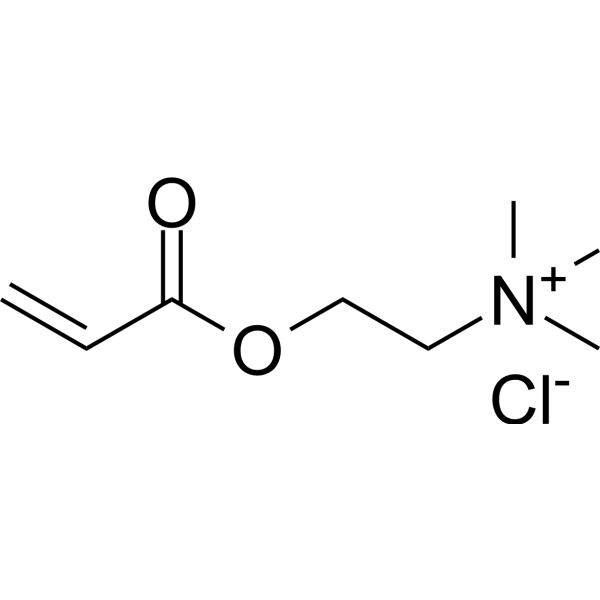
AETA (2-Acryloxyethyltrimethylammonium chloride) can be used for the synthesis of hydrophilic polymers and hydrogels. Hydrogels are used for membranes, catheters, contact lenses, and drug delivery systems .
loading...
    loading...
Cat. No.: HY-158221
Synonyms: CSMA
Chondroitin Sulfate Methacryloyl (CSMA) is methacrylated chondroitin sulfate and is biocompatible. Chondroitin Sulfate Methacryloyl has a higher degree of methacrylation than HAMA (HY-158220), and the degree of methacrylation is closely related to customizable mechanical properties, swelling properties and enzymatic degradability. Chondroitin Sulfate Methacryloyl is a versatile biomaterial suitable for biomimetic hydrogel scaffolds and an ideal 3D printing hydrogel ink . Chondroitin Sulfate Methacryloyl needs to self-assemble into fibrous hydrogel under the action of photoinitiator LAP (HY-44076), and target bioactive adhesion sites, play an inherent supporting role for tissue cells and biodegradable activity.
Application: cell culture, biological 3D printing, tissue engineering, etc.
loading...
    loading...
Cat. No.: HY-W097122
CAS No.: 170941-79-4
Research Areas:  

Others

Fmoc-Gly-Gly-Gly-OH is a self-assembling gelator tripeptide modified with 9-fluorenylmethoxycarbonyl (Fmoc). Fmoc-Gly-Gly-Gly-OH forms a secondary supramolecular network through non-covalent interactions in hybrid polymer hydrogel systems. Fmoc-Gly-Gly-Gly-OH contributes to the construction of double-network hydrogels. Fmoc-Gly-Gly-Gly-OH can be used in studies of tissue regeneration and biomedical delivery applications .
loading...
    loading...
Cat. No.: HY-172354
Acrylate-PEG2000-NHS is a photosensitive PEG compound that can be cross-linked when exposed to ultraviolet light and is used to synthesize PEG hydrogels .
loading...
    loading...
Cat. No.: HY-158223
Synonyms: CMCSMA
Carboxymethyl chitosan Methacryloyl (CMCSMA) is methacrylated carboxymethyl chitosan with properties as a 3D printing ink. A composite hydrogel made of Carboxymethyl chitosan Methacryloyl can effectively accelerate bone healing in an infectious microenvironment after implantation in a rat model of Staphylococcus aureus-infected femoral defect . Carboxymethyl chitosan Methacryloyl needs to self-assemble into fibrous hydrogel under the action of photoinitiator LAP (HY-44076), and target bioactive adhesion sites, play an inherent supporting role for tissue cells and biodegradable activity.
Application: cell culture, biological 3D printing, tissue engineering, etc.
loading...
    loading...
Cat. No.: HY-B2221B2
CAS No.: 9004-62-0
Research Areas:  

Others

Hydroxyethyl cellulose, Viscosity (2%):40000mPa.s is a class of nonionic cellulose ether gel-forming polymers with pH-independent drug release properties. When used as a tablet coating, Hydroxyethyl cellulose, Viscosity (2%):40000mPa.s regulates the water permeation rate, thereby altering the drug release lag time; the higher the viscosity, the longer the drug release lag time. When used as a hydrogel thickener, it increases the dynamic viscosity of the system. Hydroxyethyl cellulose, Viscosity (2%):40000mPa.s can be used in organic synthesis-related research, such as pharmaceutical excipients, hydrogel thickeners, etc.
loading...
    loading...
Cat. No.: HY-B2221B3
CAS No.: 9004-62-0
Research Areas:  

Others

Hydroxyethyl cellulose, Viscosity (2%):6000mPa.s is a class of nonionic cellulose ether gel-forming polymers with pH-independent drug release properties. When used as a tablet coating, Hydroxyethyl cellulose, Viscosity (2%):6000mPa.s regulates the water permeation rate, thereby altering the drug release lag time; the higher the viscosity, the longer the drug release lag time. When used as a hydrogel thickener, it increases the dynamic viscosity of the system. Hydroxyethyl cellulose, Viscosity (2%):6000mPa.s can be used in organic synthesis-related research, such as pharmaceutical excipients, hydrogel thickeners, etc.
loading...
    loading...
Cat. No.: HY-172380
PCL-PEG-PCL diacrylate (MW 800) is an amphiphilic triblock copolymer composed of PEG and two polycaprolactones (PCL). PCL-PEG-PCL diacrylate (MW 800) can be cross-linked by free radical polymerization and/or photopolymerization to form a cross-linked hydrogel network .
loading...
    loading...
Cat. No.: HY-Y0425
CAS No.: 623-27-8
Terephthalaldehyde is a crosslinking agent. Terephthalaldehyde forms a crosslinked structure inside the gelatin matrix by forming Schiff base imines with the amino groups of gelatin, thereby constructing a three-dimensional network. Terephthalaldehyde improves the hydrophobicity of the gelatin matrix, delays water vapor penetration and enhances the liquid water resistance of gelatin films. Terephthalaldehyde can be used as a crosslinking agent to prepare crosslinked chitosan hydrogel (CAAT) via ultrasound-induced synthesis. Terephthalaldehyde helps CAAT hydrogels selectively adsorb anionic dyes from aqueous media, including multi-component systems containing cationic dyes. Terephthalaldehyde serves as a starting material for the synthesis of bis-heterocyclic compounds (including bis-thiazole and bis-triazolopyrimidine compounds) .
loading...
    loading...
Cat. No.: HY-156829H
PLGA-PEG-PLGA (hydrogel) (LA:GA 7:1) (20% solution) is a biodegradable thermosensitive hydrogel product that can undergo phase transition at a specific temperature. PLGA-PEG-PLGA (hydrogel) (LA:GA 7:1) (20% solution) can be widely used in drug delivery systems, tissue engineering, wound dressings, and biosensors. The gelation temperature varies with concentration. The gelation temperature varies with the concentration; the higher the concentration, the lower the gelation temperature .
loading...
    loading...
Cat. No.: HY-158220C
Synonyms: HAMA (MW 50000)
Hyaluronic acid methacryloyl (HAMA) (MW 50000) is a methacrylate-modified hyaluronic acid that serves as a hydrogel former, hydrolysis-resistant material, photocrosslinkable hydrogel scaffold, and drug delivery carrier for tissue engineering. Hyaluronic acid methacryloyl (MW 50000) forms hydrogels via photocrosslinking; when combined with AuMA NPs through a one-step photocrosslinking method, its effective swelling ratio increases, and the mechanical reinforcement effect of Au NPs compensates for the impact caused by reduced crosslinking density. Hyaluronic acid methacryloyl (MW 50000) can be combined with AuMA NPs via a one-step photocrosslinking method, enabling non-invasive monitoring of hydrogel degradation with contrast-enhanced micro-CT .
loading...
    loading...
Cat. No.: HY-168937D
HS-PEG-NH2 (Mn 3500) hydrochloride is a bifunctional cross-linker that can be used to synthesize PEG hydrogels .
loading...
    loading...
Cat. No.: HY-W019682
CAS No.: 84889-09-8
Research Areas:  

Cancer

Fmoc-FF is a building block. Fmoc-FF-prepared hydrogels and nanogels selectively deliver Dexamethasone (HY-14648) to leukemia cells .
loading...
    loading...
Cat. No.: HY-P6299
CAS No.: 944792-75-0
Research Areas:  

Neurological Disease Cancer

MAX8 is a synthetic β-hairpin peptide that folds rapidly and self-assembles into a β-sheet-rich fibrous hydrogel network via non-covalent crosslinking. MAX8 hydrogel exhibits excellent shear-thinning and self-healing properties, enabling precise delivery via syringe and maintaining local retention after implantation. MAX8 hydrogel can uniformly encapsulate cells while preserving their viability and morphology, and protect growth factors (e.g., NGF) and chemotherapeutic drugs from degradation. MAX8 is applicable for spinal cord injury repair, medulloblastoma treatment, and three-dimensional high-throughput drug screening .
loading...
    loading...
Cat. No.: HY-168941
HS-PEG7500-COOH is a bi-functional PEG derivative. HS-PEG7500-COOH is used to synthesize PEG hydrogels .
loading...
    loading...
Cat. No.: HY-172354A
Acrylate-PEG3500-NHS is a photosensitive PEG compound that can be cross-linked when exposed to ultraviolet light and is used to synthesize PEG hydrogels .
loading...
    loading...

