

682 Results for "

PEG-2000

" in MedChemExpress (MCE) Product Catalog:
Products (682)

682 Results for "PEG-2000" in MCE Product Catalog:

Cat. No.: HY-140706
CAS No.: 134874-49-0
Purity:  ≥98.0%
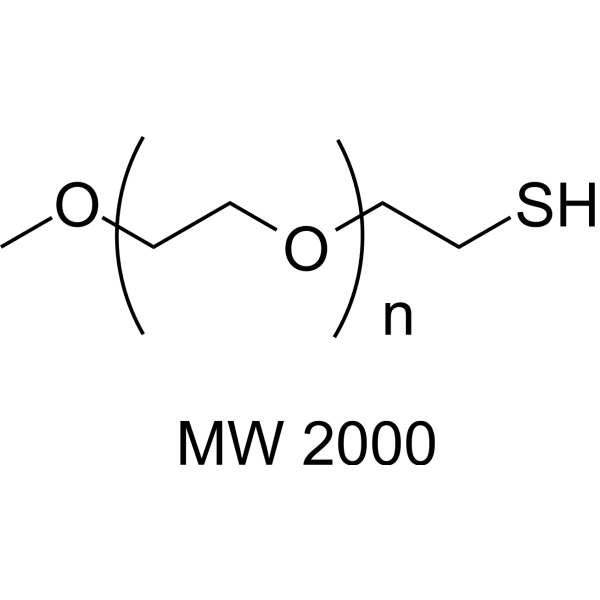
Synonyms: mPEG2000-SH
Research Areas:  

Cancer

m-PEG2000-thiol (mPEG2000-SH) modifies DNA thiolation for the synthesis of gold nanorods (AuNRs). Thiolated DNA can be loaded onto AuNR by the mPEG-SH/Tween 20 assisted method (Tween 20 and mPEG-SH repeatedly displace CTAB on the AuNR surface). DNA AuNRs have been widely used in nanostructure assembly, gene therapy, biosensing, and drug delivery.
loading...
    loading...
Cat. No.: HY-W591449
Target:  

Liposome

Research Areas:  

Cancer

DOPE-PEG2000-Azide is a liposome to simulate biological phospholipid membrane. Liposomes are the main component of vesicles with concentric phospholipid bilayer membranes, which can be used to construct drug delivery systems for anti-cancer and anti-infection fields. Highly polar water-soluble payloads can be trapped in the internal aqueous space of liposomes, while lipophilic payloads can partition into and become part of the lipid bilayer. Especially for delivering antisense oligonucleotides, it can overcome problems such as inefficient cellular uptake and rapid loss in the body .
loading...
    loading...
Cat. No.: HY-W250928C
CAS No.: 956494-20-5
Target:  

Fluorescent Dye

Research Areas:  

Others

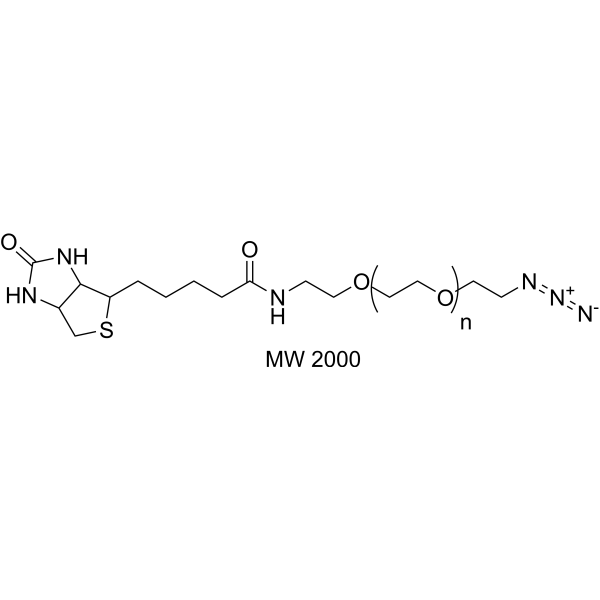
Biotin-PEG2000-azide is a biotin labeled PEG derivative. Biotin is an enzyme co-factor, can be used for labeling protein; PEG is a hydrophilic and water-soluble polymer with low toxicity; azide, is a moderately good leaving group, can react with alkyne by Cu-catalyzation, which improve the efficiency of biotin binding targets. It contains an azide group and can undergo copper-catalyzed azide-alkyne cycloaddition (CuAAc) with molecules containing alkyne groups. It can also undergo ring strain-promoted alkyne-azide cycloaddition (SPAAC) with molecules containing DBCO or BCN groups.
loading...
    loading...
Cat. No.: HY-W440954
Target:  

Liposome

Research Areas:  

Others

Stearic acid-PEG2000-CH2CO2H is a heterobifunctional polyPEG with 18-carbon aliphatic chain and carboxyl. The polymer has stearic acid as the hydrophobic tail and PEG as the hydrophilic chain, therefore it forms micelles in water. Carboxyl can react with amine in the presence of activator, such as HATU/EDC to generate a stable amide bond. Reagent grade, for research use only.
loading...
    loading...
Cat. No.: HY-N15909
CAS No.: 2389048-57-9
Category:  

Lipids

Target:  

Fluorescent Dye

DSPE PEG(2000)-N-Cyanine 5.5 is a phospholipid. Phospholipids have good biocompatibility and significant amphiphilic characteristics, making them the main and suitable dosage form or excipient in drug formulations, thereby achieving better therapeutic effects. DSPE PEG(2000)-N-Cyanine 5.5 can be used in drug delivery research.
loading...
    loading...
Cat. No.: HY-N15995
CAS No.: 2342575-87-3
Research Areas:  

Others

DOPE-PEG(2000) Carboxylic acid sodium is a stabilizer. DOPE-PEG(2000) Carboxylic acid sodium produce a coating around the ferrofluid droplet chains which are dispersed in 5CB. DOPE-PEG(2000) Carboxylic acid sodium tends to fold, effectively shielding the surrounding LC molecules from the homeotropic anchoring at the droplet interface and leading to smaller deformations and thus also creating a more stable interface .
loading...
    loading...
Cat. No.: HY-187323A
Research Areas:  

Cancer

DSG-PEG2000-GE11 is a functionalized PEGylated lipid conjugate composed of three modular components: distearoylglycerol (DSG) as the lipid anchoring group, a polyethylene glycol (PEG) spacer arm with a molecular weight of 2000 Da, and GE11 peptide (YHWYGYTPQNVI) (HY-P10128) as the terminal targeting/functional ligand. It can be incorporated into liposomes, lipid nanoparticles (LNPs), or other nanocarriers to confer ligand-directed targeting capability against EGFR (HER1) on the surface of various epithelial tumor cells (lung cancer, breast cancer, colorectal cancer, head and neck cancer).
loading...
    loading...
Cat. No.: HY-N16036
CAS No.: 2342575-90-8
Category:  

Lipids

Target:  

Liposome

DOPE-PEG(2000)-HALO-TAG ammonium is a PEG polymer containing unsaturated DOPE phospholipids. DOPE-PEG(2000)-HALO-TAG ammonium can be used to prepare liposomes or other nanoparticles for drug delivery.
loading...
    loading...
Cat. No.: HY-N16002
CAS No.: 2315262-14-5
Target:  

Liposome

Research Areas:  

Others

DSPE-PEG(2000)-square is functionalized PEG lipid that can be used to synthesize lipid nanoparticles for drug delivery.
loading...
    loading...
Cat. No.: HY-N15837
CAS No.: 2936622-20-5
Target:  

Liposome

Research Areas:  

Others

DSPE-PEG(2000)-N-Triphenylphosphonium is functionalized PEG lipid that can be used to synthesize lipid nanoparticles for drug delivery.
loading...
    loading...
Cat. No.: HY-W1052298D
Synonyms: DMPE-PEG10000-Amine
DMPE-PEG2000-NH2 (DMPE-PEG2000-Amine) is a conjugate composed of DMPE, a PEG chain, and a terminal primary amino group (-NH2). The primary amino group in DMPE-PEG2000-NH2 can be covalently linked to functional groups such as carboxylic acids, NHS esters, and isocyanates for targeted modification of liposomes/nanoparticles.
loading...
    loading...
Cat. No.: HY-172270A
Target:  

Liposome

Research Areas:  

Cancer

DSPE-PEG1000-PTP is synthesised by conjugating the amino group of plectin-1 peptide (PTP) with DSPE-PEG-NHS ester via amide bonds. DSPE-PEG1000-PTP can be used to construct drug delivery vectors .
loading...
    loading...
Cat. No.: HY-183174A
Target:  

Liposome

Research Areas:  

Others

DSG-PEG1000-Galactose is a conjugate composed of DSG, a PEG chain, and terminal galactose. DSG-PEG1000-Galactose combines the membrane compatibility of phospholipids with the targeted recognition capabilities of galactose, making it suitable for research in biomaterial construction and drug delivery.
loading...
    loading...
Cat. No.: HY-D1005A8
CAS No.: 9003-11-6
Synonyms: PEG-PPG-PEG, 2000 (Average)
Poloxamer 181 L61 is a block polymer of polyethylene oxide and polypropylene oxide with an average molecular weight of 2000. Poloxamer has the ability to inhibit P-gp. Poloxamer 181 has antimicrobial activity and can inhibit Mycobacterium avium. Poloxamer 181 can form a thermally reversible hydrogel and is used as a food additive, and as an agent delivery carrier in cosmetics, pharmaceuticals and tissue engineering .
loading...
    loading...
Cat. No.: HY-157950
CAS No.: 2936651-86-2
Target:  

Liposome

Research Areas:  

Cancer

DSPE-PEG2K-triGalNAc ammonium is a polar lipid composed of DSPE and tri-N-acetylgalactosamine that can be used to construct liposomes target to asialoglycoprotein receptor (ASGPR).
loading...
    loading...
Cat. No.: HY-168940B
CAS No.: 139729-28-5
NH2-PEG5000-COOH is a compound composed of an NH2 group, PEG units (MW = 2000) and a carboxyl group (-COOH) . NH2-PEG-COOH is widely used for surface modification and functionalization of polymer carriers or nanoparticles .
loading...
    loading...
loading...
    loading...
Cat. No.: HY-145396
Purity:  ≥98.0%
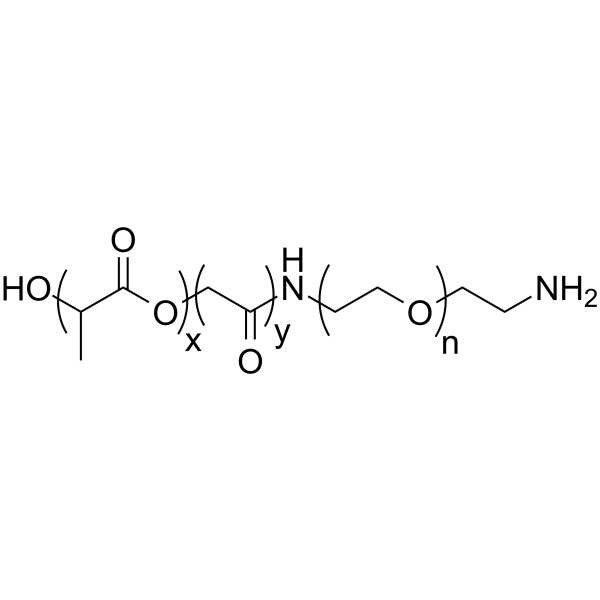
PLGA-PEG-NH2 is a material to synthesis nanomicelles. PLGA-PEG-NH2 nanomicelle is an efficient delivery system of Irinotecan for targeted colorectal cancer and hepatocellular carcinoma .
loading...
    loading...
Cat. No.: HY-D2837
mPEG-PEI-Cy5 (MW 2000) is a fluorescent dye composed of polyethylene glycol (PEG), FITC (HY-66019) and a Biotin (HY-B0511). mPEG-PEI-Cy5 (MW 2000) can be used for fluorescent labeling and imaging .
loading...
    loading...
Cat. No.: HY-187312
Research Areas:  

Cancer

DOPE-PEG1000-GE11 is a functionalized PEGylated lipid conjugate composed of three modular components: dioleoylphosphatidylethanolamine (DOPE) as the lipid anchoring group, a polyethylene glycol (PEG) spacer arm with a molecular weight of 1000 Da, and GE11 peptide (YHWYGYTPQNVI) (HY-P10128) as the terminal targeting/functional ligand. DSG-PEG2000-GE11 can be incorporated into liposomes, lipid nanoparticles (LNPs), or other nanocarriers to confer ligand-directed targeting capability against EGFR (HER1) on the surface of various epithelial tumor cells (lung cancer, breast cancer, colorectal cancer, head and neck cancer).
loading...
    loading...

