881 Results for "

cycloaddition reaction

" in MedChemExpress (MCE) Product Catalog:
Products (881)

881 Results for "cycloaddition reaction" in MCE Product Catalog:

Cat. No.: HY-140313A
Target:  

ADC Linkers

Research Areas:  

Cancer

Methyltetrazine-DBCO TEA is a non-cleavable ADC linker used in the synthesis of antibody-drug conjugates (ADCs). Methyltetrazine-DBCO TEA is a click chemistry reagent, it contains a DBCO group that can undergo strain-promoted alkyne-azide cycloaddition (SPAAC) with molecules containing Azide groups. Methyltetrazine-DBCO TEA also contains a Tetrazine group that can undergo an inverse electron demand Diels-Alder reaction (iEDDA) with molecules containing TCO groups .
loading...
    loading...
Cat. No.: HY-L258
437 compounds

In modern medicinal chemistry and chemical biology research, alkyne (-C≡C-) structures play an important role in click chemistry, bioorthogonal labeling, and the construction of functional molecules due to their unique linear geometry and high reactivity. In particular, driven by the development of copper-catalyzed azide-alkyne cycloaddition (CuAAC) and copper-free click reactions (SPAAC), terminal alkyne groups have become important “chemical handles” for building complex biomolecular systems.

The MCE Alkyne Compound Library contains 437 compounds designed for the construction of click chemistry reaction systems and the development of diverse functional molecules. In drug discovery, these structures serve as key reactive sites that can efficiently undergo click reactions with azide groups, enabling modular assembly of PROTAC molecules, construction of ADC linkers, and rapid synthesis of bioorthogonal labeling probes. In addition, alkyne groups exhibit high stability, mild reaction conditions, and excellent biocompatibility, allowing them to maintain reactivity in complex biological environments. This contributes to improved efficiency and controllability in drug development, making them indispensable chemical building blocks in modern drug design and functional molecular engineering.

Cat. No.: HY-160773
Research Areas:  

Others

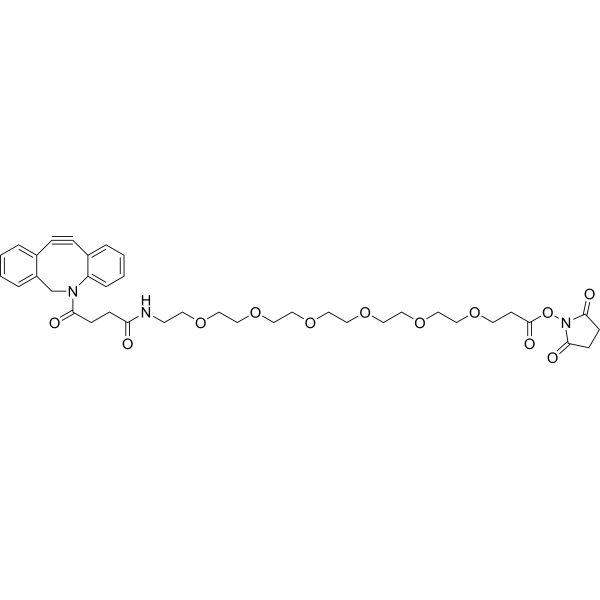
DBCO-PEG6-NHS ester is a click chemistry PEG reagent containing an NHS ester that reacts specifically with primary amines, such as side chains of lysine residues or aminosilane-coated surfaces, under neutral or slightly alkaline conditions. , efficient reaction to form covalent bonds. DBCO-PEG6-NHS ester also contains a DBCO group that can undergo strain-promoted alkyne-azide cycloaddition (SPAAC) with molecules containing Azide groups .
loading...
    loading...
Cat. No.: HY-171562
Research Areas:  

Metabolic Disease

Cholesterol-SA-PEG2000-Azide is a lipid that can be used for drug delivery. Cholesterol-SA-PEG2000-Azide contains Cholesterol (HY-N0322), Succinic acid (HY-N0420), PEG units and an azide group. Cholesterol-SA-PEG2000-Azide contains an azide group that can undergo copper-catalyzed azide-alkyne cycloaddition reaction (CuAAc) with molecules containing an alkyne group .
loading...
    loading...
Cat. No.: HY-D3521
CAS No.: 1807503-82-7
Target:  

Fluorescent Dye

Research Areas:  

Others

Coumarin 343 azide is a fluorescent dye used for the fluorescent labeling of alkyne-containing biomolecules based on click chemistry. Its detection mechanism relies on the copper (I)-catalyzed azide-alkyne cycloaddition (CuAAC), a type of click reaction: under mild aqueous conditions, the azide group of this dye selectively reacts with the alkyne moiety of propargyl geldanamycin to form a triazole bond that conjugates the fluorescent dye to the target biomolecule; fluorescence is generated upon successful conjugation to the target .
loading...
    loading...
Cat. No.: HY-D3574
Target:  

Fluorescent Dye

Research Areas:  

Others

AF488 Picolyl Azide is a Fluorescent dye designed for bioorthogonal visualization applications. AF488 Picolyl Azide functions via copper (I)-catalyzed azide-alkyne cycloaddition click chemistry, where its azide group undergoes covalent reaction with alkyne-functionalized molecules to form fluorescent triazole conjugates. AF488 Picolyl Azide enables the visualization of metabolically labeled isoprenoids in bacteria, which localize to the cell membrane and division septum .
loading...
    loading...
Cat. No.: HY-108369R
CAS No.: 79598-48-4
Research Areas:  

Cancer

Azido-PEG1-CH2CO2H (Standard) is the analytical standard of Azido-PEG1-CH2CO2H (HY-108369). This product is intended for research and analytical applications. Azido-PEG1-CH2CO2H is a PROTAC linker, which refers to the alkyl/ether composition. Azido-PEG1-CH2CO2H can be used in the synthesis of PROTAC BRD4 Degrader-1 . Azido-PEG1-CH2CO2H is a click chemistry reagent, it contains an Azide group and can undergo copper-catalyzed azide-alkyne cycloaddition reaction (CuAAc) with molecules containing Alkyne groups. It can also undergo strain-promoted alkyne-azide cycloaddition (SPAAC) reactions with molecules containing DBCO or BCN groups.
loading...
    loading...
Cat. No.: HY-151833
CAS No.: 2639395-39-2
Target:  

ADC Linkers

Research Areas:  

Others

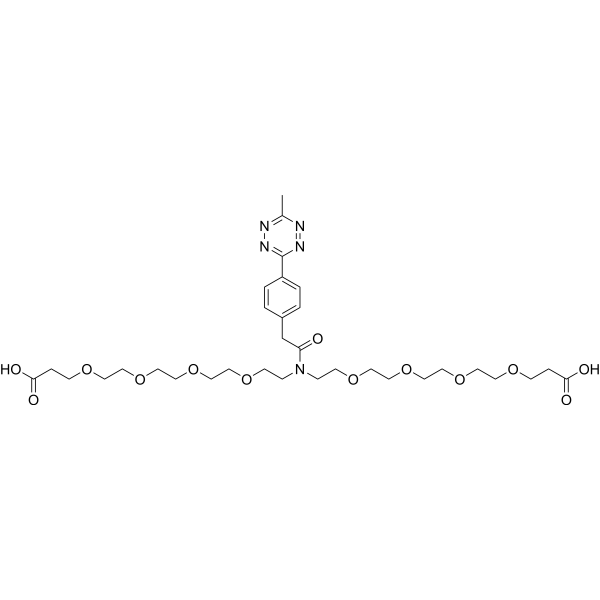
Methyltetrazine-amido-N-bis(PEG4-acid) is a click chemistry reagent containing an azide group. Methyltetrazine-amido-N-bis(PEG4-acid) is a PEG derivative that contains a methyltetrazine group and two acid groups. This reagent can react with TCO-containing compounds to form a stable covalent bond without the catalysis of Cu or elevated temperatures. The inverse-electron demand Diels-Alder cycloaddition reaction of TCO with tetrazines is the fastest bioorthogonal reaction with exceptional selectivity. The terminal carboxylic acid can react with primary amine groups in the presence of activators (e.g. EDC, or HATU) to form a stable amide bond. PEG linker increases the water solubility of the compound. Reagent grade, for research use only . Methyltetrazine-amido-N-bis(PEG4-acid) is a click chemistry reagent, it contains a Tetrazine group that can undergo an inverse electron demand Diels-Alder reaction (iEDDA) with molecules containing TCO groups.
loading...
    loading...
Cat. No.: HY-140312
Target:  

PROTAC Linkers

Research Areas:  

Cancer

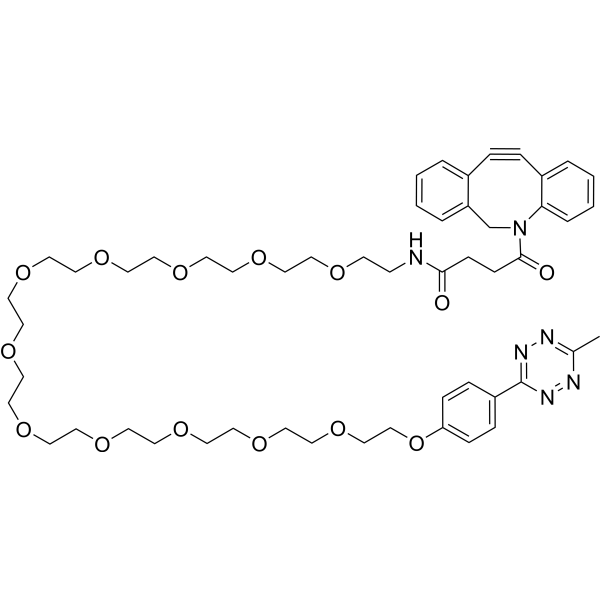
Methyltetrazine-PEG12-DBCO is a PEG-based PROTAC linker that can be used in the synthesis of PROTACs . Methyltetrazine-PEG12-DBCO is a click chemistry reagent, it contains a DBCO group that can undergo strain-promoted alkyne-azide cycloaddition (SPAAC) with molecules containing Azide groups. Methyltetrazine-PEG12-DBCO also contains a Tetrazine group that can undergo an inverse electron demand Diels-Alder reaction (iEDDA) with molecules containing TCO groups.
loading...
    loading...
Cat. No.: HY-D1071
CAS No.: 2055022-06-3
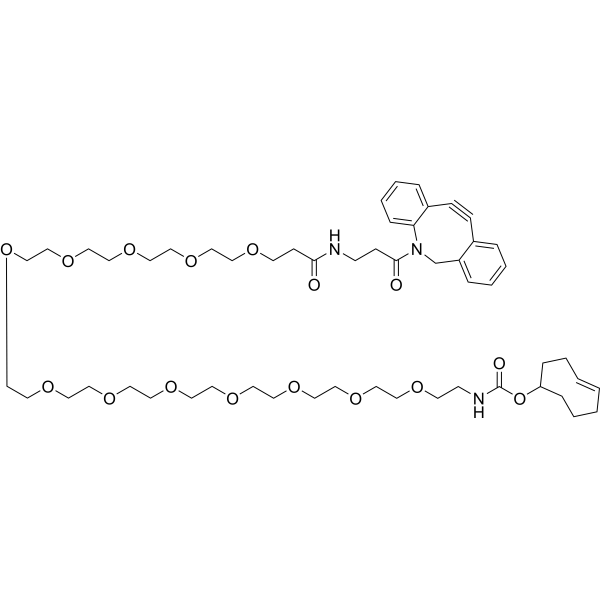
DBCO-PEG12-TCO cantains a TCO and a DBCO moiety. TCO group can specifically react with terrahydrazine. DBCO-PEG12-TCO is a click chemistry reagent, it contains a DBCO group that can undergo strain-promoted alkyne-azide cycloaddition (SPAAC) with molecules containing Azide groups. DBCO-PEG12-TCO also contains a TCO group that can undergo an inverse electron demand Diels-Alder reaction (iEDDA) with molecules containing Tetrazine groups.
loading...
    loading...
Cat. No.: HY-W1123941
Synonyms: Dopamine-PEG9-Azide
Dopamine-PEG-N3 (Dopamine-PEG-Azide is a compound composed of dopamine, PEG segments and an azide group (-N3). Dopamine-PEG-N3 can be used as a crosslinker to connect different materials together to build new composite materials and improve the performance of materials. Dopamine-PEG-N3 is a click chemistry reagent. It contains an azide group and can undergo copper-catalyzed azide-alkyne cycloaddition reaction (CuAAc) with molecules containing an alkyne group.
loading...
    loading...
Cat. No.: HY-118411R
CAS No.: 61135-33-9
Synonyms: EdU (Standard)
Research Areas:  

Cancer

5-Ethynyl-2'-deoxyuridine (Standard) is the analytical standard of 5-Ethynyl-2'-deoxyuridine (HY-118411). This product is intended for research and analytical applications. 5-Ethynyl-2'-deoxyuridine (EdU), a thymidine analogue, is incorporated into cellular DNA during DNA replication and the subsequent reaction of EdU with a fluorescent azide in a “Click” reaction. EdU staining is a fast, sensitive and reproducible method to study cell proliferation . 5-Ethynyl-2'-deoxyuridine is an alkyl chain-based PROTAC linker that can be used in the synthesis of PROTACs . 5-Ethynyl-2'-deoxyuridine is a click chemistry reagent, it contains an Alkyne group and can undergo copper-catalyzed azide-alkyne cycloaddition (CuAAc) with molecules containing Azide groups.
loading...
    loading...
Cat. No.: HY-118411S
CAS No.: 1610530-40-9
Synonyms: EdU-13C
5-Ethynyl-2'-deoxyuridine- 13C1 (EdU- 13C1) is the 13C-labeled 5-Ethynyl-2'-deoxyuridine (HY-118411). 5-Ethynyl-2'-deoxyuridine (EdU), a thymidine analogue, is incorporated into cellular DNA during DNA replication and the subsequent reaction of EdU with a fluorescent azide in a “Click” reaction. EdU staining is a fast, sensitive and reproducible method to study cell proliferation . 5-Ethynyl-2'-deoxyuridine is an alkyl chain-based PROTAC linker that can be used in the synthesis of PROTACs . 5-Ethynyl-2'-deoxyuridine is a click chemistry reagent, it contains an Alkyne group and can undergo copper-catalyzed azide-alkyne cycloaddition (CuAAc) with molecules containing Azide groups.
loading...
    loading...
Cat. No.: HY-118411S1
CAS No.: 1610530-35-2
Synonyms: EdU-13C2
5-Ethynyl-2'-deoxyuridine- 13C2 (EdU- 13C2) is the 13C-labeled 5-Ethynyl-2'-deoxyuridine (HY-118411). 5-Ethynyl-2'-deoxyuridine (EdU), a thymidine analogue, is incorporated into cellular DNA during DNA replication and the subsequent reaction of EdU with a fluorescent azide in a “Click” reaction. EdU staining is a fast, sensitive and reproducible method to study cell proliferation . 5-Ethynyl-2'-deoxyuridine is an alkyl chain-based PROTAC linker that can be used in the synthesis of PROTACs . 5-Ethynyl-2'-deoxyuridine is a click chemistry reagent, it contains an Alkyne group and can undergo copper-catalyzed azide-alkyne cycloaddition (CuAAc) with molecules containing Azide groups.
loading...
    loading...
Cat. No.: HY-D1320
CAS No.: 1267539-32-1
Target:  

Fluorescent Dye

Research Areas:  

Others

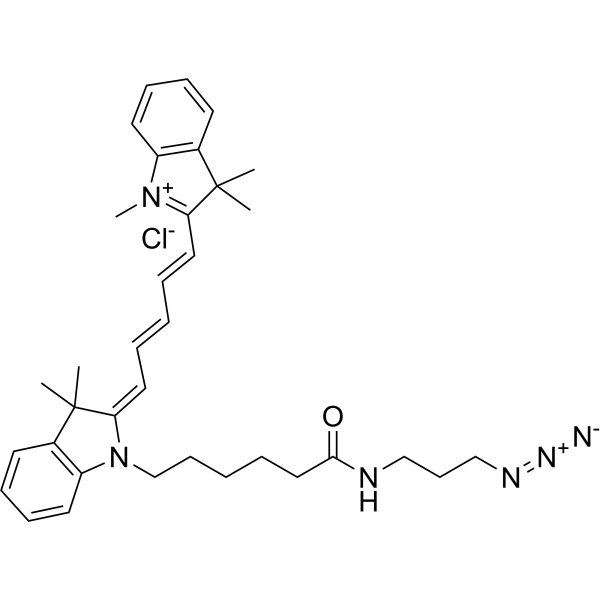
Cyanine5 azide chloride is a Fluorescent probe for cell-selective bacterial protein labeling, as well as a fluorescent dye for single-molecule imaging and dynamic tracking of intracellular organelles. Cyanine5 azide chloride can conjugate with the alkynyl side chain of propargylglycine incorporated into bacterial proteins by the engineered methionyl-tRNA synthetase variant PraRS via copper (I)-catalyzed azide-alkyne [3+2] cycloaddition reaction, thereby enabling in-gel fluorescent visualization of labeled proteins. Cyanine5 azide chloride can diffuse across cell membranes and undergo copper-free click reaction with DBCO-functionalized scAVD pre-bound to DBCO-functionalized biotin, forming fluorescent nanoprobes with enhanced brightness, photostability and localization accuracy, and exhibiting discrete photobleaching steps. The excitation wavelength of Cyanine5 azide chloride is Ex = 633 nm .
loading...
    loading...
Cat. No.: HY-D3577
Target:  

Fluorescent Dye

Research Areas:  

Others

AF555 Picolyl Azide is a Fluorescent dye that enables site-specific fluorescent labeling via click chemistry. AF555 Picolyl Azide conjugates with the non-canonical amino acid N-propargyl-L-lysine introduced through ochre stop codon suppression via the copper (I)-catalyzed azide-alkyne cycloaddition (CuAAC) reaction, achieving labeling of hyperpolarization-activated cyclic nucleotide-gated HCN channels; its picolyl group accelerates the CuAAC reaction rate, thus completing labeling rapidly at room temperature and minimizing copper-induced cytotoxicity. AF555 Picolyl Azide forms covalent bonds with the alkynyl groups of nucleotide analogs through its azide moiety, labeling viral genomes containing 5-ethynyl-2'-deoxyuridine for visualization via fluorescence microscopy .
loading...
    loading...
Cat. No.: HY-133428
CAS No.: 2755573-20-5
Target:  

ADC Linkers

Research Areas:  

Cancer

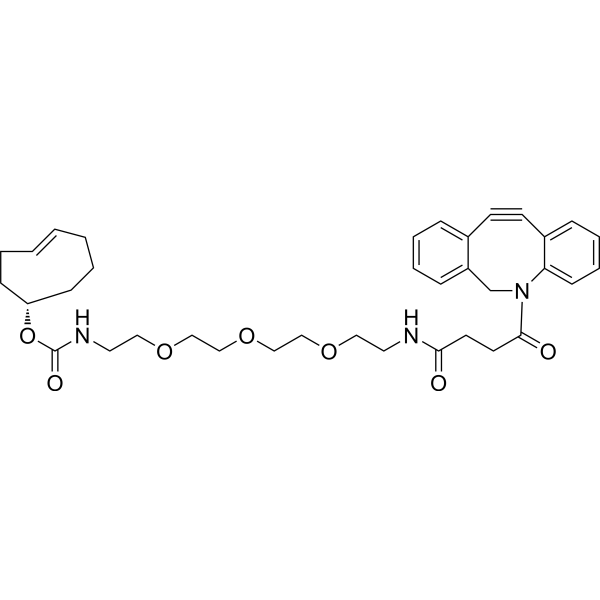
DBCO-PEG3-TCO is a non-cleavable 3 unit PEG ADC linker used in the synthesis of antibody-drug conjugates (ADCs) . DBCO-PEG3-TCO is a click chemistry reagent, it contains a DBCO group that can undergo strain-promoted alkyne-azide cycloaddition (SPAAC) with molecules containing Azide groups. DBCO-PEG3-TCO also contains a TCO group that can undergo an inverse electron demand Diels-Alder reaction (iEDDA) with molecules containing Tetrazine groups.
loading...
    loading...
Cat. No.: HY-151780
CAS No.: 2250436-47-4
Target:  

ADC Linkers

Research Areas:  

Others

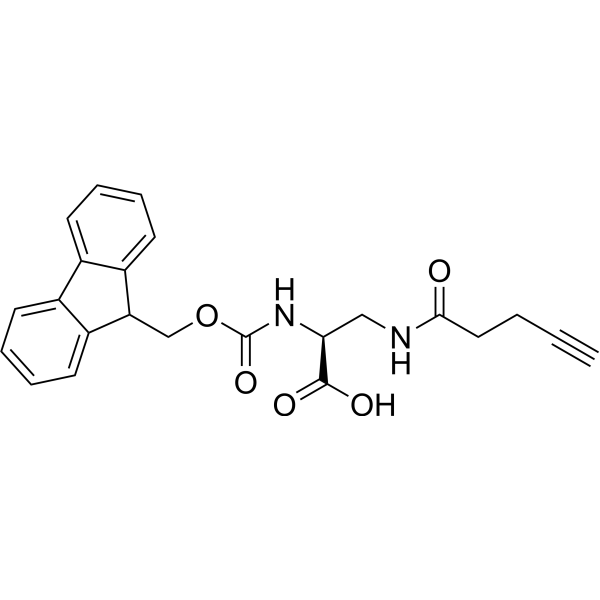
Fmoc-L-Dap(Pentynoyl)-OH is a click chemistry reagent containing an azide group. Fmoc-L-Dap(Pentynoyl)-OH serves as an amino acid building block for introducing alkyne functions into peptide sequences by standard Fmoc/tBu protocols. The alkyne residue can be engaged for copper catalyzed click reaction with organic azides or with tetrazines for copper-free conjugations . Fmoc-L-Dap(Pentynoyl)-OH is a click chemistry reagent, it contains an Alkyne group and can undergo copper-catalyzed azide-alkyne cycloaddition (CuAAc) with molecules containing Azide groups.
loading...
    loading...
Cat. No.: HY-157510
CAS No.: 2758432-00-5
Research Areas:  

Cancer

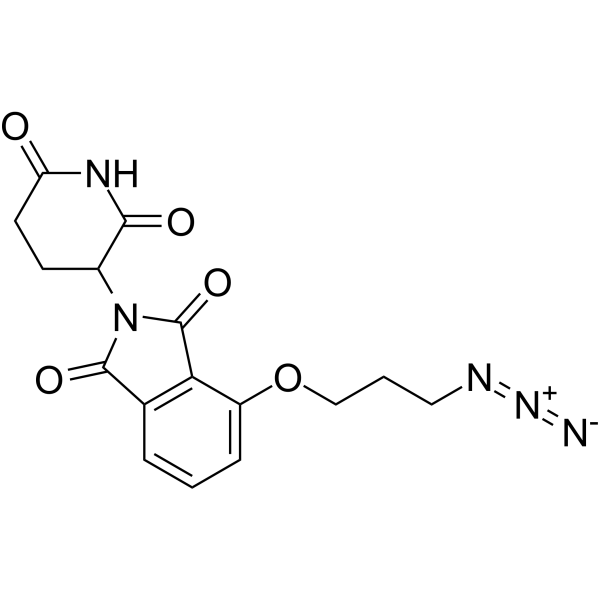
Thalidomide-O-C3-azide is a click chemistry modification of the cereblon (CRBN) inhibitor Thalidomide (HY-14658). Thalidomide-O-C3-azide contains an azide group and can undergo copper-catalyzed azide-alkyne cycloaddition reaction (CuAAc) with molecules containing alkyne groups. Thalidomide-O-C3-azide can be used as a ligand of E3 ubiquitin ligase and Linker conjugates (E3 Ligase Ligand-Linker Conjugates) for the synthesis of PROTACs .
loading...
    loading...
Cat. No.: HY-157511
CAS No.: 2411098-96-7
Research Areas:  

Cancer

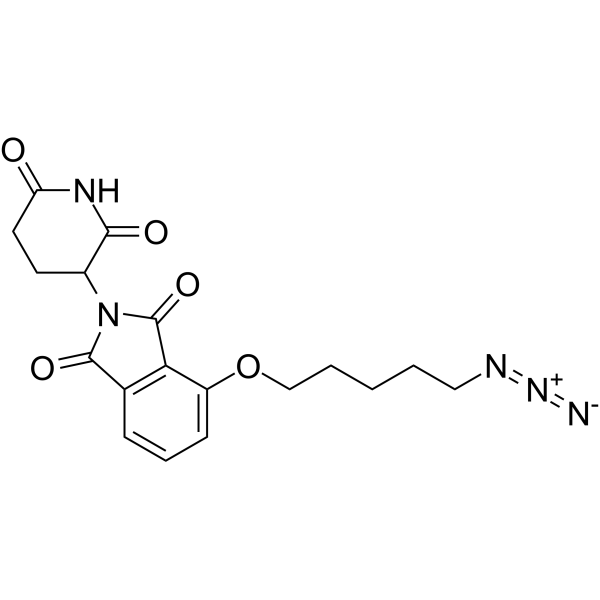
Thalidomide-O-C5-azide is a click chemistry modification of the cereblon (CRBN) inhibitor Thalidomide (HY-14658). Thalidomide-O-C5-azide contains an azide group and can undergo copper-catalyzed azide-alkyne cycloaddition reaction (CuAAc) with molecules containing alkyne groups. Thalidomide-O-C5-azide can be used as a ligand of E3 ubiquitin ligase and Linker conjugates (E3 Ligase Ligand-Linker Conjugates) for the synthesis of PROTACs .
loading...
    loading...

