110 Results for "

TiO2 sol-gel film

" in MedChemExpress (MCE) Product Catalog:
Products (110)

110 Results for "TiO2 sol-gel film" in MCE Product Catalog:

Cat. No.: HY-112768
Purity:  ≥95.0%
Research Areas:  

Others

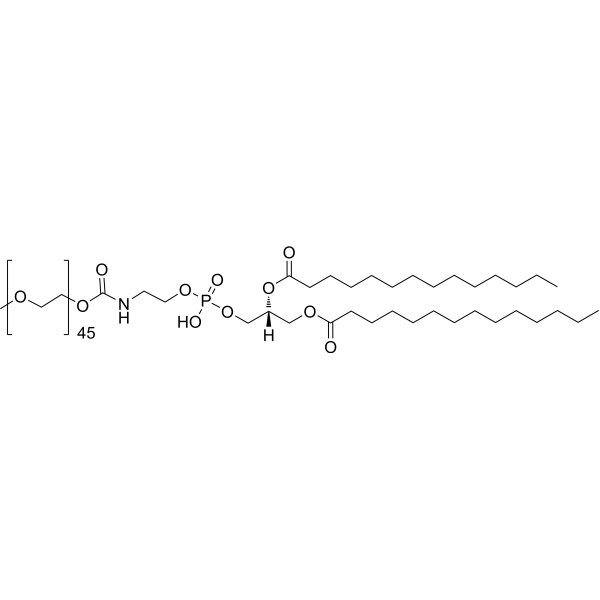
PEG2000-DMPE is a polyethylene glycol-lipid conjugate combined with phosphatidylethanolamine. PEG2000-DMPE undergoes a conformational transition from mushroom-like to brush-like at a concentration of 7 mol%, thereby exerting multiple functions such as inhibitor, stabilizer and surface defect modifier. PEG2000-DMPE can form a steric hindrance barrier on the vesicle surface to block calcium ion-induced liposome fusion, and dynamically regulate the fusion process through spontaneous transfer rate. PEG2000-DMPE can delay the thinning of foam thin liquid films and smoothly seal surface defects of solid support layers. PEG2000-DMPE can be used in the design and related research of stealth liposomes and micelles [2].
loading...
    loading...
Cat. No.: HY-W015815
CAS No.: 6960-22-1
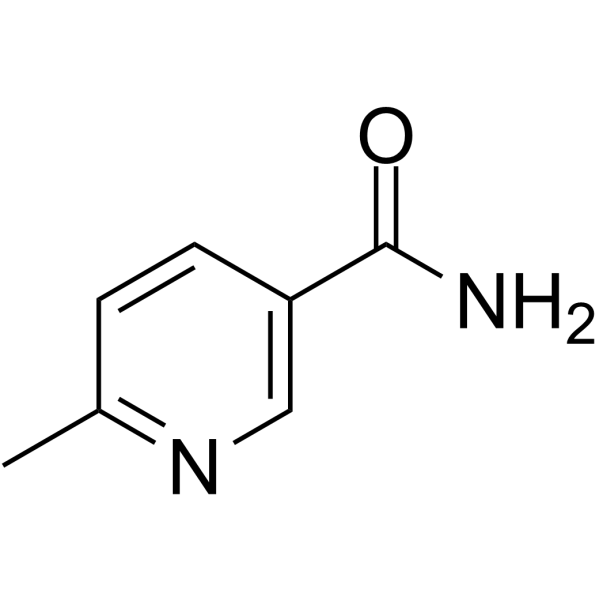
6-Methylnicotinamide is a derivative of Nicotinamide (HY-B0150). 6-Methylnicotinamide coordinates with undercoordinated Pb 2+ ions through its carbonyl group, passivating Pb-related defects. 6-Methylnicotinamide reduces trap density and non-radiative recombination in the perovskite absorber layer while inducing interfacial dipole formation. 6-Methylnicotinamide enhances the hydrophobicity, grain size, and environmental, thermal, and photostability of perovskite films. 6-Methylnicotinamide induces complementation of VP16-deficient HSV-1 replication and stimulates immediate-early gene expression. 6-Methylnicotinamide is upregulated in the acute phase of intracerebral hemorrhage and may exacerbate neurological injury. 6-Methylnicotinamide can be used for research on intracerebral hemorrhage and herpes simplex virus type 1 infection [2] .
loading...
    loading...
Cat. No.: HY-W127391
CAS No.: 17598-94-6
Synonyms: (Rac)-1,2-Didodecanoylglycerol
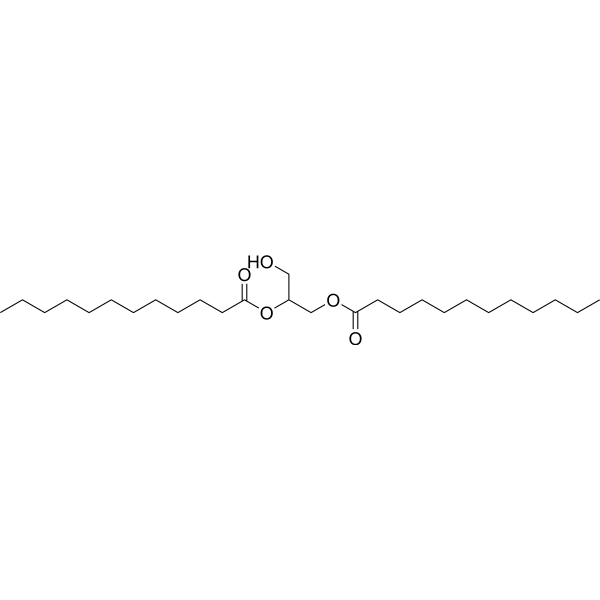
1,2-Dilaurin is a diacylglycerol containing lauric acid at the sn-1 and sn-2 positions. It has been used as an internal standard for the quantification of diglycerides in rat desheathed sciatic nerves. [1] Monomolecular films containing 1,2-dilauroyl-rac-glycerol have been used as substrates to measure surface pressure and the effect of pancreatic procolipase and colipase on porcine pancreatic lipase activity. [2] References: [1]. Zhu, X. and Eichberg, J. 1,2-Diacylglycerol content and its arachidonyl-containing molecular species are reduced in the sciatic nerve of streptozotocin-induced diabetic rats. J. Neurochemistry. 55(3), 1087-1090 (1990).[2]. Wieloch, T., Borgstr m, B., Piéroni, G. et al. Porcine trypsinogen and its trypsin-activated form: lipid binding and lipase activation on monomolecular membranes. FEBS Express. 128(2), 217-220 (1981).
loading...
    loading...
Cat. No.: HY-L0103V
680,000 compounds
UORSY Screening Compounds Library contains about 680,000 compounds. The library has extensively developed a polymerization synthesis method that provides a highly diverse chemical structure. More than 85% of the compounds in the library have drug-like physicochemical properties, and more than 35% of the compounds have lead-like properties.
Cat. No.: HY-W250120
CAS No.: 37220-17-0
Konjac glucomannan (Viscosity≥15000mPa.s) is an orally active acetylated (1-4)-β-D-glucomannan with multiple biological activities including anti-diabetic, anti-obesity, anti-inflammatory effects, as well as film-forming and gelling properties. Konjac glucomannan (Viscosity≥15000mPa.s) forms a defensive coating on the intestinal surface, reducing levels of blood glucose, cholesterol, triglycerides and blood pressure; it is specifically degraded by colonic β-mannanase produced by human colonic bacteria. Konjac glucomannan (Viscosity≥15000mPa.s) can be used as a food additive, dietary supplement and excipient for oral colon-targeted drug delivery systems. Konjac glucomannan (Viscosity≥15000mPa.s) is applicable to research related to various diseases such as type 2 diabetes, obesity, atopic dermatitis and metabolic syndrome, as well as research in fields including biotechnology, pharmaceuticals and tissue engineering [2] .
loading...
    loading...
Cat. No.: HY-Y0850U1
CAS No.: 9002-89-5
Synonyms: Polyvinyl alcohol (Mw 61000, 98-99% hydrolyzed, ~1400 polymerizaTiOn); Poly(Ethenol) (Mw 61000, 98-99% hydrolyzed, ~1400 polymerizaTiOn)
PVA (Mw 61000, 98-99% hydrolyzed, ~1400 polymerization) is a semicrystalline and biocompatible synthetic polymer with excellent safety properties including non-toxicity, no accumulation, and non-mutagenicity. PVA (Mw 61000, 98-99% hydrolyzed, ~1400 polymerization) undergoes cross-linking via acetal bond formation between hydroxyl and aldehyde groups, and it can be used to prepare highly rigid, low-solubility degradable films as well as for dry or minimally invasive in vitro wound studies. PVA (Mw 61000, 98-99% hydrolyzed, ~1400 polymerization) can construct a hydroxyl-rich microenvironment to trap photogenerated holes, thereby promoting hydrogen peroxide production and enhancing the redox cycle of iron species in the photo-Fenton reaction. PVA (Mw 61000, 98-99% hydrolyzed, ~1400 polymerization) can act as a sacrificial agent and substrate to achieve synchronous degradation with pollutants, and it is applicable to sustainable waste management and water treatment [2] .
loading...
    loading...
Cat. No.: HY-Y0850U2
CAS No.: 9002-89-5
Synonyms: Polyvinyl alcohol (Mw 130000, 87-89% hydrolyzed, ~2700 polymerizaTiOn); Poly(Ethenol) (Mw 130000, 87-89% hydrolyzed, ~2700 polymerizaTiOn)
PVA (Polyvinyl alcohol; Poly(Ethenol)) (Mw 130000, 87-89% hydrolyzed, ~2700 polymerization) is a non-toxic, biodegradable, and highly biocompatible semicrystalline synthetic polymer. PVA (Mw 130000, 87-89% hydrolyzed, ~2700 polymerization) acts as a coating agent to improve tableting performance, and can be cross-linked with sodium trimetaphosphate to prepare tubular vascular grafts or form hydrogels for use as artificial articular cartilage and sustained-release matrices for growth factors. PVA (Mw 130000, 87-89% hydrolyzed, ~2700 polymerization) enhances the redox cycle of iron species in photo-assisted Fenton reactions to simultaneously generate hydrogen peroxide and degrade pollutants, enabling integrated sustainable waste management and water treatment. PVA (Mw 130000, 87-89% hydrolyzed, ~2700 polymerization) is used in the manufacture of biodegradable films and in studies of dry or minimally invasive ex vivo wounds, but cannot form freeze-thaw cross-linked solid sheets for wound dressings [2] .
loading...
    loading...
Cat. No.: HY-Y0850U8
CAS No.: 9002-89-5
Synonyms: Polyvinyl alcohol (Mw 47000, 98-99% hydrolyzed, ~1000 polymerizaTiOn); Poly(Ethenol) (Mw 47000, 98-99% hydrolyzed, ~1000 polymerizaTiOn)
PVA (Polyvinyl alcohol; Poly(Ethenol)) (Mw 47000, 98-99% hydrolyzed, ~1000 polymerization) is a semicrystalline synthetic polymer with excellent biocompatibility and biodegradability, which is non-toxic and non-mutagenic upon oral administration in the human body. PVA (Mw 47000, 98-99% hydrolyzed, ~1000 polymerization) can serve as an excipient, inhibitor or coating agent to prepare solid dispersions by absorbing water and inhibiting drug crystal nucleation and growth, and can encapsulate insulin-like growth factor-1. PVA (Mw 47000, 98-99% hydrolyzed, ~1000 polymerization) can form physically crosslinked cryogels and degradable films, and is widely used in the construction of vascular grafts, the synthesis of articular cartilage, and studies on dry or minimally invasive ex vivo wounds. PVA (Mw 47000, 98-99% hydrolyzed, ~1000 polymerization) also promotes hydrogen peroxide generation and enhances the redox cycle of iron species, thus acting as a sacrificial agent to effectively degrade pollutants [2] .
loading...
    loading...
Cat. No.: HY-W015815R
CAS No.: 6960-22-1
6-Methylnicotinamide (Standard) is the analytical standard of 6-Methylnicotinamide (HY-W015815). This product is intended for research and analytical applications. 6-Methylnicotinamide is a derivative of Nicotinamide (HY-B0150). 6-Methylnicotinamide coordinates with undercoordinated Pb 2+ ions through its carbonyl group, passivating Pb-related defects. 6-Methylnicotinamide reduces trap density and non-radiative recombination in the perovskite absorber layer while inducing interfacial dipole formation. 6-Methylnicotinamide enhances the hydrophobicity, grain size, and environmental, thermal, and photostability of perovskite films. 6-Methylnicotinamide induces complementation of VP16-deficient HSV-1 replication and stimulates immediate-early gene expression. 6-Methylnicotinamide is upregulated in the acute phase of intracerebral hemorrhage and may exacerbate neurological injury. 6-Methylnicotinamide can be used for research on intracerebral hemorrhage and herpes simplex virus type 1 infection [2] .
loading...
    loading...
Cat. No.: HY-L221
626 compounds

Cosmetics are complex mixtures formulated through the rational blending and processing of various natural, synthetic, or extracted raw materials. The ingredients used in cosmetics are diverse in type and functionality. Based on their properties and applications, cosmetic ingredients can generally be classified into two main categories: base materials and auxiliary ingredients. The former constitutes the primary component of cosmetics, accounting for a significant proportion in formulations and serving as the key functional substances. Auxiliary ingredients, on the other hand, play roles in shaping the product, ensuring stability, or imparting color, fragrance, and other specific characteristics.Establishing a systematic ingredient database is of great significance for cosmetic research and development. By analyzing the physicochemical properties (such as oil-water partition coefficients and molecular weight distribution), biological activity mechanisms (such as antioxidant pathways and cellular signaling regulation), and compatibility of ingredients, the database can provide precise guidance for formulation design. This approach helps shorten the development cycle of cosmetic/skincare products and reduces trial-and-error costs.

MCE offers 626 types of cosmetic ingredient compounds, including antioxidants, humectants, emulsifiers, film-forming agents, and more.

