132 Results for "

higher affinity

" in MedChemExpress (MCE) Product Catalog:
Products (132)

132 Results for "higher affinity" in MCE Product Catalog:

Cat. No.: HY-10473R
CAS No.: 355129-15-6
Synonyms: KB2115 (Standard)
Eprotirome (Standard) is the analytical standard of Eprotirome (HY-10473). This product is intended for research and analytical applications. Eprotirome (KB2115) is a liver-selective thyroid hormone receptor (TR) agonist. KB2115 has modestly higher affinity for TRβ than for TRα. Eprotirome reduces low-density lipoprotein (LDL) cholesterol concentrations. Eprotirome can be used for dyslipidemias and obesity research .
loading...
    loading...
Cat. No.: HY-W754019
CAS No.: 82117-51-9
Cinuperone is a multi-target competitive receptor ligand and σ receptor antagonist that acts on Dopamine D1, σ, Dopamine D1, and 5-HT2 receptors. Cinuperone shows significantly higher affinity for σ receptors than for Dopamine D1 receptors, and only exhibits moderate binding activity for dopamine D2 receptors. Cinuperone can be used in the research of central nervous system diseases .
loading...
    loading...
Cat. No.: HY-107650A
Purity:  96.25%
Synonyms: CI 979 hydroiodide; RU 35926 hydroiodide
Target:  

mAChR

Research Areas:  

Neurological Disease

Milameline (CI 979; RU35926) hydroiodide is a nonselective, partical and orally active muscarinic receptor agonist that improves cognition. Milameline hydroiodide has equal affinity for different subtypes of human muscarinic receptors with IC50 of 1.3 µM for M1-, 1.1 µM for M2-, 1.5 µM for M3-, and 1.9 µM for M4-muscarinic receptors. Milameline hydroiodide has a higher affinity for sites [ 3H]CMD (IC50 = 20 nM), than [ 3H]QNB, (IC50 = 3059 nM). Milameline hydroiodide produces both central and peripheral cholinergic effects and reverses the cognitive deficits induced by Scopolamine (HY-N0296). Milameline hydroiodide can be used for the study of Alzheimer’s Disease .
loading...
    loading...
Cat. No.: HY-182094
Target:  

Liposome

Research Areas:  

Metabolic Disease

DSPE-PEG1000-KTP is a PEG compound which composed of DSPE and a Kidney-targeting peptide KTP (HY-P11069). KTP can interact with specific proteins on the surface of renal tubular epithelial cells or exhibit higher affinity in the specific renal microenvironment, tending to aggregate or be internalized within the renal tubular epithelium. DSPE-PEG1000-KTP can actively guide carriers such as nanomedicines, liposomes, and microspheres to the kidney .
loading...
    loading...
Cat. No.: HY-182094A
Target:  

Liposome

Research Areas:  

Metabolic Disease

DSPE-PEG2000-KTP is a PEG compound which composed of DSPE and a Kidney-targeting peptide KTP (HY-P11069). KTP can interact with specific proteins on the surface of renal tubular epithelial cells or exhibit higher affinity in the specific renal microenvironment, tending to aggregate or be internalized within the renal tubular epithelium. DSPE-PEG2000-KTP can actively guide carriers such as nanomedicines, liposomes, and microspheres to the kidney .
loading...
    loading...
Cat. No.: HY-182094B
Target:  

Liposome

Research Areas:  

Metabolic Disease

DSPE-PEG3400-KTP is a PEG compound which composed of DSPE and a Kidney-targeting peptide KTP (HY-P11069). KTP can interact with specific proteins on the surface of renal tubular epithelial cells or exhibit higher affinity in the specific renal microenvironment, tending to aggregate or be internalized within the renal tubular epithelium. DSPE-PEG3400-KTP can actively guide carriers such as nanomedicines, liposomes, and microspheres to the kidney .
loading...
    loading...
Cat. No.: HY-182094C
Target:  

Liposome

Research Areas:  

Metabolic Disease

DSPE-PEG5000-KTP is a PEG compound which composed of DSPE and a Kidney-targeting peptide KTP (HY-P11069). KTP can interact with specific proteins on the surface of renal tubular epithelial cells or exhibit higher affinity in the specific renal microenvironment, tending to aggregate or be internalized within the renal tubular epithelium. DSPE-PEG5000-KTP can actively guide carriers such as nanomedicines, liposomes, and microspheres to the kidney .
loading...
    loading...
Cat. No.: HY-B0814S1
CAS No.: 1133210-23-7
Synonyms: (R)-Cetirizine-d4
Research Areas:  

Inflammation/Immunology

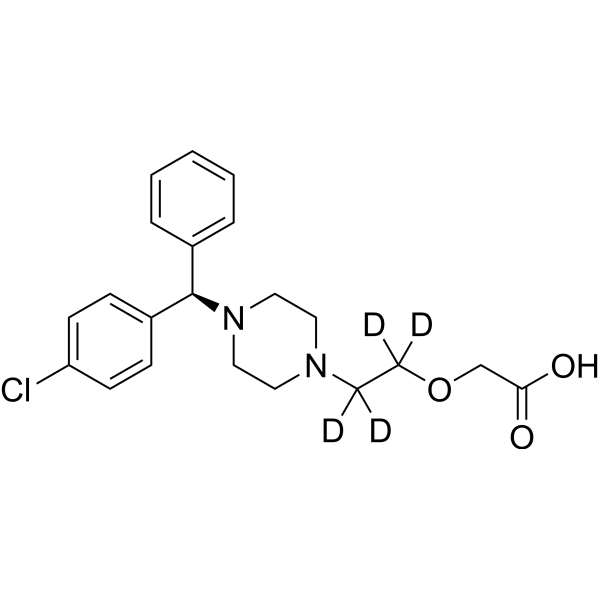
Levocetirizine-d4 ((R)-Cetirizine-d4) is the deuterium-labeled Levocetirizine (HY-B0814) . Levocetirizine ((R)-Cetirizine) is a third-generation peripheral H1-receptor antagonist. Levocetirizine is an antihistaminic agent which is the R-enantiomer of Cetirizine. Levocetirizine has a higher affinity for the histamine H1-receptor than (S)-Cetirizine and can effectively treat allergic rhinitis and chronic idiopathic urticaria .
loading...
    loading...
Cat. No.: HY-10211R
CAS No.: 75747-14-7
Synonyms: 17-AAG (Standard); NSC 330507 (Standard); CP 127374 (Standard)
Tanespimycin (Standard) is the analytical standard of Tanespimycin. This product is intended for research and analytical applications. Tanespimycin (17-AAG) is a potent HSP90 inhibitor with an IC50 of 5 nM, having a 100-fold higher binding affinity for tumour cell derived HSP90 than normal cell derived HSP90 . Tanespimycin depletes cellular STK38/NDR1 and reduces STK38 kinase activity. Tanespimycin also downregulates the stk38 gene expression .
loading...
    loading...
Cat. No.: HY-103197R
CAS No.: 109544-45-8
Synonyms: RX821002 hydrochloride (Standard)
2-Methoxyidazoxan (monohydrochloride) (Standard) is the analytical standard of 2-Methoxyidazoxan (monohydrochloride). This product is intended for research and analytical applications. 2-Methoxyidazoxan monohydrochloride (RX821002 hydrochloride) is a highly selective alpha 2-adrenoceptor antagonist with little or no imidazoline antagonist effect. RX 821002 has markedly higher affinity for (guinea-pig) alpha 2D-adrenoceptors (pKd 9.7) than for (rabbit) alpha 2A-adrenoceptors (pKd 8.2) .
loading...
    loading...
Cat. No.: HY-130179
CAS No.: 1346016-43-0
Target:  

Apoptosis

Research Areas:  

Neurological Disease

RC-33 hydrochloride is a selective and metabolically stable σ receptor agonist with activity in enhancing nerve growth factor (NGF)-induced neurite outgrowth. Both enantiomers of RC-33 hydrochloride bind to the σ receptor with similar affinity and show almost equal effectiveness as σ receptor agonists. The R-configured enantiomer of RC-33 hydrochloride shows higher liver metabolic stability in the presence of NADPH. RC-33 hydrochloride was selected as the best candidate for further in vivo studies in animal models of amyotrophic lateral sclerosis .
loading...
    loading...
Cat. No.: HY-B2021
CAS No.: 102851-06-9
Target:  

Insecticide

Research Areas:  

Neurological Disease

τ-Fluvalinate is an insecticide and in-hive miticide, with its mechanism involving interfering with nervous systems. τ-Fluvalinate binds to the open state of Varroa destructor (VdNaV1) and Apis mellifera (AmNaV1) voltage-dependent sodium channels, with EC50 values of 160 nM and 60 nM respectively. τ-Fluvalinate has higher affinity for AmNaV1, which causes sublethal toxicity to honeybees. τ-Fluvalinate can be applied for research on Varroa destructor infestation in honeybee colonies .
loading...
    loading...
Cat. No.: HY-124984
CAS No.: 2990506-75-5
Purity:  98.07%
Target:  

mGluR

Research Areas:  

Neurological Disease

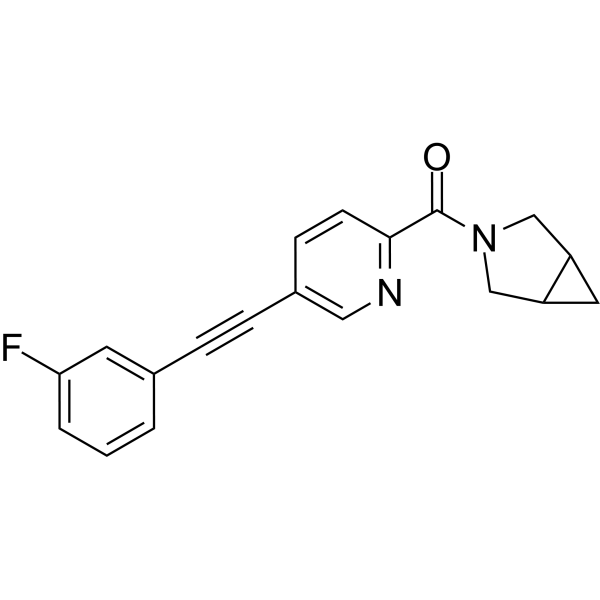
ML353 is a selective ligand of mGlu5 silent allosteric modulator (SAM) with an Ki value of 18.2 nM. ML353 improves the affinity of common allosteric sites, 20-fold higher than the previous mGlu5 SAM tool compound 5mpep. ML353 has potential applications in solving the intrinsic activity of SAM in vivo or as a agent blocker . ML353 is a click chemistry reagent, it contains an Alkyne group and can undergo copper-catalyzed azide-alkyne cycloaddition (CuAAc) with molecules containing Azide groups.
loading...
    loading...
Cat. No.: HY-187957
Target:  

mAChR ERK

Research Areas:  

Neurological Disease

M1/M4 muscarinic agonist 4 is a dual-site muscarinic acetylcholine receptor ligand with potent agonistic activity at M1/M4 muscarinic acetylcholine receptors. M1/M4 muscarinic agonist 4 activates M1R to induce phosphorylation of ERK1/2, and activates M4R to induce GαoB protein activation as well as ERK1/2 phosphorylation. M1/M4 muscarinic agonist 4 exhibits higher binding affinity for M4R than for other muscarinic receptors, while its binding affinity for the W435A mutant M4R is reduced. M1/M4 muscarinic agonist 4 can be used in the research of schizophrenia .
loading...
    loading...
Cat. No.: HY-137465
CAS No.: 2412055-93-5
Target:  

PROTACs Trk Receptor

Research Areas:  

Cancer

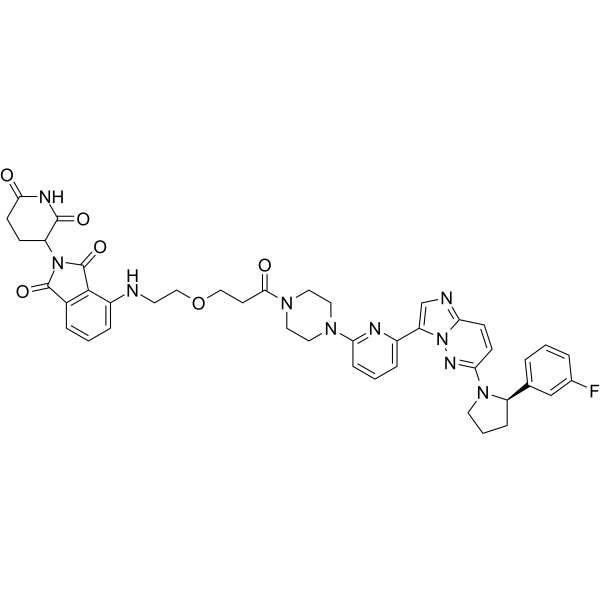
CG428 is a potent and selective CRBN-dependent tropomyosin receptor kinase (TRK) PROTAC degrader that has anti-tumor activity. CG428 reduces levels of the tropomyosin 3 TPM3-TRKA fusion protein in KM12 colorectal carcinoma cells (DC50 = 0.36 nM) and inhibits downstream PLCγ1 phosphorylation (IC50 = 0.33 nM). CG428 has a higher binding affinity for TRKA than TRKB and TRKC (Kd = 1 nM, 28 nM and 4.2 nM, respectively). CG428 can be used for the research of colorectal carcinoma .
loading...
    loading...
Cat. No.: HY-19732
CAS No.: 133085-33-3
Target:  

Angiotensin Receptor

Research Areas:  

Cardiovascular Disease

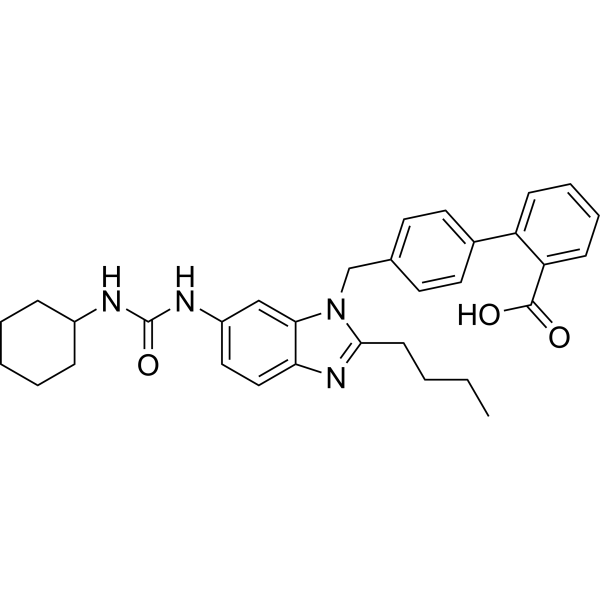
BIBS 39 is a non-peptide angiotensin II receptor antagonist with antihypertensive activity, with higher affinity for the AT1 receptor than for the AT2 receptor. BIBS 39 competitively blocks AT1-mediated vasoconstriction and pressor responses, and effectively inhibits the activity of the renin-angiotensin-aldosterone system. BIBS 39 reduces diastolic blood pressure and induces mild, transient reflex tachycardia, with no off-target functional activity on the norepinephrine, K +/Cl or vasopressin pathways. BIBS 39 can be used in research related to hypertension and renal hypertension [1][2 ][3].
loading...
    loading...
Cat. No.: HY-P10365
Research Areas:  

Others

Vmm-p15 is a peptide agonist optimized for the adhesion G protein-coupled receptor GPR64 (also known as ADGRG2 or HE6). The affinity of VPM-p15 with GPR64 is significantly higher than that of the original p15 peptide. The cAMP level induced by VMM-P15 increased significantly, activated GPR64, and triggered downstream Gs, Gq, and G12/13 signaling. VPM-p15 can be used to study the activation mechanism of adherent GPCR family members .
loading...
    loading...
Cat. No.: HY-W714853
CAS No.: 65732-07-2
(+)-Theta-cypermethrin is a stereoisomer of Cypermethrin (HY-B0829) that possesses blood-brain barrier penetration ability and binds to AKT1, SRC, STAT3 and EGFR with high affinity. (+)-Theta-cypermethrin reduces the amplitude of delayed rectifier potassium channel currents, shifts the steady-state activation curve to negative potentials, and shifts the steady-state inactivation curve to negative potentials at higher concentrations. (+)-Theta-cypermethrin induces abnormal electrical activity in rat hippocampal neurons. (+)-Theta-cypermethrin causes chronic respiratory system damage and exhibits neurotoxicity .
loading...
    loading...
Cat. No.: HY-100552
CAS No.: 155584-74-0
Purity:  99.83%
Target:  

5-HT Receptor

Research Areas:  

Neurological Disease

VUF10166 is a potent and high-affinity 5-HT3 receptor antagonist, with Ki values of 0.04 nM (5-HT3A) and 22 nM (5-HT3AB). VUF10166 inhibits 5-HT-induced responses at 5-HT3A and 5-HT3AB receptors at nanomolar concentrations. At 5-HT3 receptor, VUF10166 at higher concentrations also acts as a partial agonist, with an EC50 of 5.2 μM .
loading...
    loading...
Cat. No.: HY-B0161CR
CAS No.: 116539-60-7
Synonyms: (R)-LY248686 (Standard)
Research Areas:  

Neurological Disease

(R)-Duloxetine (Standard) ((R)-LY248686 (Standard)) is the analytical standard of (R)-Duloxetine (HY-B0161C). This product is intended for research and analytical applications. (R)-Duloxetine ((R)-LY248686) is a neuronal voltage-gated sodium channel blocker with analgesic activity. (R)-Duloxetine blocks Na + currents with higher affinity for the inactivated state than for the resting state. (R)-Duloxetine alleviates postoperative mechanical allodynia and hyperalgesia. (R)-Duloxetine exerts its effects through a local peripheral mechanism of action. (R)-Duloxetine can be used for research on postoperative (post-incisional) pain .
loading...
    loading...

