132 Results for "

higher affinity

" in MedChemExpress (MCE) Product Catalog:
Products (132)

132 Results for "higher affinity" in MCE Product Catalog:

Cat. No.: HY-163980
Research Areas:  

Others

AChE-IN-73 (compound 6) is an insecticide with higher toxicity than HY-B0815. The LC50 for C. pipiens is 78.0 mg/L. AChE-IN-73 has high affinity for acetylcholinesterase (AChE) and nicotinic acetylcholine receptors (nAChR), with binding energies of -8.11 kcal/mol and -6.27 kcal/mol, respectively. AChE-IN-73 is a potentially potent mosquito inhibitor .
loading...
    loading...
Cat. No.: HY-109743
CAS No.: 1000036-77-0
Target:  

Dopamine Receptor

Research Areas:  

Neurological Disease

BP14979 is a dopamine D3 receptor agonist with activity in the study of neurological diseases. BP14979 can be used to develop ligands with higher selectivity and affinity for D3 receptors. The structural characteristics of BP14979 make it potential in modulating the efficacy of D3 receptors. The design of BP14979 is based on the difference in efficacy with D3R selective antagonists, providing opportunities for optimizing new drug development .
loading...
    loading...
Cat. No.: HY-B0161C
CAS No.: 116539-60-7
Synonyms: (R)-LY248686
Target:  

Sodium Channel

Research Areas:  

Neurological Disease

(R)-Duloxetine ((R)-LY248686) is a neuronal voltage-gated sodium channel blocker with analgesic activity. (R)-Duloxetine blocks Na + currents with higher affinity for the inactivated state than for the resting state. (R)-Duloxetine alleviates postoperative mechanical allodynia and hyperalgesia. (R)-Duloxetine exerts its effects through a local peripheral mechanism of action. (R)-Duloxetine can be used for research on postoperative (post-incisional) pain .
loading...
    loading...
Cat. No.: HY-B0161D
CAS No.: 910138-96-4
Synonyms: LY248686 hydrochloride
Target:  

Sodium Channel

Research Areas:  

Neurological Disease

(R)-Duloxetine hydrochloride ((R)-LY248686 hydrochloride) is a neuronal voltage-gated sodium channel blocker with analgesic activity. (R)-Duloxetine hydrochloride blocks Na + currents with higher affinity for the inactivated state than for the resting state. (R)-Duloxetine hydrochloride alleviates postoperative mechanical allodynia and hyperalgesia. (R)-Duloxetine hydrochloride exerts its effects through a local peripheral mechanism of action. (R)-Duloxetine hydrochloride can be used for research on postoperative (post-incisional) pain .
loading...
    loading...
Cat. No.: HY-W076756
CAS No.: 171722-92-2
Target:  

mAChR

Research Areas:  

Inflammation/Immunology

4-Piperidyl N-(2-biphenyl)carbamate (compound MA) is a competitive muscarinic acetylcholine receptor (mAChR) antagonist. 4-Piperidyl N-(2-biphenyl)carbamate exhibits higher affinity for M2 and M3 mAChR than β2AR (M2 pKi = 7.33; M3 pKi = 7.51; β2AR pKi = 4.94) .
loading...
    loading...
Cat. No.: HY-107650
CAS No.: 139886-04-7
Synonyms: CI 979 hydrochloride; RU 35926 hydrochloride
Target:  

mAChR

Research Areas:  

Neurological Disease

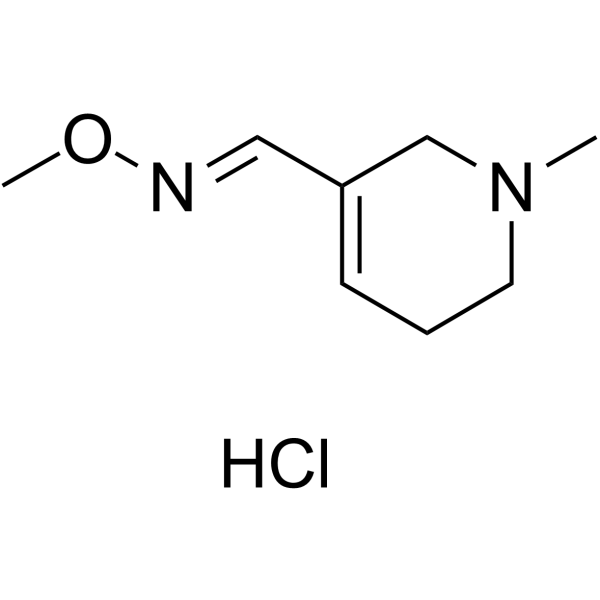
Milameline (CI 979; RU35926) hydrochloride is a nonselective, partical and orally active muscarinic receptor agonist that improves cognition. Milameline hydrochloride has equal affinity for different subtypes of human muscarinic receptors with IC50 of 1.3 µM for M1-, 1.1 µM for M2-, 1.5 µM for M3-, and 1.9 µM for M4-muscarinic receptors. Milameline hydrochloride has a higher affinity for sites [ 3H]CMD (IC50 = 20 nM), than [ 3H]QNB, (IC50 = 3059 nM). Milameline hydrochloride produces both central and peripheral cholinergic effects and reverses the cognitive deficits induced by Scopolamine (HY-N0296). Milameline hydrochloride can be used for the study of Alzheimer’s Disease .
loading...
    loading...
Cat. No.: HY-135460
CAS No.: 139886-32-1
Synonyms: CI-979; RU35926
Target:  

mAChR

Research Areas:  

Neurological Disease

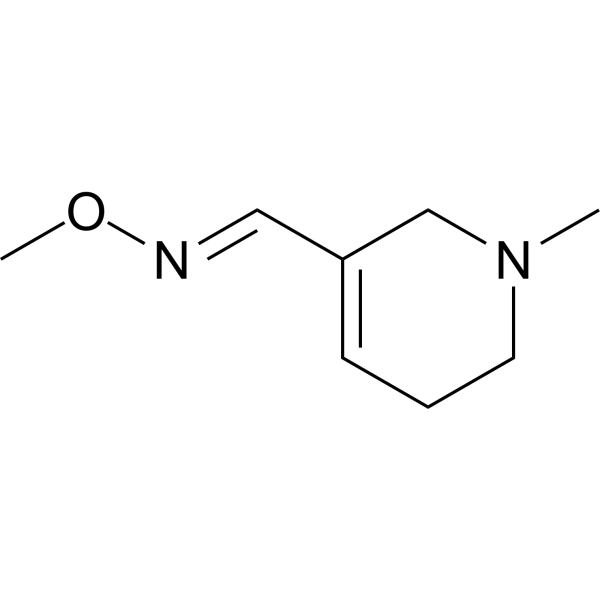
Milameline (CI-979; RU35926) is a nonselective, partical and orally active muscarinic receptor agonist that improves cognition. Milameline has equal affinity for different subtypes of human muscarinic receptors with IC50 of 1.3 µM for M1-, 1.1 µM for M2-, 1.5 µM for M3-, and 1.9 µM for M4-muscarinic receptors. Milameline has a higher affinity for sites [ 3H]CMD (IC50 = 20 nM), than [ 3H]QNB, (IC50 = 3059 nM). Milameline produces both central and peripheral cholinergic effects and reverses the cognitive deficits induced by Scopolamine (HY-N0296). Milameline can be used for the study of Alzheimer’s Disease .
loading...
    loading...
Cat. No.: HY-115390
CAS No.: 114616-11-4
14,15-Dehydro Leukotriene B4 (Compound 4) is a LTB4 receptor antagonist. 14,15-Dehydro Leukotriene B4 also has a higher binding affinity for BLT1 with a Ki value of 27 nM and BLT2 with a Ki value of 473 nM. 14,15-Dehydro Leukotriene B4 inhibits LTB4-induced release of lysozymes from rat polymorphonuclear leukoctyes with an IC50 value of 1 µM .
loading...
    loading...
Cat. No.: HY-16381C
CAS No.: 820232-50-6
Synonyms: (2R)-SOM230 (diaspartate)
Target:  

Endogenous Metabolite

Research Areas:  

Others

(2R)-Pasireotide ((2R)-SOM230) diaspartate exhibits a 40-fold higher affinity for somatostatin receptor 5 than other somatostatin analogs.
loading...
    loading...
Cat. No.: HY-119771
CAS No.: 35418-52-1
Target:  

Ferroportin Bacterial

Research Areas:  

Infection

Schizokinen is an iron-transport agent. Schizokinen can be obtained from Bacillus megaterium. Schizokinen possesses a higher affinity for iron(III) than Desferrioxamine B. Schizokinen reduces the division lag of bacteria .
loading...
    loading...
Cat. No.: HY-100202R
CAS No.: 16858-02-9
Synonyms: TPEDA (Standard)
TPEN (Standard) is the analytical standard of TPEN (HY-100202). This product is intended for research and analytical applications. TPEN (TPEDA) is a specific cell-permeable heavy metal chelator. TPEN has a higher affinity for Zn2+, but a lower affinity for Mg2+ and Ca2+. TPEN induces DNA damage and increases intracellular ROS production. TPEN also inhibits cell proliferation and induces apoptosis .
loading...
    loading...
Cat. No.: HY-111142
CAS No.: 91595-86-7
Target:  

Others

Research Areas:  

Others

COR 32-24 is a compound that enters the brain through the purine transport system and has the activity of being transported by this system. The brain uptake index of COR 32-24 in rats decreases with the increase of the concentration of unlabeled compound, and its affinity for purine transporters is higher than that for adenine.
loading...
    loading...
Cat. No.: HY-P1994A
CAS No.: 117829-60-4
Research Areas:  

Neurological Disease

JMV 170, a CCK derivative, is a selective CCK-B agonist. JMV 170 binds to the CCK-B receptor with a 10-fold higher affinity than to the CCK-A receptor. JMV 170 shows contractile effects on pig smooth muscle cells with an EC50 of 9 pmol/L .
loading...
    loading...
Cat. No.: HY-129296
CAS No.: 173943-29-8
Target:  

Endogenous Metabolite

Research Areas:  

Neurological Disease

YM-44781 free acid is a non-peptide neuropeptide receptor antagonist with efficient NK(2) and NK(1) receptor antagonist activity. YM-44781 exhibits significant binding affinity on the NK(2) receptor (pKi = 9.94) and also on the NK(1) receptor Higher binding affinity (pKi = 9.09). In addition, YM-44781 also showed significant inhibitory effects on bladder contraction induced by selective NK(1) receptor agonists .
loading...
    loading...
Cat. No.: HY-D2282
CAS No.: 2561482-42-4
DFHBI-BI is a mimic of the green fluorescence protein chromophore. DFHBI-BI can be bound and activated by Broccoli ( a fluorogenic RNA aptamer) with higher affinity. DFHBI-BI prevents thermal unfolding of Broccoli at 37°C in mammalian cells, subsequently forming more fluorescent Broccoli-BI complexes. The fluorescence wavelength is 559/635 nm .
loading...
    loading...
Cat. No.: HY-111156
CAS No.: 911290-20-5
Target:  

Monoamine Oxidase

Research Areas:  

Neurological Disease

NW-1172 (free base) (compound 22b) is a 5-HT3 receptor antagonist with performance-enhancing activity in a delayed matching task in monkeys, with the (R) isomer producing more systematic improvements than the (S) isomer, a difference paralleled by the higher affinity of the (R) enantiomer for the 5-HT3 receptor.
loading...
    loading...
Cat. No.: HY-100943R
CAS No.: 54-84-2
Synonyms: SQ 10643 (Standard)
Cinanserin (hydrochloride) (Standard) is the analytical standard of Cinanserin (hydrochloride) (HY-100943). This product is intended for research and analytical applications. Cinanserin hydrochloride (SQ 10643) is a potent, selective and highly affinity 5-HT2 receptor antagonist with a Ki of 41 nM. Cinanserin hydrochloride has a much higher binding affinity for the 5-HT2 than for the 5-HT1 receptor (Ki of 3500 nM). Cinanserin is also an inhibitor of 3C-like proteinase of severe acute respiratory syndrome coronavirus and strongly reduces virus replication in vitro .
loading...
    loading...
Cat. No.: HY-111241
CAS No.: 873445-73-9
Target:  

Dopamine Receptor

Research Areas:  

Neurological Disease

SV 293 is a selective antagonist with neutral antagonist activity. SV 293 binds to human D2 receptors with 100-fold higher affinity and has lower affinity for human D3 and D4 dopamine receptor subtypes. SV 293 was found to block the effects of the full agonist quinpirole in forskolin-dependent adenylate acylase inhibition assays and electrophysiological assays. SV 293 can be used as a useful pharmacological tool to study the role of dopamine D2-like receptor subtypes in dopamine pathways associated with neurological, neuropsychiatric and movement disorders .
loading...
    loading...
Cat. No.: HY-183248
Research Areas:  

Cancer

BRDT-IN-2 is a BRDT-BD1-preferring inhibitor (Ki=10 μM) with higher affinity for BRDT-BD1 than BRD4-BD1. BRDT-IN-2 preferentially binds BRDT-BD1 without direct interaction with BRDT-BD1’s Arg54 residue. BRDT-IN-2 binds BRD4-BD1 with lower affinity via structured water molecule displacement in its binding pocket. BRDT-IN-2 can be used for the research of multiple myeloma .
loading...
    loading...
Cat. No.: HY-P11680
CAS No.: 253438-99-2
Target:  

DNA/RNA Synthesis

Research Areas:  

Others

BOC-PNA-thioU(PMB)-OH is a peptide nucleic acid (PNA) monomer characterized by a PMB protecting group on its thiouracil, which enhances its binding affinity to adenine. BOC-PNA-thioU(PMB)-OH exhibits excellent resistance to enzymatic degradation and strong hybridization properties, making it valuable for applications in gene diagnosis, antisense therapy, and other molecular biology fields requiring higher binding strength and greater functionalization.
loading...
    loading...

