



Cinanserin hydrochloride (Standard)
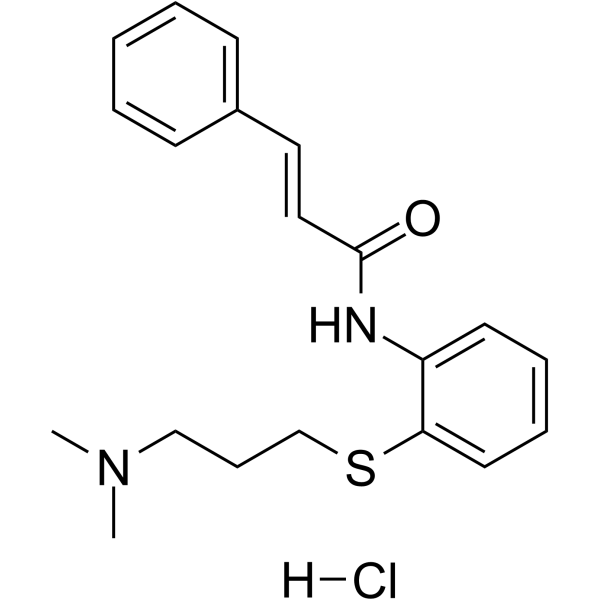
Cinanserin (hydrochloride) (Standard) is the analytical standard of Cinanserin (hydrochloride) (HY-100943). This product is intended for research and analytical applications. Cinanserin hydrochloride (SQ 10643) is a potent, selective and highly affinity 5-HT2 receptor antagonist with a Ki of 41 nM. Cinanserin hydrochloride has a much higher binding affinity for the 5-HT2 than for the 5-HT1 receptor (Ki of 3500 nM). Cinanserin is also an inhibitor of 3C-like proteinase of severe acute respiratory syndrome coronavirus and strongly reduces virus replication in vitro.
Nos produits utilisent uniquement pour la recherche. Nous ne vendons pas aux patients.
- CAS No.: 54-84-2
- Formule: C20H25ClN2OS
- Masse moléculaire:376.94
-
Stockage:
Please store the product under the recommended conditions in the Certificate of Analysis.


To place orders, for customer services and technical support, please contact: MedChemExpress USA
Tel: 609-228-6898 E-mail: [email protected] [email protected]


-
 Product Information
-
Chemical Information
- Pureté et documentation
-
 Help & FAQs


-
HY-100943
Cinanserin hydrochloride5-HT2 Receptor Antagonist -
HY-B2116
OsalmidHBV Inhibitor -
HY-B1213
Trimipramine maleate5-HT Receptor Antagonist -
HY-136465
A2ti-1A2t Inhibitor -
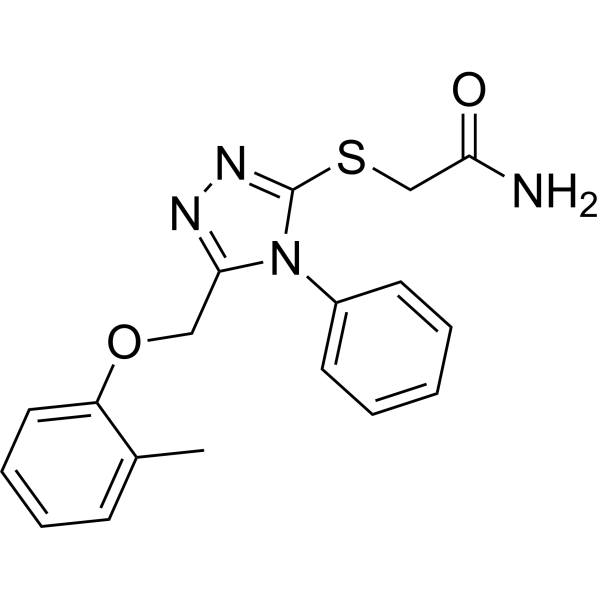
HY-136466
A2ti-2A2t Inhibitor -
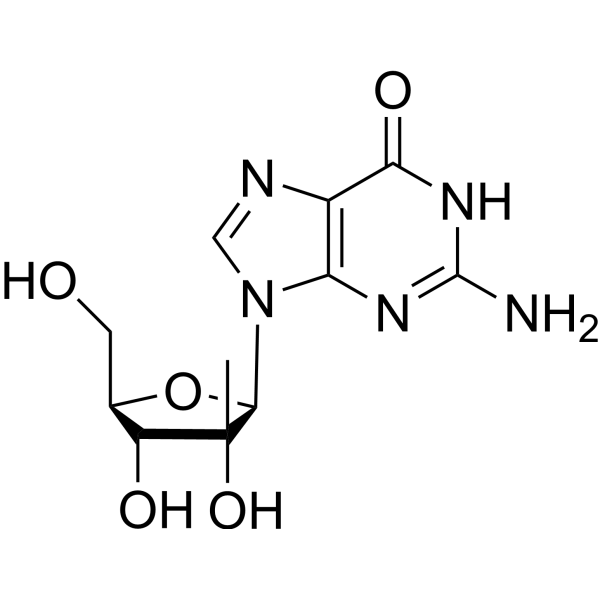
HY-128139
2'-C-MethylguanosineGuanosine Analog -

HY-B1213R
Trimipramine maleate (Standard)5-HT Receptor Antagonist


Product Information
Information
Application
The compound is the grade of analytical standard, which is the reference standard supplied assay. It is commonly used in qualitative, quantitative and methodological research experiments in HPLC, GC and MS.


Chemical Information
-
CAS No. 54-84-2
-
Masse moléculaire 376.94
-
Formule C20H25ClN2OS
-
SMILES
O=C(NC1=CC=CC=C1SCCCN(C)C)/C=C/C2=CC=CC=C2.[H]Cl
-
Synonyms
SQ 10643 (Standard)
-
Livraison
Room temperature in continental US; may vary elsewhere.
-
Stockage
Please store the product under the recommended conditions in the Certificate of Analysis.


Pureté et documentation
Références
[1]. Chen L, et al. Cinanserin is an inhibitor of the 3C-like proteinase of severe acute respiratory syndrome coronavirus and strongly reduces virus replication in vitro. J Virol. 2005 Jun;79(11):7095-103. [Content Brief]
[2]. Hernekamp JF, et al. Cinanserin reduces plasma extravasation after burn plasma transfer in rats. Burns. 2013 Sep;39(6):1226-33. [Content Brief]
[3]. Leysen JE, et al. Receptor binding profile of R 41 468, a novel antagonist at 5-HT2 receptors. Life Sci. 1981 Mar 2;28(9):1015-22. [Content Brief]

Calculators
Concentration (start) × Volume (start) = Concentration (final) × Volume (final)


Cinanserin hydrochloride (Standard) Related Classifications
HY-100943R Related Classifications
 Powered by Bioz