
1201 Results for "

rutile TiO2 nanoparticles

" in MedChemExpress (MCE) Product Catalog:
Products (1201)

1201 Results for "rutile TiO2 nanoparticles" in MCE Product Catalog:

Cat. No.: HY-168943C
PLGA nanoparticles, 1μm, are biodegradable tumor-targeting nanocarriers that can serve as drug delivery enhancers and multidrug resistance inhibitors. PLGA nanoparticles, 1μm, passively enriched through the EPR effect and actively targeted via ligand-mediated endocytosis, can encapsulate various antitumor active molecules. PLGA nanoparticles, 1μm can specifically recognize multiple types of tumor cells and improve cellular uptake, cytotoxicity and antiproliferative effects after modification with ligands such as transferrin, folic acid, and RGD. PLGA nanoparticles, 1μm can encapsulate various therapeutic drugs and can be surface modified to achieve targeting, imaging, and prolonged circulation time, making them suitable for cancer-related research [2] .
loading...
    loading...
Cat. No.: HY-W002484R
CAS No.: 6100-74-9
Synonyms: Acetoisovanillone (Standard); Isoacetovanillone (Standard)
3-Hydroxy-4-methoxyacetophenone (Acetoisovanillone; Isoacetovanillone) (Standard) is the analytical standard of 3-Hydroxy-4-methoxyacetophenone (HY-W002484). This product is intended for research and analytical applications. 3-Hydroxy-4-methoxyacetophenone (Acetoisovanillone; Isoacetovanillone) is an acetophenone derivative that can be isolated from the bulbs of Crinum macowanii (Amaryllidaceae). 3-Hydroxy-4-methoxyacetophenone is the phenolic acetophenone product generated from the TiO2-photocatalyzed oxidation of 3,4-dimethoxyacetophenone [2].
loading...
    loading...
Cat. No.: HY-D2314
CAS No.: 1650559-73-1
Cyanine 7-amine (chloride hydrochloride) can be used to label cationic nanoparticles (NPs) or to NP conjugates (NPCs). It can track the residence time and clearance of nanoparticles in the body .
loading...
    loading...
Cat. No.: HY-W440810
CAS No.: 959040-06-3
Target:  

Liposome

연구분야:  

Others

Undecyl 6-bromohexanoate can be useful for the preparation of lipid nanoparticles.
loading...
    loading...
Cat. No.: HY-173289
CAS No.: 2089251-49-8
연구분야:  

Others

LNP Lipid-26 can be applied in the generation of lipid nanoparticles (LNPs).
loading...
    loading...
Cat. No.: HY-173286
CAS No.: 2089253-10-9
Target:  

Liposome

연구분야:  

Others

LNP Lipid-182 can be employed in the development of lipid nanoparticles (LNPs).
loading...
    loading...
Cat. No.: HY-173297
CAS No.: 2036272-53-2
Target:  

Liposome

연구분야:  

Others

LNP Lipid-12 can be exploited for creating lipid nanoparticles (LNPs).
loading...
    loading...
Cat. No.: HY-173295
CAS No.: 2036272-60-1
Target:  

Liposome

연구분야:  

Others

LNP Lipid II-10 can be used in the development of lipid nanoparticles (LNPs).
loading...
    loading...
Cat. No.: HY-172334
CAS No.: 3067164-96-6
Target:  

Liposome

연구분야:  

Metabolic Disease

2N12B is a bioreducible ionizable lipid containing disulfide bonds. 2N12B can be used to prepare lipid nanoparticles (LNPs) for the delivery of mRNA in vitro and in vivo. Lipid nanoparticles containing 2N12B can deliver siRNA to inhibit retinal neovascularization .
loading...
    loading...
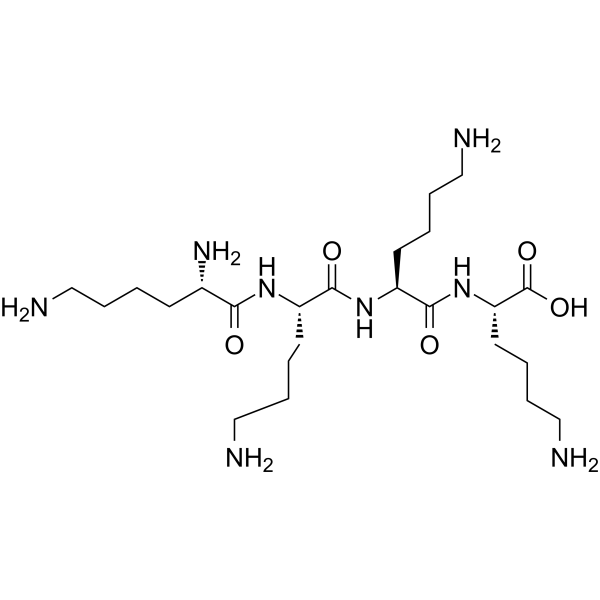
Cat. No.: HY-126721
CAS No.: 997-20-6
연구분야:  

Others

Tetralysine is a cationic moietie that may be used in the construction of gene delivery vectors and DNA nanoparticles .
loading...
    loading...
Cat. No.: HY-184648
Gold nanoparticles, also known as gold nanoparticle colloids, are colloidal systems formed by dispersing gold nanoparticles in a solution. Common methods for preparing gold nanoparticle colloids include the sodium citrate reduction of chloroauric acid method, also called the seed growth method or electrochemical synthesis method. The color of gold nanoparticle colloids changes with the size of the gold nanoparticles. Generally, the larger the diameter of the gold nanoparticles, the more the wavelength of light absorbed by the solution shifts towards longer wavelengths, and the particles will exhibit the complementary color of the absorbed light.
loading...
    loading...
Cat. No.: HY-184647
Target:  

Metal Nanoparticles

연구분야:  

Others

Citrate-modified ferric oxide nanoparticles are functionalized nanoparticles formed by attaching citric acid to the surface of Fe3O4 nanoparticles. Due to their excellent biocompatibility and stability, Citrate-modified ferric oxide nanoparticles can be used as drug carriers for drug delivery and contrast enhancement in magnetic resonance imaging (MRI).
loading...
    loading...
Cat. No.: HY-184638
APTS Fe2O3 Nanoparticles (Aminated ferric oxide magnetic nanoparticles) are magnetic nanomaterials modified with amino functional groups using APTS. This material consists of a ferric oxide (Fe3O4) nanoparticle core and an amino (-NH2) surface modification layer. The aminated surface helps improve the biocompatibility of the nanoparticles and reduce cytotoxicity. The amino functional groups can be further chemically modified for coupling with biomolecules such as drugs, proteins, and nucleic acids. The amino functional groups undergo protonation at different pH values, resulting in different surface charges on the nanoparticles in different pH environments.
loading...
    loading...
Cat. No.: HY-184637
DMSA Coated Fe2O3 Nanoparticles (Carboxylated ferric oxide nanoparticles) are magnetic nanomaterials with carboxyl (-COOH) groups modified on their surface. These materials typically consist of ferric oxide (Fe2O3) nanoparticles as a core, with carboxyl functional groups introduced to the surface through chemical modification. The carboxylation of the nanoparticle surface increases its negative surface charge, contributing to improved solubility and stability in water. Carboxylated ferric oxide nanoparticles exhibit good biocompatibility, making them suitable for biomedical applications.
loading...
    loading...
Cat. No.: HY-184617
Due to their unique physical and chemical properties, noble metal nanoparticles, represented by platinum, gold, silver, and palladium, have been extensively studied by many scientists. Palladium is a noble metal belonging to the platinum group elements. Its elemental form is a silvery-white transition metal, soft in texture and possessing good ductility and malleability. Palladium nanoparticles, due to their unique physical, chemical, and electronic properties, have shown remarkable application potential in multiple fields. The preparation methods for palladium nanoparticles mainly include chemical reduction and physical reduction methods. Chemical reduction generally involves adding a reducing agent to reduce palladium ions to elemental palladium. Common reducing agents used include sodium citrate, sodium borohydride, and hydrogen gas. Because the chemical reduction process is relatively fast, protective agents such as polyvinylpyrrolidone (PVP) are generally added to prevent palladium particles from agglomerating.
loading...
    loading...
Cat. No.: HY-184610
Selenium is an essential trace element for the human body, playing a vital role in various physiological activities and significantly impacting human health. Selenium deficiency can lead to a variety of diseases, while excessive amounts may be toxic. In recent years, selenium nanoparticles (SeNPs) have attracted increasing attention due to their excellent biocompatibility, low toxicity, and high antioxidant activity, making them suitable for a wide range of applications. Particularly in the fields of biomedicine, nutritional supplementation, food preservation, and environmental remediation, selenium nanoparticles hold immense application potential.
loading...
    loading...
Cat. No.: HY-184629
Ultra-small magnetic iron oxide nanoparticles refer to iron oxide (Fe3O4) nanoparticles with very small size. These nanoparticles typically have a diameter of less than 10 nanometers (<10 nm), and the size observed by TEM is usually in the range of 5-10 nm.
loading...
    loading...
Cat. No.: HY-184618
Due to their unique physical and chemical properties, noble metal nanoparticles, represented by platinum, gold, silver, and palladium, have been extensively studied by many scientists. Palladium is a noble metal belonging to the platinum group elements. Its elemental form is a silvery-white transition metal, soft in texture and possessing good ductility and malleability. Palladium nanoparticles, due to their unique physical, chemical, and electronic properties, have shown remarkable application potential in multiple fields. Surface modification of palladium nanoparticles with sodium citrate can significantly improve their dispersibility, stability, and biocompatibility, and facilitate further coupling with other biomolecules or fluorescent molecules.
loading...
    loading...
Cat. No.: HY-184619
Due to their unique physical and chemical properties, noble metal nanoparticles, represented by platinum, gold, silver, and palladium, have been extensively studied by many scientists. Palladium is a noble metal belonging to the platinum group elements. Its elemental form is a silvery-white transition metal, soft in texture and possessing good ductility and malleability. Palladium nanoparticles, due to their unique physical, chemical, and electronic properties, have shown remarkable application potential in multiple fields. PEI surface modification of palladium nanoparticles can significantly improve their dispersibility, stability, and biocompatibility, and facilitate further coupling with other biomolecules or fluorescent molecules.
loading...
    loading...
Cat. No.: HY-184625
Polyethyleneimine (PEI)-modified magnetic iron(III) oxide (Fe3O4) nanoparticles are a composite nanomaterial that combines the properties of magnetic nanoparticles and polyethyleneimine. Polyethyleneimine is a highly branched polymer with a high density of amino groups. These amino groups stabilize the Fe3O4 nanoparticles and provide sites for further functionalization. The amino groups of PEI impart a high surface positive charge to the Fe3O4 nanoparticles, which helps enhance their interaction with negatively charged cell membranes.
loading...
    loading...

