
158 Results for "

powder X-ray diffraction

" in MedChemExpress (MCE) Product Catalog:
Products (158)

158 Results for "powder X-ray diffraction" in MCE Product Catalog:

Cat. No.: HY-DY2029
Target:  

Fluorescent Dye

Research Areas:  

Others

Ready-to-Use Wright Staining Solution is a pre-mixed Romanowsky type absorbent composite staining agent, containing Eosin Y (HY-D0505) and methylene blue (HY-14536). Ready-to-Use Wright Staining Solution is suitable for staining of blood and cell smears, bacteria, protozoan parasites, etc., without the need for manual weighing of powder or complex preparation, thus saving time and ensuring the consistency of diagnostic results.
loading...
    loading...
Cat. No.: HY-154739A
CAS No.: 112945-52-5
Research Areas:  

Others

Amorphous silica can be used as an excipient, such as viscosifier, suspending agent, tablet disintegrating agent, adsorbent dispersing agent as liquid in powders. Pharmaceutical excipients, or pharmaceutical auxiliaries, refer to other chemical substances used in the pharmaceutical process other than pharmaceutical ingredients. Pharmaceutical excipients generally refer to inactive ingredients in pharmaceutical preparations, which can improve the stability, solubility and processability of pharmaceutical preparations. Pharmaceutical excipients also affect the absorption, distribution, metabolism, and elimination (ADME) processes of co-administered drugs .
loading...
    loading...
Cat. No.: HY-157356
Violet Red Bile Glucose Agar can be used for counting intestinal bacteria and identification of enterobacteriaceae. The composition of 1 liter of Violet Red Bile Glucose Agar contains: 7.0 g gelatin pancreatic enzyme hydrolysate, 3.0 g yeast extract powder, 1.5 g sodium deoxycholate, 10.0 g glucose, 5.0 g sodium chloride, 0.03 g neutral red, 0.002 g crystal violet, and 15.0 g agar in per liter .
loading...
    loading...
Cat. No.: HY-123630
CAS No.: 25956-17-6
Purity:  98.01%
Synonyms: FD&C RED NO. 40; CI 16035
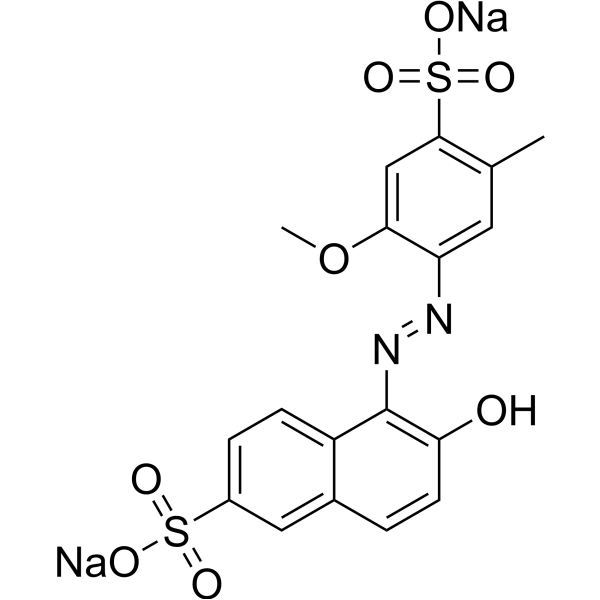
Allura Red AC is a food colorant, appearing as a deep red water-soluble powder or granules, used in various applications such as beverages, syrups, candies, and cereals. Allura Red AC can statically quench the intrinsic fluorescence of HSA. Additionally, Allura Red AC is a 5-hydroxytryptamine (5-HT) pathway-associated pro-inflammatory agent, capable of exacerbating experimental colitis. Allura Red AC holds potential for research in inflammatory bowel disease (IBD), intestinal barrier function, and food additive safety .
loading...
    loading...
Cat. No.: HY-B2235B
CAS No.: 8002-43-5
Synonyms: L-α-Phosphatidylcholine (egg yolk, Type XVI-E), 99%, lyophilized powder; 1,2-Diacyl-sn-glycero-3-phosphocholine (egg yolk, Type XVI-E), 99%; egg yolk Lecithins, Type XVI-E, 99%
L-α-Lecithin (egg yolk, Type XVI-E), 99% (L-α-Phosphatidylcholine (egg yolk, Type XVI-E), 99%) is an active biomaterial. L-α-Lecithin (egg yolk, Type XVI-E), 99% forms liposomes with compounds (PF or BA). L-α-Lecithin (egg yolk, Type XVI-E), 99% increases membrane fluidity and affects microemulsion stability and fluorescence intensity stained with Nile red (HY-D0718). L-α-Lecithin (egg yolk, Type XVI-E), 99% It can be used for cell membrane structure research, biological membrane potential research, and liposome research .
loading...
    loading...
Cat. No.: HY-123630R
CAS No.: 25956-17-6
Synonyms: FD&C RED NO. 40 (Standard); CI 16035 (Standard)
Allura Red AC (Standard) is an analytical standard of Allura Red AC. This product is intended for research and analytical applications. Allura Red AC is a food colorant, appearing as a deep red water-soluble powder or granules, used in various applications such as beverages, syrups, candies, and cereals. Allura Red AC can statically quench the intrinsic fluorescence of HSA. Additionally, Allura Red AC is a 5-hydroxytryptamine (5-HT) pathway-associated pro-inflammatory agent, capable of exacerbating experimental colitis. Allura Red AC holds potential for research in inflammatory bowel disease (IBD), intestinal barrier function, and food additive safety .
loading...
    loading...
Cat. No.: HY-P12013
Research Areas:  

Inflammation/Immunology

PEG12KL4 is a PEG-modified amphipathic cell-penetrating peptide. PEG12KL4 promotes the transfection and delivery of mRNA into lung cells, maintains mRNA stability, and forms mRNA complexes that retain integrity and translatability. PEG12KL4 endows lipid nanoparticles (LNPs) with anti-nebulization properties, enhances transfection efficiency in artificial mucus when used in combination with LNPs, and enables the formation of dry powder formulations with low toxicity and mild inflammatory responses. PEG12KL4 can be used in studies related to drug delivery for pulmonary diseases (cystic fibrosis, chronic obstructive pulmonary disease) .
loading...
    loading...
Cat. No.: HY-L0095V
270,000 compounds
OTAVAchemicals Screening Collection contains about 270,000 re-supply compounds for prompt delivery. All compounds have undergone quality control to confirm their chemical structures.
Cat. No.: HY-W761985
CAS No.: 65907-30-4
Target:  

Insecticide

Research Areas:  

Inflammation/Immunology

Furathiocarb is a carbamate pro-insecticide and a contact allergen. Furathiocarb is commonly used in studies related to contact allergy. Furathiocarb induces significant proliferation of MHC II-positive B cells in auricular lymph node cells and induces the production of Th1 cytokines (such as IL-2, TNF-γ and IFN-γ). However, Furathiocarb does not induce respiratory allergy in mice. After absorption through the abdominal skin of isolated rats, Furathiocarb is completely metabolized into carbofuran, and its permeation amount increases with time and dosage. The skin permeation rates of both emulsifiable concentrate (EC) and wettable powder (WP) formulations of Furathiocarb are higher than that of Furathiocarb itself, with no significant difference between the two formulations .
loading...
    loading...
Cat. No.: HY-L0096V
1,400,000 compounds
Vitas-M Screening Compounds Library (stock) contains about 1,400,000 chemical substances. They are synthetic small molecule organic compounds for biological screening and lead optimization. Select any number of items as a "cherry pick".
Cat. No.: HY-L026P
3,298 compounds

New drug development is a time-consuming and high-cost process. Drug repurposing (also called drug repositioning, reprofiling or re‑tasking) offers various advantages over developing an entirely new drug for a given indication, such as lower risk and less investment. Clinical drugs have confirmed bioactivities, clear mechanisms and high safety that are suitable for drug repurposing.

MCE owns a unique collection of 3,298 clinical compounds that refer to various research areas including anti-cancer, anti-infection, anti-inflammation, nervous disease. Those compounds are of detailed information on clinical development status, research area, targets, etc. Clinical Compound Library Plus, with powerful screening capability, further complements Clinical Compound Library (HY-L026) by adding some compounds with low solubility or solution stability (Part B) to this library. All those supplementary are supplied in powder form.

Cat. No.: HY-L022P
3,663 compounds

New drug development is a time-consuming and high-cost process. Drug repurposing (also called drug repositioning, reprofiling or re‑tasking) offers various advantages over developing an entirely new drug for a given indication. First, the risk of failure is lower. Second, the time frame for drug development can be reduced. Third, less investment is needed. Approved drugs have identified bioactivities, good pharmacokinetic characteristics and safety which are suitable for drug repurposing.

MCE owns a unique collection of 3,663 approved compounds which have been completed extensive preclinical and clinical studies and have well-characterized bioactivities, safety and bioavailability properties. MCE FDA-Approved Drug Library Plus, with more powerful screening capability, further complements FDA-Approved Drug Library (HY-L022) by adding some compounds with low solubility or solution stability (Part B) to this library. All those supplementary are supplied in powder form.

Cat. No.: HY-L0114V
439,804 compounds

This library contains about 439,804 natural and synthetic screening compounds. The information in the database includes logP, H-bond donors, H-bond acceptors, rotable bonds.

Cat. No.: HY-L035P
6,142 compounds

New drug development is a time-consuming and high-cost process. Drug repurposing (also called drug repositioning, reprofiling or re‑tasking) offers various advantages over developing an entirely new drug for a given indication. First, the risk of failure is lower. Second, the time frame for drug development can be reduced. Third, less investment is needed. Approved and clinical drugs, especially after phase I drugs, have identified bioactivities, good pharmacokinetic characteristics and safety, which are suitable for drug repurposing.

MCE Drug Repurposing Compound Library plus contains 6,142 approved and passed phase I clinical drugs, which have been completed extensive preclinical and clinical studies and have well-characterized bioactivities, safety and bioavailability properties.

MCE Drug Repurposing Compound Library plus, with more powerful screening capability, further complement MCE Drug Repurposing Compound Library (HY-L035) by adding some compounds with low solubility or stability (Part B) to this library. All those supplementary compounds are supplied in powder form.

Cat. No.: HY-L021P
6,400 compounds

Natural products are small molecules produced naturally by any organism including primary and secondary metabolites. Natural sources may lead to basic research on potential bioactive components for commercial development as lead compounds in drug discovery.

Nature has been a source of medicinal agents for thousands of years, and an impressive number of modern drugs have been isolated from natural sources, many based on their use in traditional medicine. With the development of new molecular targets, there is an increasing demand for novel molecular diversity for screening. Natural products will play a crucial role in meeting this demand through the continued investigation of world’s bio-diversity, much of which remains unexplored.

MCE provides a unique collection of 6,400 natural compounds that contains Saccharides and Glycosides, Phenylpropanoids, Quinones, Flavonoids, Terpenoids and Glycosides, Steroids, Alkaloid, Phenols, Acids and Aldehydes. Natural Product Library Plus, with more powerful screening capability, further complements Natural Product Library (HY-L021) by adding some compounds with low solubility or solution stability (Part B) to this library. All those supplementary are supplied in powder form.

Cat. No.: HY-L0101V
2,244,487 compounds
FCH Group Screening Library Collection contains about 2,244,487 lead-like compounds for biological screening. This brand new collection comprises polar molecules with pharmacologically important groups such as free carboxylic and amino groups.
Cat. No.: HY-L0103V
680,000 compounds
UORSY Screening Compounds Library contains about 680,000 compounds. The library has extensively developed a polymerization synthesis method that provides a highly diverse chemical structure. More than 85% of the compounds in the library have drug-like physicochemical properties, and more than 35% of the compounds have lead-like properties.

