11 Results for "

Anti-pulmonary fibrosis

" in MedChemExpress (MCE) Product Catalog:
Products (11)

11 Results for "Anti-pulmonary fibrosis" in MCE Product Catalog:

22
22 Cited Publications
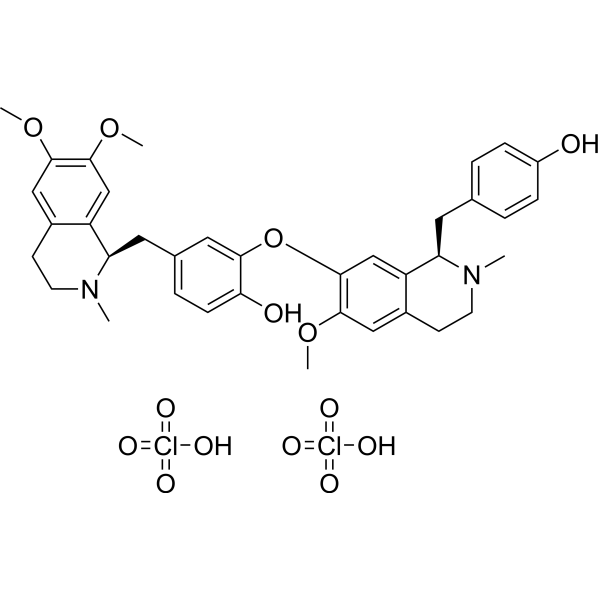
Cat. No.: HY-N0485
CAS No.: 5088-90-4
Liensinine Diperchlor​ate is a major isoquinoline alkaloid, extracted from the seed embryo of Nelumbo nucifera Gaertn. Liensinine Diperchlor​ate inhibits late-stage autophagy/mitophagy through blocking autophagosome-lysosome fusion. Liensinine Diperchlor​ate has a wide range of biological activities, including anti-arrhythmias, anti-hypertension, anti-pulmonary fibrosis, relaxation on vascular smooth muscle, etc .
loading...
    loading...
1
1 Cited Publications
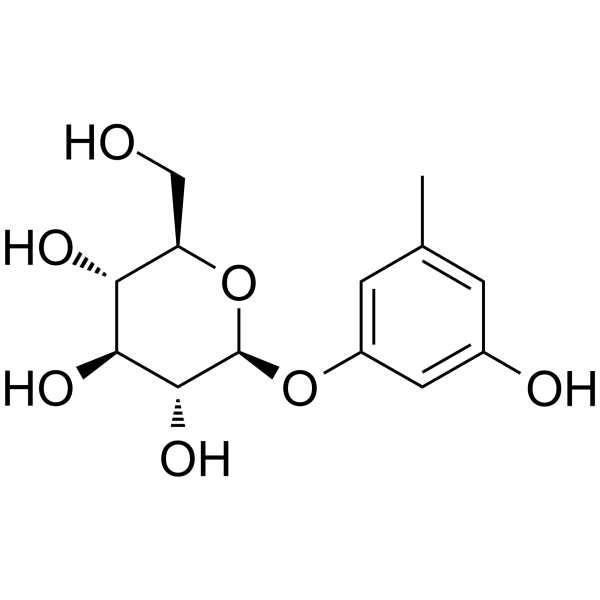
Cat. No.: HY-N0008
CAS No.: 21082-33-7
Orcinol glucoside is an orally active, blood-brain barrier permeable osteoblast proliferation promoter that targets the Nrf2/Keap1, mTOR and p38 signaling pathways. Orcinol glucoside promotes Nrf2 nuclear translocation, upregulates antioxidant enzyme levels, enhances the phosphorylation of mTOR and p70S6K, and inhibits the enzymatic activity of HAS2 as well as the nuclear translocation of GR. Orcinol glucoside also alleviates oxidative stress, inhibits autophagic flux, osteoclastogenesis and TGF-β1-induced M2 polarization, while reducing collagen deposition and effectively promoting the proliferation, differentiation and mineralization of osteoblasts. Orcinol glucoside also exhibits anti-pulmonary fibrosis, anxiolytic and antidepressant activities. Orcinol glucoside can be used in the research of senile and glucocorticoid-induced osteoporosis, idiopathic pulmonary fibrosis (IPF), anxiety and other related diseases .
loading...
    loading...
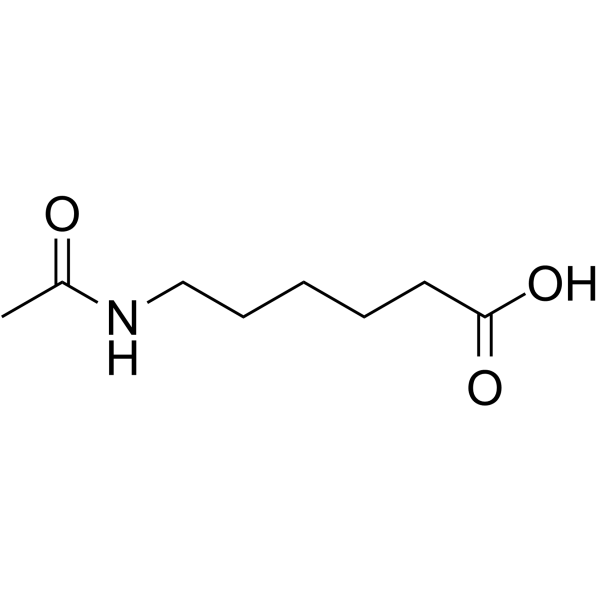
Cat. No.: HY-B1259
CAS No.: 57-08-9
Synonyms: Acexamic acid; 6-Acetamidocaproic acid
6-Acetamidohexanoic acid (Acexamic acid; 6-Acetamidocaproic acid) is a metabolite of Hexamethylene bisacetamide (HMBA) (HY-124284) with anti-pulmonary fibrosis activity. 6-Acetamidohexanoic acid does not induce differentiation of human promyelocytic leukemia cells, but is taken up by such cells. 6-Acetamidohexanoic acid serves as a carboxylic acid substrate component for constructing carboxylesterase-responsive near-infrared phototheranostic probes. 6-Acetamidohexanoic acid is applicable to research related to pulmonary fibrosis, refractory hypoxemia and cervical cancer .
loading...
    loading...
Cat. No.: HY-L125
2,810 compounds

Pulmonary fibrosis (PF), also known as diffuse interstitial pulmonary fibrosis, is a very common end-stage manifestation of several diseases, including idiopathic pulmonary fibrosis (IPF), pulmonary hypertension, and scleroderma, characterised by excessive matrix deposition and destruction of the lung architecture, finally leading to respiratory insufficiency. PF has become a global disease with significantly increased incidence rate, and the most common form of pulmonary fibrosis is idiopathic pulmonary fibrosis (IPF).

Lung fibrosis is a complex disease, a multitude of signal factors and signaling pathways is disrupted in this complex disease, such as TGF-β, Wnt, VEGF and PI3K–Akt. MCE offers a unique collection of 2,810 compounds with identified and potential anti-pulmonary fibrosis activity. MCE Anti-Pulmonary Fibrosis Compound Library is a useful tool for anti-pulmonary fibrosis drugs screening and other related research.

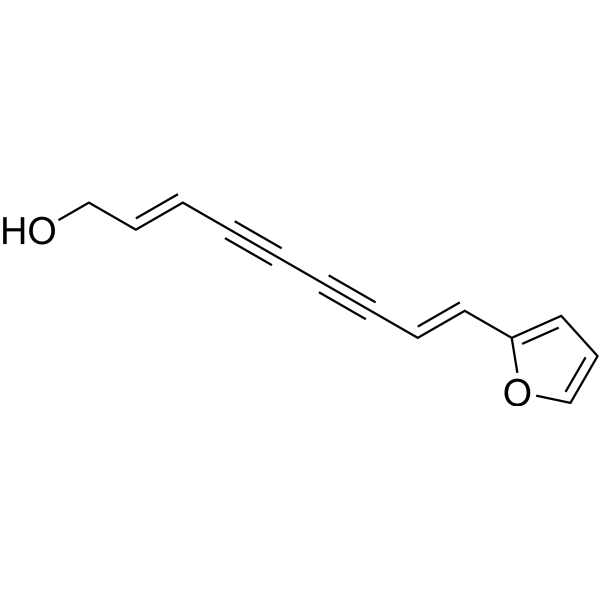
Cat. No.: HY-N2092
CAS No.: 61642-89-5
Atractylodinol, an antimicrobial, is a PRRSV (porcine reproductive and respiratory syndrome virus) inhibitor. Atractylodinol inhibits TGF-β receptor I recycling by binding to vimentin (KD of 454 nM) and inducing the formation of filamentous aggregates .
loading...
    loading...
Cat. No.: HY-179042
CAS No.: 3100351-69-4
TGF-β/Smad-IN-3 (Compound 4w) is an effective TGF-β/Smad inhibitor. TGF-β/Smad-IN-3 exerts anti-pulmonary fibrosis activity by simultaneously inhibiting the TGF-β/Smad and MAPK signaling pathways. TGF-β/Smad-IN-3 significantly inhibits collagen deposition induced by TGF-β1, with its IC50 value being 3.21 μM. TGF-β/Smad-IN-3 has an IC₅₀ of 46.77 nM for the autocrine motility factor (ATX). TGF-β/Smad-IN-3 significantly reduces the expression levels of α-SMA, COL1A1 and FN in TGF-β1-induced CCC-HPF-1 cells, and effectively inhibited TGF-β1-induced cell migration. TGF-β/Smad-IN-3 can be used for the study of pulmonary fibrosis .
loading...
    loading...
Cat. No.: HY-170420
CAS No.: 3047794-08-8
Target:  

JNK

Research Areas:  

Others

JNK-1-IN-5 (Compound 14) is a potent JNK1 inhibitor with sub-nanomolar efficacy. JNK-1-IN-5 suppresses TGF-β-induced epithelial-mesenchymal transition. JNK-1-IN-5 is promising for research of anti-pulmonary fibrosis agent targeting JNK1 .
loading...
    loading...
Cat. No.: HY-N17650
CAS No.: 3038746-92-5
Salviamarinic acid A is a water-soluble phenolic acid that can be extracted from Salvia miltiorrhiza with potent anti-pulmonary fibrosis activity. Salviamarinic acid A significantly increases cell viability, cell index, cell motility and E-cadherin expression, and reduces TGF-β1, α-SMA and Collagen I levels. Salviamarinic acid A can be used for pulmonary fibrosis research .
loading...
    loading...
Cat. No.: HY-N17890
Bletimalate D is a 2-isobutylmalate found in the tubers of Bletilla striata. Bletimalate D shows no significant anti-pulmonary fibrosis activity and has cytotoxicity .
loading...
    loading...
Cat. No.: HY-N20728
CAS No.: 2221029-53-2
25-Methoxyalisol F is a regulator of NOX4 and phosphorylated Nrf2 with anti-pulmonary fibrosis activity. 25-Methoxyalisol F modulates the NOX4-Nrf2 signaling pathway, regulates the expression of NOX4 and p-Nrf2, and ameliorates TGF-β1-induced cellular damage. 25-Methoxyalisol F can be used in studies related to pulmonary fibrosis .
loading...
    loading...
Cat. No.: HY-B1259R
CAS No.: 57-08-9
Synonyms: Acexamic acid (Standard); 6-Acetamidocaproic acid (Standard)
6-Acetamidohexanoic acid (Acexamic acid; 6-Acetamidocaproic acid) (Standard) is the analytical standard of 6-Acetamidohexanoic acid. This product is intended for research and analytical applications. 6-Acetamidohexanoic acid (Acexamic acid; 6-Acetamidocaproic acid) is a metabolite of Hexamethylene bisacetamide (HMBA) (HY-124284) with anti-pulmonary fibrosis activity. 6-Acetamidohexanoic acid does not induce differentiation of human promyelocytic leukemia cells, but is taken up by such cells. 6-Acetamidohexanoic acid serves as a carboxylic acid substrate component for constructing carboxylesterase-responsive near-infrared phototheranostic probes. 6-Acetamidohexanoic acid is applicable to research related to pulmonary fibrosis, refractory hypoxemia and cervical cancer.
loading...
    loading...
  • 1

