1. Search Result
Search Result
Results for "

Artemia salina

" in MedChemExpress (MCE) Product Catalog:

14

Inhibitors & Agonists

1

Peptides

10

Natural
Products

Cat. No. 상품명 Target 연구분야 Chemical Structure
  • HY-137680

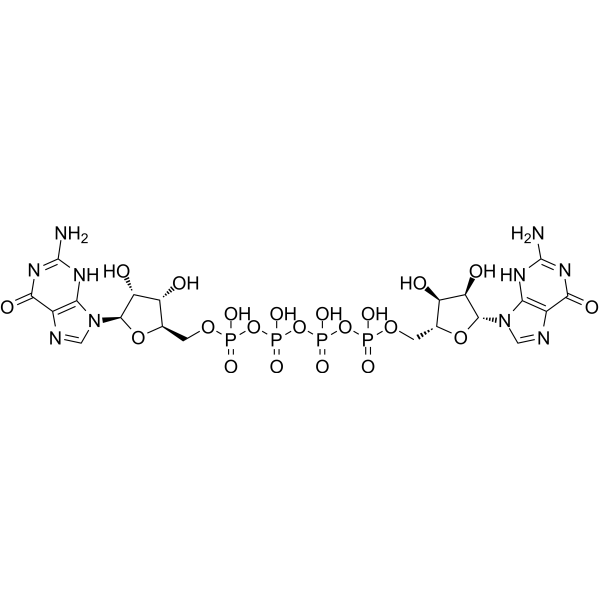
    Diguanosine tetraphosphate

    Endogenous Metabolite Others
    GP4G (Diguanosine tetraphosphate) is a symmetrical bis-diphospho nucleoside that can be isolated from the cysts of Artemia salina. GP4G is an epithelial cell and hair growth regulator .
    GP4G
  • HY-111926

    Biochemical Assay Reagents Others
    N6-Methyladenosine 5'-monophosphate disodium salt is an N6-methyladenosine derivative and also the phosphorylated form of N 6-methyladenosine. N6-Methyladenosine 5'-monophosphate disodium salt serves as an elution reagent for m6A-modified RNA in MeRIP assays .
    N6-Methyladenosine 5'-monophosphate disodium salt
  • HY-119979

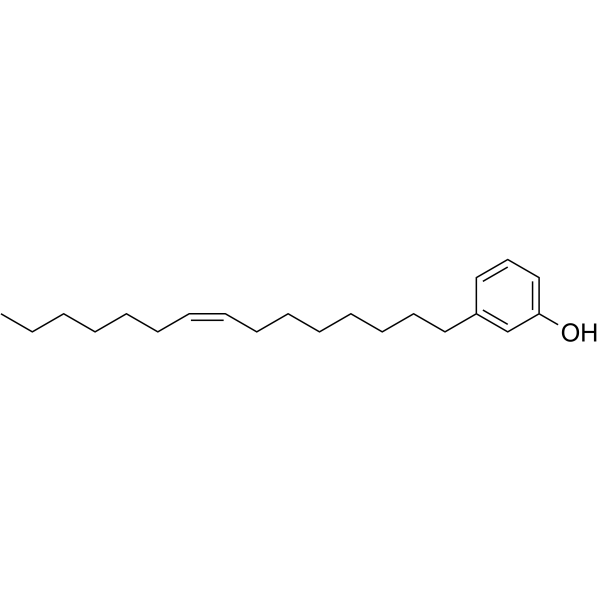
    Cardanol C15:1

    Apoptosis Reactive Oxygen Species (ROS) Mitochondrial Metabolism MMP CDK Caspase Bcl-2 Family PARP MDM-2/p53 Cholinesterase (ChE) Infection Inflammation/Immunology Cancer
    Cardanol monoene (Cardanol C15:1) is a phenolic compound which can be found in cashew nut shell liquid. Cardanol monoene can inhibit cancer cells proliferation, migration, cause S phase arrest, induce apoptosis, ROS production and mitochondrial depolarization. Cardanol monoene downregulates MMP-2, MMP-9, cyclinA1 expression, regulates CDK2, p53, Bax, cytochrome c, cleaved caspase-3, cleaved PARP, Apaf-1 expression and Bax/Bcl-2 ratio. Cardanol monoene shows weak DPPH radical scavenging activity and AChE inhibition activity. Cardanol monoene is lethal to Artemia salina nauplii. Cardanol monoene. Cardanol monoene can be used for the research of cancer, infection and inflamation .
    Cardanol monoene
  • HY-N6600

    Environmental Pollutants Biochemical Assay Reagents Others
    Octadecane is an alkane used as a phase change material for storing thermal energy at ambient temperature. Octadecane can endow pesticide formulations with environmental responsiveness in the field of agricultural nanomaterials, enabling precise and safe pesticide application .
    Octadecane
  • HY-N3968

    GTN; (R)-(+)-Goniothalamin

    Apoptosis Insecticide Bacterial Fungal Reactive Oxygen Species (ROS) Infection Inflammation/Immunology Cancer
    Goniothalamin (GTN) is a styryl lactone. Goniothalamin exhibits insecticidal, anti-tumor and antibacterial activities. Goniothalamin induces cell cycle arrest and apoptosis in tumor cells. Goniothalamin acts as a larvicide against Culex quinquefasciatus larvae and as a cytotoxin against brine shrimp larvae. Goniothalamin functions as an antibacterial agent against Gram-positive and Gram-negative bacteria, and also acts as an antifungal agent against pathogens including Candida albicans, Trichophyton rubrum and Trichophyton mentagrophytes. Goniothalamin is applicable to research related to breast cancer, lymphatic filariasis, bacterial infections and fungal infections .
    Goniothalamin
  • HY-N16403

    Cytochrome P450 Endogenous Metabolite Bacterial Insecticide Fungal Infection Cancer
    Aspergillusidone F is a Depsidone and antibacterial agent. Aspergillusidone F can be isolated from a marine fungus Aspergillus unguis. Aspergillusidone F potently inhibits Aromatase with an IC50 of 0.5 μM. Aspergillusidone F exhibits antibacterial activity against Pseudomonas aeruginosa and Methicillin (HY-121544)-resistant Staphylococcus aureus. Aspergillusidone F exhibits potent larvicidal activity against Artemia salina larvae, with an LC50 value of 12.8 μM. Aspergillusidone F exhibits anticancer activity against intrahepatic cholangiocarcinoma, non-small cell lung cancer, and acute lymphoblastic leukemia .
    Aspergillusidone F
  • HY-P11334

    Aminopeptidase Phosphatase Angiotensin-converting Enzyme (ACE) DNA/RNA Synthesis Cancer
    Cyanostatin B, a cyanobacterial lipopeptide, is a leucine aminopeptidase M (LAP) inhibitor (IC50 = 12 ng/mL). Cyanostatin B is a weak inhibitor of protein phosphatase (PP2A) and also exhibits weak inhibitory activity against angiotensin-converting enzyme (ACE), with an IC50 value of 130 μg/mL. Cyanostatin B demonstrates both cytotoxic and genotoxic effects on human hepatocytes, although non-toxic to Artemia salina. Cyanostatin B inhibits the proliferation of HepG2 cells, induces DNA single-strand breaks, and causes genomic instability. .
    Cyanostatin B
  • HY-N16394

    Endogenous Metabolite Cancer
    4-Hydroxyscytalone (Compound 3) is a microbial secondary metabolite. 4-Hydroxyscytalone can be isolated from the oak fungus Diplodia corticola. 4-Hydroxyscytalone has toxicity against Artemia salina with a LC50 of 90.6 μ/mL, but no significant antifungal activity. 4-Hydroxyscytalone can be used for cancer therapy research .
    4-Hydroxyscytalone
  • HY-N10273

    Fungal Infection
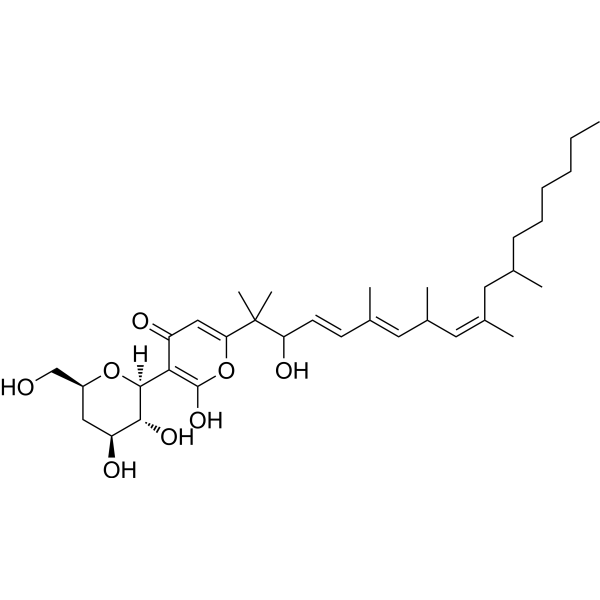
    Deoxyfusapyrone is an antifungal alpha-pyrone from Fusarium semitectum. Deoxyfusapyrone shows a strong antibiotic activity towards Geotrichum candidum in disk diffusion assays, but is not toxic to Artemia salina larvae .
    Deoxyfusapyrone
  • HY-N14276

    Antibiotic Bacterial Infection Cancer
    Miyakamide B1 is an antibiotic with insecticidal effect. Miyakamide B1 inhibits the growth of Artemia salina. Miyakamide B1 has a weak antixanthomonas activity. Miyakamide B1 inhibits P388 cells with an IC50 of 8.8 μg/mL .
    Miyakamide B1
  • HY-N14274

    Antibiotic Bacterial Infection Cancer
    Miyakamide A1 is an antibiotic with insecticidal effect. Miyakamide A1 inhibits the growth of Artemia salina. Miyakamide A1 has a weak antixanthomonas activity. Miyakamide A1 inhibits P388 cells with an IC50 of 10.5 μg/mL .
    Miyakamide A1
  • HY-N14277

    Antibiotic Bacterial Infection Cancer
    Miyakamide B2 is an antibiotic with insecticidal effect. Miyakamide B2 inhibits the growth of Artemia salina. Miyakamide B2 has a weak antixanthomonas activity. Miyakamide B2 inhibits P388 cells with an IC50 of 7.6 μg/mL .
    Miyakamide B2
  • HY-N14275

    Antibiotic Bacterial Infection Cancer
    Miyakamide A2 is an antibiotic with insecticidal effect. Miyakamide A2 inhibits the growth of Artemia salina. Miyakamide A2 has a weak antixanthomonas activity. Miyakamide A2 inhibits P388 cells with an IC50 of 12.2 μg/mL .
    Miyakamide A2
  • HY-183367

    TNF Receptor Interleukin Related Inflammation/Immunology
    Anti-inflammatory agent 115 is a potent anti-inflammatory agent. Anti-inflammatory agent 115 reduces secretion of myeloperoxidase (MPO), TNF-α, IL-1β, and IL-6. Anti-inflammatory agent 115 decreases ear tissue thickness and neutrophil infiltration in 12-O-tetradecanoylphorbol-13-acetate (TPA) (HY-18739)-induced topical edema in mice. Anti-inflammatory agent 115 can be used for the research of inflammatory diseases .
    Anti-inflammatory agent 115

온라인 문의

Your information is safe with us. * Required Fields.

호칭


Country or Region *

고객명 *


회사명 *

Department *


메일주소 *


상품명 *

Cat. No.


Requested quantity *

전화번호 *


비고

온라인 문의

Inquiry Information

상품명:
Cat. No.:
수량:
MCE Japan Authorized Agent:

