
20 Results for "

CPT2

" in MedChemExpress (MCE) Product Catalog:
Products (20)

20 Results for "CPT2" in MCE Product Catalog:

7
7 Publications Verification
Cat. No.: HY-B1334A
CAS No.: 6724-53-4
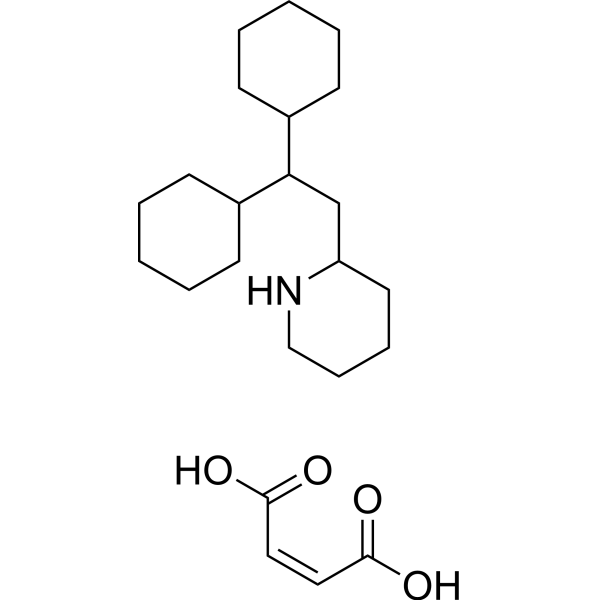
Perhexiline maleate is an orally active CPT1 and CPT2 inhibitor that reduces fatty acid metabolism. Perhexiline maleate induces mitochondrial dysfunction and apoptosis in hepatic cells. Perhexiline maleate can cross the blood brain barrier (BBB) and shows anti-tumor activity. Perhexiline maleate can be used in the research of cancers, and cardiovascular disease like angina [2] .
loading...
    loading...
7
7 Publications Verification
Cat. No.: HY-B1334
CAS No.: 6621-47-2
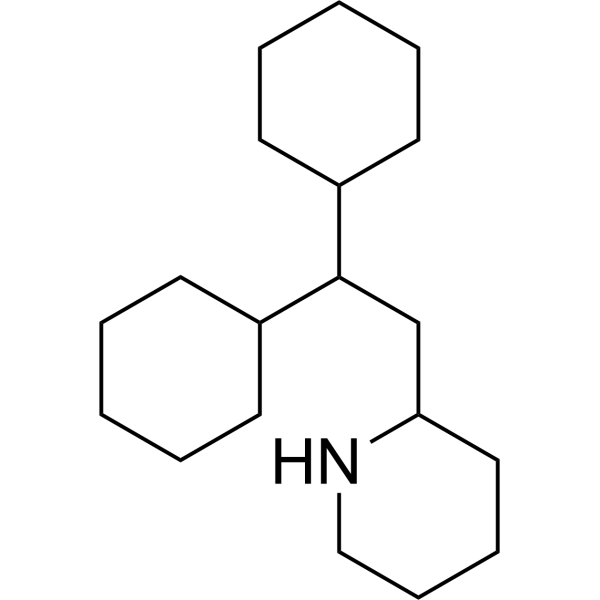
Perhexiline is an orally active CPT1 and CPT2 inhibitor that reduces fatty acid metabolism. Perhexiline induces mitochondrial dysfunction and apoptosis in hepatic cells. Perhexiline can cross the blood brain barrier (BBB) and shows anti-tumor activity. Perhexiline can be used in the research of cancers, and cardiovascular disease like angina [2] .
loading...
    loading...
1
1 Cited Publications
Cat. No.: HY-107543
CAS No.: 634207-53-7
Purity:  99.81%
Synonyms: 8-CPT-2'-O-Me-cAMP sodium
Target:  

Ras

Research Areas:  

Cardiovascular Disease

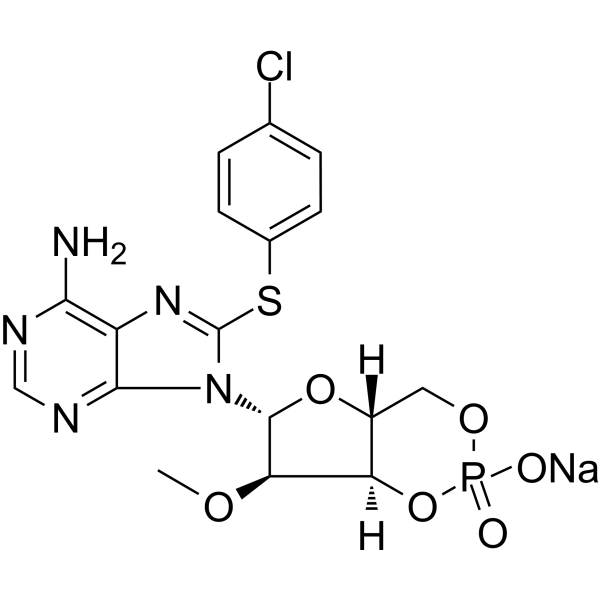
8-pCPT-2′-O-Me-cAMP (8-CPT-2'-O-Me-cAMP) sodium, an analog of cAMP, is an activator of exchange proteins activated by cAMP (Epac). 8-pCPT-2′-O-Me-cAMP sodium activates Epac1 (EC50 = 2.2 μM), but not PKA (EC50 >10 μM). 8-pCPT-2′-O-Me-cAMP sodium stimulates Epac-mediated Ca 2+ release in pancreatic β-cells in vitro. 8-pCPT-2′-O-Me-cAMP sodium is a Rap1 activator. 8-pCPT-2′-O-Me-cAMP sodium enhances the retinal pigment epithelium barrier against the pathological choroidal endothelial cell invasion that occurs in macular degeneration [2] .
loading...
    loading...
Cat. No.: HY-113261
CAS No.: 38677-66-6
Purity:  99.91%
Oleoylcarnitine, the metabolite which accumulates through suppression of fatty acid β-oxidation, can enhance hepatocarcinogenesis via STAT3 activation .
loading...
    loading...
Cat. No.: HY-108433
CAS No.: 1670277-66-3
Synonyms: Carnitine palmitoyltransferase 2
Target:  

Apoptosis MDM-2/p53

Research Areas:  

Metabolic Disease Cancer

CPT2 (Carnitine palmitoyltransferase 2), an enzyme that participates in fatty acid oxidation, also is a colorectal cancer (CRC) prognostic biomarker. CPT2 overexpression can activate p-p53 to increase p53 expression, thereby inhibiting tumor proliferation and promoting apoptosis. CPT2 deficiency results in the most common inherited disorder of long-chain fatty acid oxidation affecting skeletal muscle. Downregulation of CPT2 is also highly correlated with the progression of various cancers and has potential for cancer research [2].
loading...
    loading...
Cat. No.: HY-RS23907
Cpt2 Rat Pre-designed siRNA Set A contains three designed siRNAs for Cpt2 gene (Rat), as well as a negative control, a positive control, and a FAM-labeled negative control.
loading...
    loading...
Cat. No.: HY-175272
Research Areas:  

Cancer

DBCO-PEG8-VKG-CPT2 is a drug-linker conjugate for ADC. DBCO-PEG8-VKG-CPT2 consists of a topoisomerase 1 inhibitor (7-MAD-MDCPT) (HY-132162) and a stable and cleavable linker (DBCO-PEG8-VKG) (HY-175426). DBCO-PEG8-VKG-CPT2 can be used for synthesis of ADCs .
loading...
    loading...
Cat. No.: HY-175673
CAS No.: 2211175-99-2
LCB-2151 (Compound 2), a nucleoside analogue, is an anticancer agent. LCB-2151 disrupts the two primary sources of ATP production (glycolysis and mitochondrial oxidative phosphorylation), reducing the bioenergetic capacity of KRAS-mutated pancreatic cancer cells and inducing ROS formation. LCB-2151 effectively inhibits key enzymes (such as CACT and CPT2) in glycolysis, the TCA cycle and fatty acid β-oxidation. LCB-2151 has significant cytotoxicity and induces cells apoptosis. LCB-2151 can be used for radiation therapy of cancers research .
loading...
    loading...
Cat. No.: HY-RS03125

CPT2 Human Pre-designed siRNA Set A contains three designed siRNAs for CPT2 gene (Human), as well as a negative control, a positive control, and a FAM-labeled negative control.

loading...
    loading...
Cat. No.: HY-RS17451

Cpt2 Mouse Pre-designed siRNA Set A contains three designed siRNAs for Cpt2 gene (Mouse), as well as a negative control, a positive control, and a FAM-labeled negative control.

loading...
    loading...
Cat. No.: HY-116312
CAS No.: 510774-50-2
Synonyms: 8-CPT-2'-O-Me-cAMP
Target:  

Ras

Research Areas:  

Cardiovascular Disease

8-pCPT-2′-O-Me-cAMP (8-CPT-2'-O-Me-cAMP), an analog of cAMP, is an activator of exchange proteins activated by cAMP (Epac). 8-pCPT-2′-O-Me-cAMP activates Epac1 (EC50 = 2.2 μM), but not PKA (EC50 >10 μM). 8-pCPT-2′-O-Me-cAMP stimulates Epac-mediated Ca 2+ release in pancreatic β-cells in vitro. 8-pCPT-2′-O-Me-cAMP is a Rap1 activator. 8-pCPT-2′-O-Me-cAMP enhances the retinal pigment epithelium barrier against the pathological choroidal endothelial cell invasion that occurs in macular degeneration [2] .
loading...
    loading...
Cat. No.: HY-P704989
Purity:  ≥ 90%, as determined by reducing SDS-PAGE.
Synonyms: Carnitine O-palmitoyltransferase 2, mitochondrial; CPT2; Carnitine palmitoyltransferase II (CPT II); CPT1
Species:  
Source:  
loading...
    loading...
Cat. No.: HY-B1334AR
CAS No.: 6724-53-4
Perhexiline (maleate) (Standard) is the analytical standard of Perhexiline (maleate). This product is intended for research and analytical applications. Perhexiline maleate is an orally active CPT1 and CPT2 inhibitor that reduces fatty acid metabolism. Perhexiline maleate induces mitochondrial dysfunction and apoptosis in hepatic cells. Perhexiline maleate can cross the blood brain barrier (BBB) and shows anti-tumor activity. Perhexiline maleate can be used in the research of cancers, and cardiovascular disease like angina [2] .
loading...
    loading...
Cat. No.: HY-P82970
Synonyms: CPT1; CPT2; IIAE4; CPTASE

Host:  

Rabbit

Application:  

WB, IHC-P, ICC/IF

Reactivity:  

Human, Mouse, Rat

loading...
    loading...
Cat. No.: HY-P82970A
Synonyms: CPT1; CPT2; IIAE4; CPTASE

Host:  

Rabbit

Application:  

WB, IHC-P, ICC/IF

Reactivity:  

Human, Mouse, Rat

loading...
    loading...
Cat. No.: HY-P84201
Synonyms: CPT1; IIAE4; CPTASE

Host:  

Mouse

Application:  

WB, FC, ELISA

Reactivity:  

Human, Mouse, Rat

loading...
    loading...
Cat. No.: HY-P84201A
Synonyms: CPT1; IIAE4; CPTASE

Host:  

Mouse

Application:  

WB, FC, ELISA

Reactivity:  

Human, Mouse, Rat

loading...
    loading...
Cat. No.: HY-184891
CAS No.: 3028770-95-5
W1307 is a selective STAT3 inhibitor with a KD value of 1.74 μM. W1307 inhibits STAT3 Tyr705 phosphorylation, disrupts STAT3 dimerization, and suppresses STAT3 transcriptional activity. W1307 downregulates the expression of STAT3 downstream targets c-Myc, Mcl-1 and Bcl-2. W1307 transcriptionally inhibits SREBP1 and CPT2 expression to disrupt lipid homeostasis. W1307 shows potent anti-leukemic activity and synergizes with Cytarabine (Ara-C) (HY-13605) to overcome chemoresistance in acute myeloid leukemia (AML) .
loading...
    loading...
Cat. No.: HY-113261R
CAS No.: 38677-66-6
Oleoylcarnitine (Standard) is the analytical standard of Oleoylcarnitine. This product is intended for research and analytical applications. Oleoylcarnitine, the metabolite which accumulates through suppression of fatty acid β-oxidation, can enhance hepatocarcinogenesis via STAT3 activation .
loading...
    loading...
Cat. No.: HY-107543R
CAS No.: 634207-53-7
Synonyms: 8-CPT-2'-O-Me-cAMP sodium (Standard)
Target:  

Reference Standards Ras

Research Areas:  

Cardiovascular Disease

8-pCPT-2′-O-Me-cAMP sodium (Standard) is the analytical standard of 8-pCPT-2′-O-Me-cAMP (sodium) (HY-107543). This product is intended for research and analytical applications. 8-pCPT-2′-O-Me-cAMP (8-CPT-2'-O-Me-cAMP) sodium, an analog of cAMP, is an activator of exchange proteins activated by cAMP (Epac). 8-pCPT-2′-O-Me-cAMP sodium activates Epac1 (EC50 = 2.2 μM), but not PKA (EC50 >10 μM). 8-pCPT-2′-O-Me-cAMP sodium stimulates Epac-mediated Ca2+ release in pancreatic β-cells in vitro. 8-pCPT-2′-O-Me-cAMP sodium is a Rap1 activator. 8-pCPT-2′-O-Me-cAMP sodium enhances the retinal pigment epithelium barrier against the pathological choroidal endothelial cell invasion that occurs in macular degeneration [2] .
loading...
    loading...
  • 1

