
7 Results for "

DA 3003-2

" in MedChemExpress (MCE) Product Catalog:
Products (7)

7 Results for "DA 3003-2" in MCE Product Catalog:

  • Targets Recommended:
Cat. No.: HY-118798
CAS No.: 383907-47-9
Purity:  99.66%
Synonyms: NSC663285
Target:  

Phosphatase

Research Areas:  

Cancer

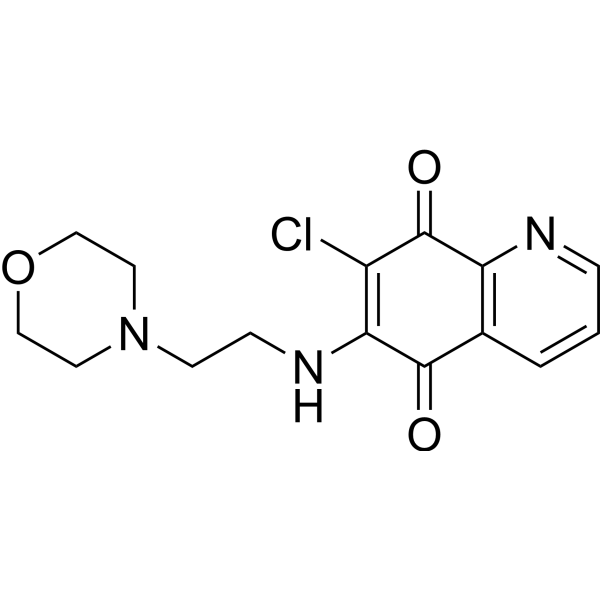
DA 3003-2 is a potent and selectively Cdc25 inhibitor. DA 3003-2 shows antiproliferative activity. DA 3003-2 induces cell cycle arrest at the G2/M phase and increases the expression of P-tyr 15 Cdc2. DA 3003-2 has the potential for the research of prostate cancer .
loading...
    loading...
Cat. No.: HY-DY3003
Tissue and Cell Fixative (4% Paraformaldehyde, PFA) is mainly composed of paraformaldehyde, phosphate, and deionized water, with a pH of 7.0-7.4. Tissue and Cell Fixative (4% Paraformaldehyde, PFA) is suitable for fixing most tissues and cells, and can effectively protect the morphology and structure of tissues and cells as well as nucleic acids.
loading...
    loading...
Cat. No.: HY-P3003
CAS No.: 157232-64-9
Cereulide is an orally active, blood-brain barrier-permeable emetic toxin. Cereulide acts as a potassium ionophore that inserts into membranes, forms complexes with K +, and transports K + from the cytoplasm into the mitochondrial matrix. Cereulide disrupts the electrochemical gradient of the inner mitochondrial membrane, leading to mitochondrial swelling and dysfunction, uncoupling of oxidative phosphorylation, inhibition of ATP synthesis, ROS accumulation, and ultimately triggering apoptosis and autophagy. Cereulide exhibits multi-organ toxicity and can be used for research on emetic food poisoning .
loading...
    loading...
Cat. No.: HY-P3003S
CAS No.: 1487375-69-8
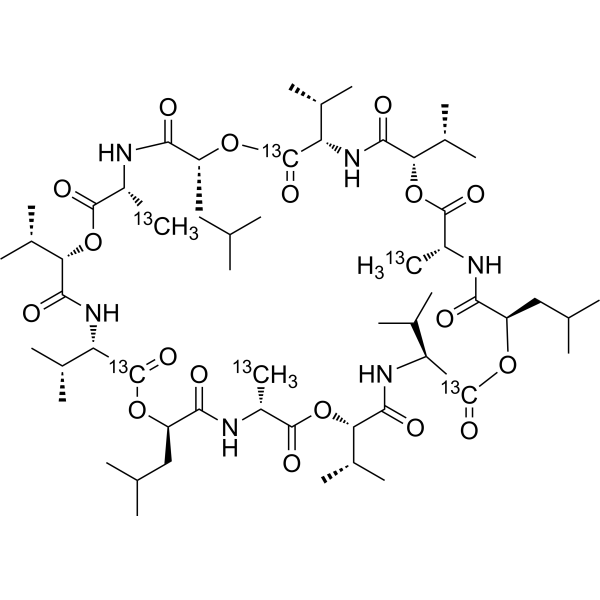
Cereulide- 13C6 is a deuterated form of Cereulide. Cereulide is an orally active, blood-brain barrier-permeable emetic toxin. Cereulide acts as a potassium ionophore that inserts into membranes, forms complexes with K +, and transports K + from the cytoplasm into the mitochondrial matrix. Cereulide disrupts the electrochemical gradient of the inner mitochondrial membrane, leading to mitochondrial swelling and dysfunction, uncoupling of oxidative phosphorylation, inhibition of ATP synthesis, ROS accumulation, and ultimately triggering apoptosis and autophagy. Cereulide exhibits multi-organ toxicity and can be used for research on emetic food poisoning.
loading...
    loading...
Cat. No.: HY-D3003
CAS No.: 2522921-17-9
M-H2S is an endoplasmic reticulum-targeted ratio-type near-infrared fluorescent probe (Ex/Em : 480 nm/560 nm) specifically designed for the detection of hydrogen sulfide (H2S) in living cells and zebrafish. M-H2S exhibits detection limit for H2S of 39.1 nM, and the fluorescence intensity ratio (F₆₅₀/F₅₆₀) within the range of 0-40 μM shows a linear relationship with the H2S concentration. M-H2S responds best under pH = 7.2 (the normal physiological pH of the endoplasmic reticulum) conditions, making it suitable for the detection of the microenvironment of the endoplasmic reticulum. M-H2S can be used to study the role of H2S in endoplasmic reticulum function, stress response, and related diseases .
loading...
    loading...
Cat. No.: HY-N3003
CAS No.: 5940-00-1
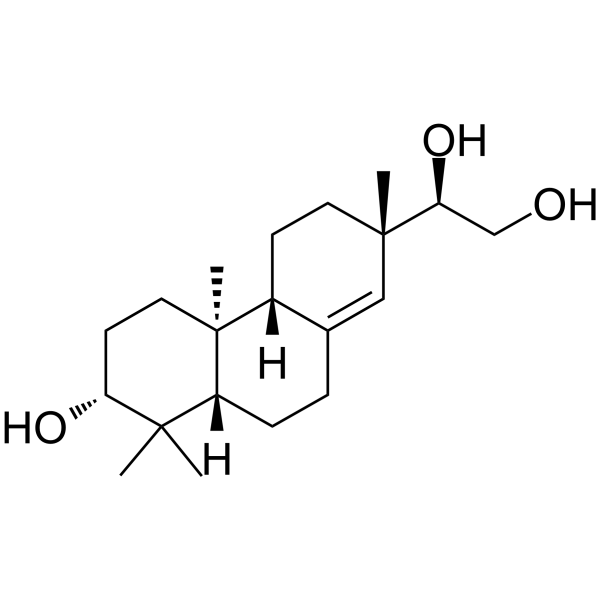
Darutigenol is an ent-pimarane-type diterpenoid isolated from Siegesbecikia orientalis L. .
loading...
    loading...
Cat. No.: HY-K3003

DMEM (Dulbecco's Modified Eagle Medium) is a widely used basal medium for supporting the growth of many different mammalian cells. Cell lines successfully cultured in DMEM include Hela, 293, Cos-7, and PC-12, as well as primary fibroblasts, neurons, glial cells, HUVECs, and smooth muscle cells, etc. The 500 mL is defined as the base specification. All larger sizes correspond to incremental volumes of this base.

loading...
    loading...

