



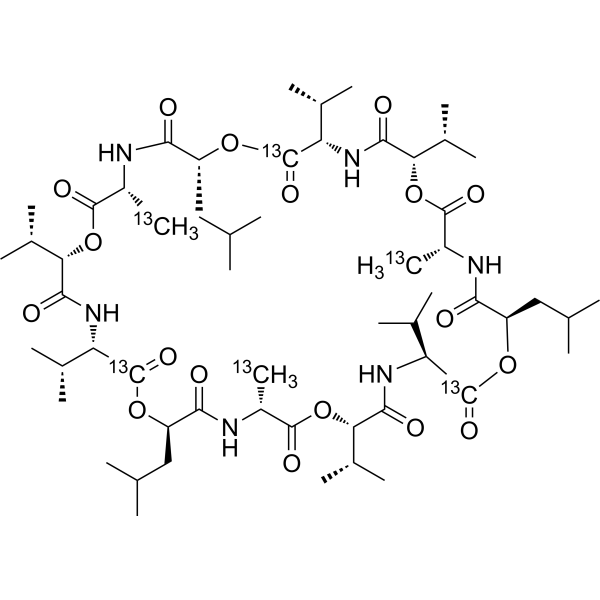
Cereulide-13C6

Based on 1 Customer Validation
Cereulide-13C6 is a deuterated form of Cereulide. Cereulide is an orally active, blood-brain barrier-permeable emetic toxin. Cereulide acts as a potassium ionophore that inserts into membranes, forms complexes with K+, and transports K+ from the cytoplasm into the mitochondrial matrix. Cereulide disrupts the electrochemical gradient of the inner mitochondrial membrane, leading to mitochondrial swelling and dysfunction, uncoupling of oxidative phosphorylation, inhibition of ATP synthesis, ROS accumulation, and ultimately triggering apoptosis and autophagy. Cereulide exhibits multi-organ toxicity and can be used for research on emetic food poisoning.
The product specifications provided below refer solely to the active content of Cereulide-13C6.
For research use only. We do not sell to patients.
- Purity : 97%
- CAS No.: 1487375-69-8
- Formula: C5113C6H96N6O18
- Molecular Weight:1159.36
-
Storage:
Solution, -20°C, 2 years

To place orders, for customer services and technical support, please contact: MedChemExpress USA
Tel: 609-228-6898 E-mail: [email protected] [email protected]


-
 Biological Activity
-
Chemical Information
- Protocols
- Purity & Documentation
- References
-
 Help & FAQs




Biological Activity
Description
The product specifications provided below refer solely to the active content of Cereulide-13C6.
In Vitro
Stable heavy isotopes of hydrogen, carbon, and other elements have been incorporated into drug molecules, largely as tracers for quantitation during the drug development process. Deuteration has gained attention because of its potential to affect the pharmacokinetic and metabolic profiles of drugs.
MedChemExpress (MCE) has not independently confirmed the accuracy of these methods. They are for reference only.
- Kinase activity and phosphorylation assays
- Western Blot
- Detection of Apoptosis
- TUNEL staining for apoptotic DNA fragmentation
- Annexin V plus membrane-impermeant dye apoptosis staining
- ROS/oxidative-stress fluorescent staining
- Autophagy
- Apoptosis Solutions
- Protocol for Kinase activity and phosphorylation assays
- Lysosome and acidic-vesicle live-cell staining
- Macroautophagy Solutions


Product Details
-
Application
1. This compound can be used as a tracer
2. This compound can be used as an internal standard for quantitative analysis by NMR, GC-MS, or LC-MS.


Chemical Information
-
CAS No. 1487375-69-8
-
Unlabeled CAS 157232-64-9
-
Appearance Liquid
-
Molecular Weight 1159.36
-
Formula C5113C6H96N6O18
-
Color Colorless to light yellow
-
SMILES
CC(C)C[C@H]1O[13C]([C@@H](NC([C@@H](OC([C@H](NC([C@H](O[13C]([C@@H](NC([C@@H](OC([C@H](NC([C@H](O[13C]([C@@H](NC([C@@H](OC([C@H](NC1=O)[13CH3])=O)C(C)C)=O)C(C)C)=O)CC(C)C)=O)[13CH3])=O)C(C)C)=O)C(C)C)=O)CC(C)C)=O)[13CH3])=O)C(C)C)=O)C(C)C)=O
-
Shipping
Room temperature in continental US; may vary elsewhere.
-
Storage
Solution, -20°C, 2 years
Purity & Documentation


References
Hot Topics
-
All
-
Topics
-
Most Recent
-
Oldest
-
Topics Oxidative Phosphorylation: Cancer & Beyond Therapeutic Target
Oxidative phosphorylation (OXPHOS) is the mitochondrial energy-conversion process in which the electron transport chain uses reducing equivalents from NADH and FADH2 to generate a proton gradient that drives ATP synthase.
2026-06-18

Calculators
Concentration (start) × Volume (start) = Concentration (final) × Volume (final)


Cereulide-13C6 Related Classifications
HY-P3003S Related Classifications
 Powered by Bioz