
16 Results for "

EPSP

" in MedChemExpress (MCE) Product Catalog:
Products (16)

16 Results for "EPSP" in MCE Product Catalog:

1
1 Cited Publications
Cat. No.: HY-B0863
CAS No.: 1071-83-6
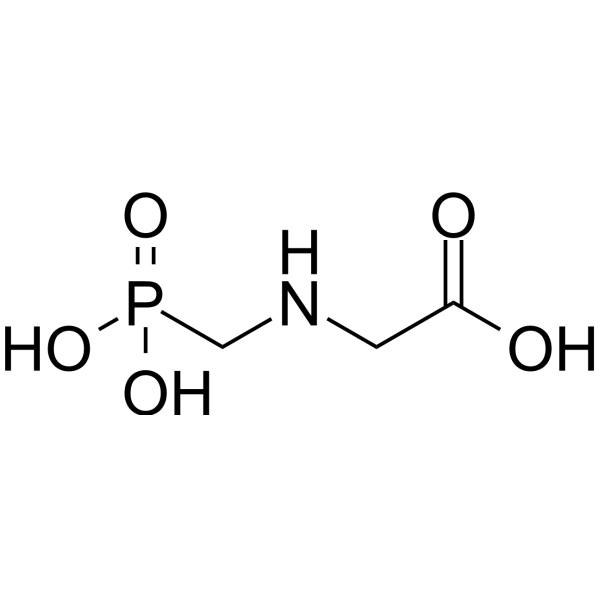
Glyphosate, a non-selective systemic biocide with broad-spectrum activity, is an herbicidal derivative of the amino acid glycine. Glyphosate inhibits the enzymatic activity of the 5-endopyruvylshikimate 3-phosphate synthase (EPSPS) in the shikimic acid pathway, preventing the synthesis of the aromatic amino acids tyrosine, phenylalanine, and tryptophan. Glyphosate induces oxidative stress, neuroinflammation, and mitochondrial dysfunction, processes that lead to neuronal death by autophagia, necrosis, or apoptosis, as well as the appearance of behavioral and motor disorders .
loading...
    loading...
1
1 Cited Publications
Cat. No.: HY-10932
CAS No.: 72432-10-1
Purity:  99.94%
Synonyms: Ro 13-5057
Target:  

nAChR iGluR

Research Areas:  

Neurological Disease

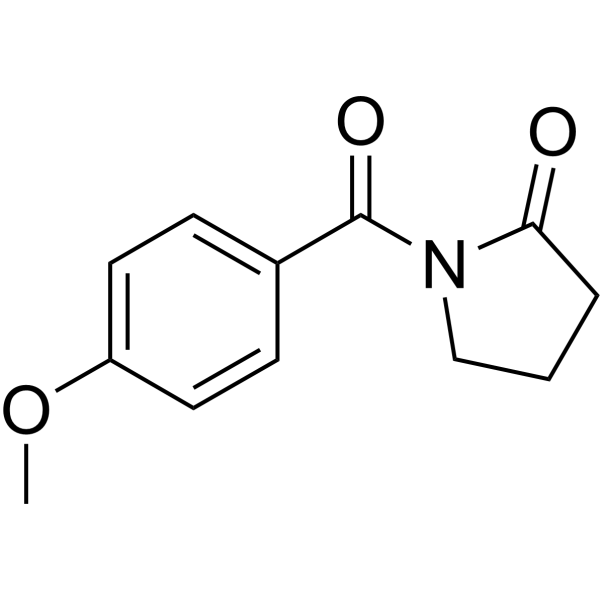
Aniracetam (Ro 13-5057) is an orally active neuroprotective agent, possessing nootropics effects. Aniracetam potentiates the ionotropic quisqualate (iQA) responses in the CA1 region of rat hippocampal slices. Aniracetam also potentiates the excitatory post synaptic potentials (EPSPs) in Schaffer collateral-commissural synapses. Aniracetam can prevents the CO2-induced impairment of acquisition in hypercapnia model rats. Aniracetam can be used to research cerebral dysfunctional disorders .
loading...
    loading...
1
1 Cited Publications
Cat. No.: HY-110094
CAS No.: 134296-40-5
Purity:  99.60%
Target:  

5-HT Receptor

Research Areas:  

Neurological Disease

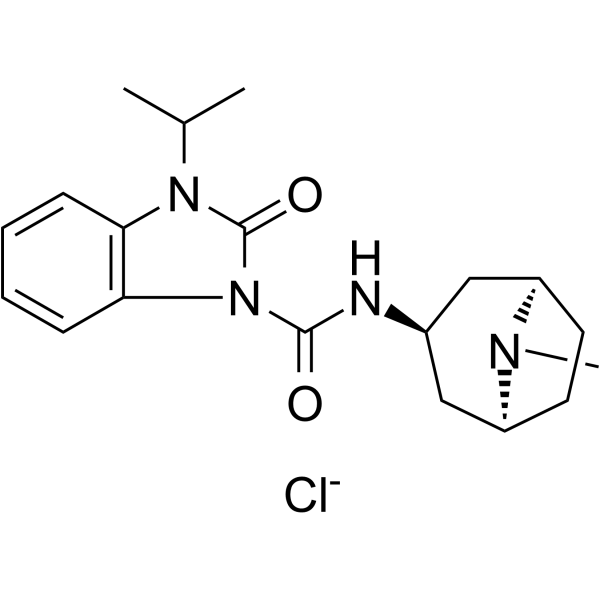
BIMU 8 is a potent and selective 5-HT4 agonist with EC50s of 18 nM, 77 nM, and 540 nM for wild type 5HT4 receptor, T3.36A, and W6.48A mutant 5-HT4 receptors .
loading...
    loading...
Cat. No.: HY-163455
CAS No.: 1334308-63-2
Target:  

HCN Channel

Research Areas:  

Neurological Disease

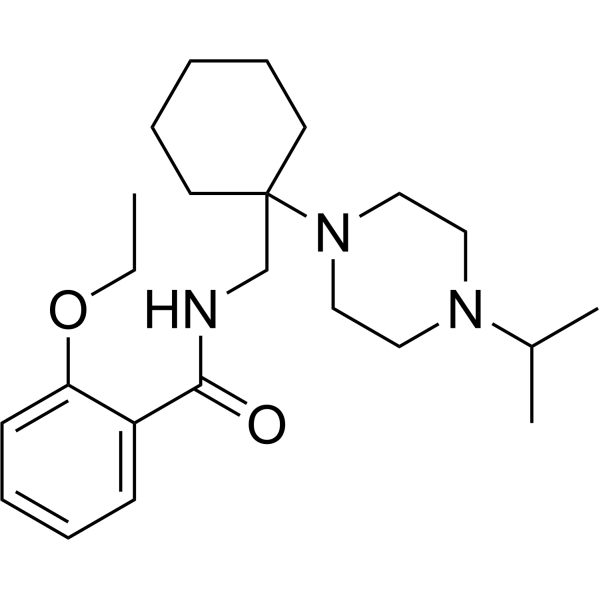
pan-HCN-IN-1 (Compound J&J12e) is an inhibitor for hyperpolarization-activated and cyclic-nucleotide-gated 1 (HCN1) ion channel, with IC50 of 58 nM. pan-HCN-IN-1 reduces the voltage sag response and enhances EPSP summation in ex vivo rats brain slices .
loading...
    loading...
Cat. No.: HY-W747676
CAS No.: 287399-31-9
Glyphosate- 13C is the 13C-labeled Glyphosate (HY-B0863). Glyphosate, a non-selective systemic biocide with broad-spectrum activity, is an herbicidal derivative of the amino acid glycine. Glyphosate inhibits the enzymatic activity of the 5-endopyruvylshikimate 3-phosphate synthase (EPSPS) in the shikimic acid pathway, preventing the synthesis of the aromatic amino acids tyrosine, phenylalanine, and tryptophan. Glyphosate induces oxidative stress, neuroinflammation, and mitochondrial dysfunction, processes that lead to neuronal death by autophagia, necrosis, or apoptosis, as well as the appearance of behavioral and motor disorders .
loading...
    loading...
Cat. No.: HY-B0863B
CAS No.: 38641-94-0
Research Areas:  

Neurological Disease

Glyphosate isopropylammonium, a non-selective systemic biocide with broad-spectrum activity, is an herbicidal derivative of the amino acid glycine. Glyphosate isopropylammonium inhibits the enzymatic activity of the 5-endopyruvylshikimate 3-phosphate synthase (EPSPS) in the shikimic acid pathway, preventing the synthesis of the aromatic amino acids tyrosine, phenylalanine, and tryptophan. Glyphosate isopropylammonium induces oxidative stress, neuroinflammation, and mitochondrial dysfunction, processes that lead to neuronal death by autophagia, necrosis, or apoptosis, as well as the appearance of behavioral and motor disorders .
loading...
    loading...
Cat. No.: HY-129517
CAS No.: 773109-55-0
Target:  

iGluR

Research Areas:  

Neurological Disease

UBP714 exhibts agonistic activity for recombinant GluN1/GluN2 receptor by binding to the positive allosteric site (PAM) of NMDARs. UBP714 enhances NMDAR-mediated field excitatory postsynaptic potentials (f-EPSPs) in Xenopus oocytes .
loading...
    loading...
Cat. No.: HY-10932R
CAS No.: 72432-10-1
Synonyms: Ro 13-5057 (Standard)
Research Areas:  

Neurological Disease

Aniracetam (Standard) is the analytical standard of Aniracetam. This product is intended for research and analytical applications. Aniracetam (Ro 13-5057) is an orally active neuroprotective agent, possessing nootropics effects. Aniracetam potentiates the ionotropic quisqualate (iQA) responses in the CA1 region of rat hippocampal slices. Aniracetam also potentiates the excitatory post synaptic potentials (EPSPs) in Schaffer collateral-commissural synapses. Aniracetam can prevents the CO2-induced impairment of acquisition in hypercapnia model rats. Aniracetam can be used to research cerebral dysfunctional disorders .
loading...
    loading...
Cat. No.: HY-P1426
Target:  

Potassium Channel

Research Areas:  

Neurological Disease

AmmTX3 is a peptide toxin identified from the venom of the scorpion Androctonus mauretanicus. AmmTX3 is a highly specific blocker of Kv4 channels, which selectively and almost completely blocks transient A-type K + currents with a Ki of 131 nM. AmmTX3 induces epileptiform behaviors and causes death in mice receiving intracerebroventricular injection. AmmTX3 increases the excitability of dentate gyrus granule cells, reduces GABAergic inhibition, enhances and stabilizes the EPSP-spike component of long-term potentiation, and impairs reference memory. AmmTX3 can be used in research related to pain, epilepsy, and autism spectrum disorder .
loading...
    loading...
Cat. No.: HY-P1716
CAS No.: 149471-11-4
Target:  

PKC

Research Areas:  

Neurological Disease

Neuropeptide DF2 is a DRNFLRFamide neuropeptide orignally isolated from crayfish. which enhances transmitter release and stimulates the amplitude of excitatory post-synaptic potentials (EPSP) through the calcium/calmodulin-dependent protein kinase .
loading...
    loading...
Cat. No.: HY-100785A
CAS No.: 2935387-13-4
Synonyms: γDGG acetate; γ-D-Glutamylglycine acetate
Target:  

iGluR

Research Areas:  

Neurological Disease

gamma-DGG acetate (γDGG acetate) is a competitive AMPA receptor blocker. gamma-DGG acetate is also a reversible Excitatory post-synaptic potentials (e.p.s.p.s) antagonist .
loading...
    loading...
Cat. No.: HY-168771
CAS No.: 71822-19-0
Synonyms: γDGG TFA; γ-D-Glutamylglycine TFA
Target:  

iGluR

Research Areas:  

Neurological Disease

gamma-DGG TFA is the antagonist for excitatory amino acid, that blocks NMDA-(HY-17551), Kainate-(HY-N2309) and Quisqualate-(HY-12597) induced depolarization, and antagonises the excitatory postsynaptic potential (e.p.s.p.) in rat hippocampal slices .
loading...
    loading...
Cat. No.: HY-116431
CAS No.: 128719-90-4
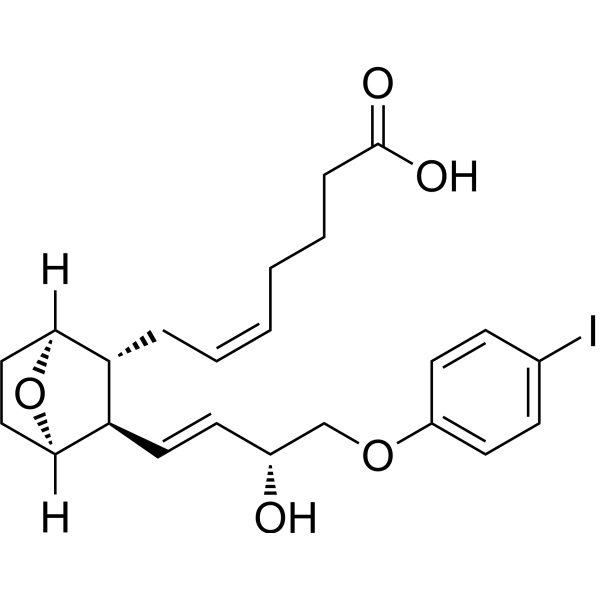
I-BOP is an agonist for thromboxane A2 receptor (TP) with a KD of 0.61 nM. I-BOP promotes proliferation through activation of PI3K pathway in vascular smooth muscle . I-BOP dose-dependently biphasicly affects the excitatory postsynaptic potential (e.p.s.p.) in hippocampal neurons .
loading...
    loading...
Cat. No.: HY-B0863S5
CAS No.: 2732154-65-1
Glyphosate- 13C, 15N-1 is the 13C- and 15N-labeled Glyphosate (HY-B0863). Glyphosate, a non-selective systemic biocide with broad-spectrum activity, is an herbicidal derivative of the amino acid glycine. Glyphosate inhibits the enzymatic activity of the 5-endopyruvylshikimate 3-phosphate synthase (EPSPS) in the shikimic acid pathway, preventing the synthesis of the aromatic amino acids tyrosine, phenylalanine, and tryptophan. Glyphosate induces oxidative stress, neuroinflammation, and mitochondrial dysfunction, processes that lead to neuronal death by autophagia, necrosis, or apoptosis, as well as the appearance of behavioral and motor disorders .
loading...
    loading...
Cat. No.: HY-P1426A
Target:  

Potassium Channel

Research Areas:  

Neurological Disease

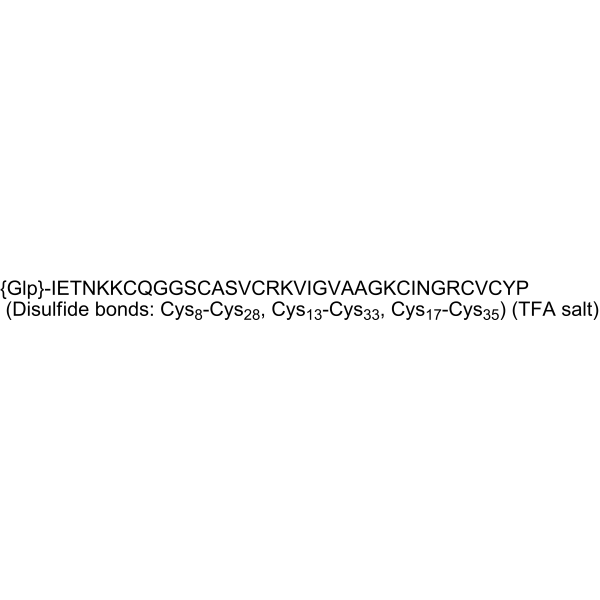
AmmTX3 TFA is a peptide toxin identified from the venom of the scorpion Androctonus mauretanicus. AmmTX3 TFA is a highly specific blocker of Kv4 channels, which selectively and almost completely blocks transient A-type K + currents with a Ki of 131 nM. AmmTX3 TFA induces epileptiform behaviors and causes death in mice receiving intracerebroventricular injection. AmmTX3 TFA increases the excitability of dentate gyrus granule cells, reduces GABAergic inhibition, enhances and stabilizes the EPSP-spike component of long-term potentiation, and impairs reference memory. AmmTX3 TFA can be used in research related to pain, epilepsy, and autism spectrum disorder .
loading...
    loading...
Cat. No.: HY-173429
Target:  

Herbicide

Research Areas:  

Infection

Herbicidal agent 10 (compound 3s) is a potent herbicidal agent. Herbicidal agent 10 inhibits SvEPSPS with an IC50 of 7.8 μM .
loading...
    loading...
  • 1

