8 Results for "

Erythroleukemia

" in MedChemExpress (MCE) Product Catalog:
Products (8)

8 Results for "Erythroleukemia" in MCE Product Catalog:

1
1 Cited Publications
Cat. No.: HY-19695
CAS No.: 62284-79-1
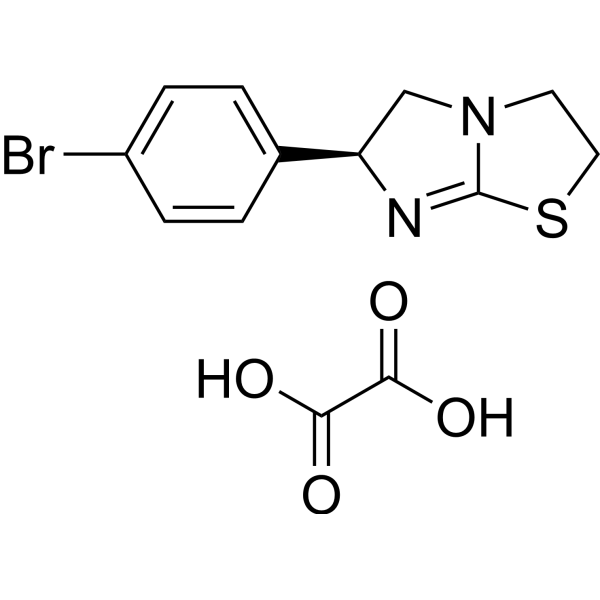
Synonyms: L-p-Bromotetramisole oxalate; 6-Bromolevamisole oxalate
(-)-p-Bromotetramisole oxalate (L-p-Bromotetramisole oxalate) is an alkaline phosphatase inhibitor. (-)-p-Bromotetramisole (oxalate) is applicable to research related to erythroleukemia .
loading...
    loading...
Cat. No.: HY-N6801
CAS No.: 23282-20-4
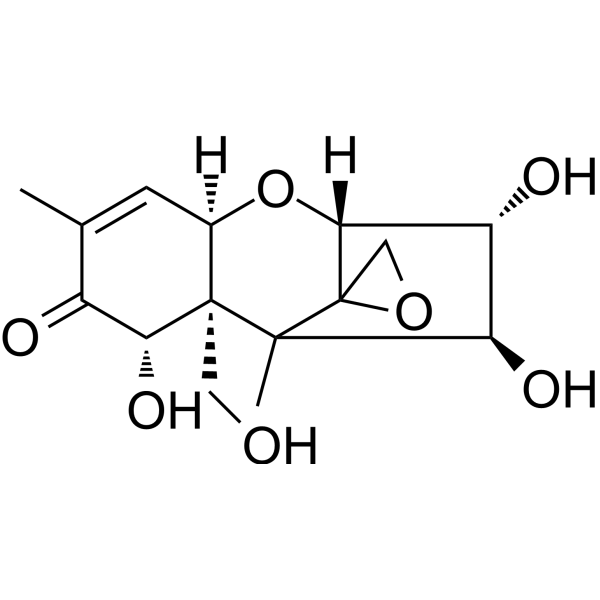
Nivalenol, a trichothecene mycotoxin that can be produced by Fusarium graminearum, is a fungal metabolite present in agricultural product. Nivalenol modulates apoptotic pathway, cell cycle regulation, Bax, ERK, caspase-3, and poly-ADP-ribose synthase activity in macrophages. Nivalenol inhibits ribosomal peptidyltransferase site, protein synthesis, DNA synthesis, and cell proliferation. Nivalenol induces late-stage apoptotic morphological changes, reduces cellular metabolism, and decreases cell proliferation in erythroleukemia cells. Nivalenol induces lymphocyte apoptosis in murine thymus, spleen, and Peyer's patches. Nivalenol can be used for the research of erythroleukemia .
loading...
    loading...
Cat. No.: HY-N6801S
CAS No.: 911392-40-0
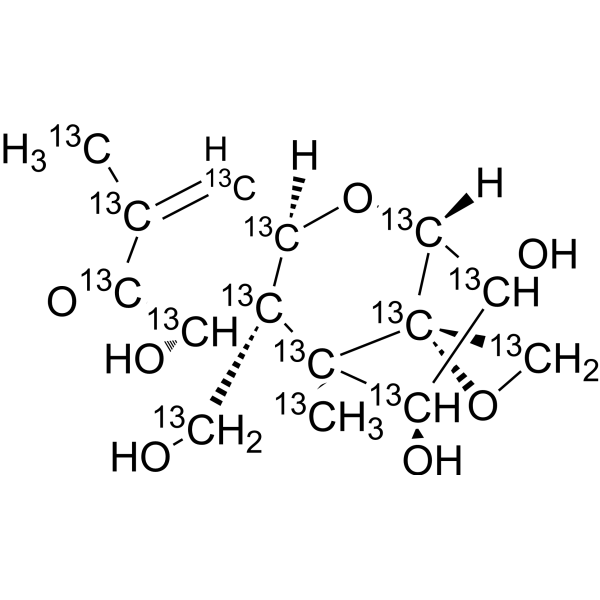
Nivalenol- 13C15 is the 13C labeled Nivalenol (HY-N6801) . Nivalenol, a trichothecene mycotoxin that can be produced by Fusarium graminearum, is a fungal metabolite present in agricultural product. Nivalenol modulates apoptotic pathway, cell cycle regulation, Bax, ERK, caspase-3, and poly-ADP-ribose synthase activity in macrophages. Nivalenol inhibits ribosomal peptidyltransferase site, protein synthesis, DNA synthesis, and cell proliferation. Nivalenol induces late-stage apoptotic morphological changes, reduces cellular metabolism, and decreases cell proliferation in erythroleukemia cells. Nivalenol induces lymphocyte apoptosis in murine thymus, spleen, and Peyer's patches. Nivalenol can be used for the research of erythroleukemia.
loading...
    loading...
Cat. No.: HY-116170
CAS No.: 1548116-54-6
Target:  

17β-HSD

연구분야:  

Cancer

SN34037 is a specific inhibitor of Aldo-keto reductase 1C3 (AKR1C3, EC 1.1.1.188) with the ability to inhibit the cytotoxic activity of PR-104A. SN34037-sensitive coumberone reduction provides a rapid and specific assay for AKR1C3 activity. SN34037 inhibits the aerobic cytotoxicity of PR-104A in TF1 erythroleukemia cells with high AKR1C3 expression, but not in Nalm6 pre-B acute lymphoblastic leukemia cells with low AKR1C3 expression .
loading...
    loading...
Cat. No.: HY-W128159
CAS No.: 932-17-2
Target:  

Hemoglobin

연구분야:  

Cancer

N-Acetyl-2-pyrrolidone (No.20) is an N-acetylated amide. N-Acetyl-2-pyrrolidone can induce the differentiation of mouse erythroleukemia cells and has the activity of stimulating proliferation. N-Acetyl-2-pyrrolidone can be used in the research of leukemia differentiation therapy .
loading...
    loading...
Cat. No.: HY-N6801R
CAS No.: 23282-20-4
Nivalenol (Standard) is the analytical standard of Nivalenol (HY-N6801). This product is intended for research and analytical applications. Nivalenol, a trichothecene mycotoxin that can be produced by Fusarium graminearum, is a fungal metabolite present in agricultural product. Nivalenol modulates apoptotic pathway, cell cycle regulation, Bax, ERK, caspase-3, and poly-ADP-ribose synthase activity in macrophages. Nivalenol inhibits ribosomal peptidyltransferase site, protein synthesis, DNA synthesis, and cell proliferation. Nivalenol induces late-stage apoptotic morphological changes, reduces cellular metabolism, and decreases cell proliferation in erythroleukemia cells. Nivalenol induces lymphocyte apoptosis in murine thymus, spleen, and Peyer's patches. Nivalenol can be used for the research of erythroleukemia.
loading...
    loading...
Cat. No.: HY-174321
CAS No.: 2834742-70-8
Target:  

p38 MAPK PI3K Akt NF-κB

연구분야:  

Cancer

A2073 is a flavagline derivative that potently inhibits the proliferation of erythroleukemia cells by causing cell cycle arrest and suppressing the MAPK, NF-κB, and PI3K signaling pathways. A2073 formes stable interactions with cell cycle-related proteins (CDK1, CCNA2, PRIM1). A2073 exhibits significant anti-proliferative activity against tumor cells while maintaining a favorable toxicity profile in a zebrafish xenograft tumor model. A2073 can be used for the study of acute erythroleukemia.
loading...
    loading...
Cat. No.: HY-183069
연구분야:  

Cancer

FKL-137 is a GLUT1 and PI3K/AKT signaling pathway inhibitor. FKL-137 binds to GLUT1, reduces glucose uptake and lactate secretion, downregulates glucose metabolism-related proteins, and inhibits erythroleukemia cell proliferation. FKL-137 downregulates PI3K, p-PI3K, AKT, p-AKT levels, disrupts the PI3K/AKT-GLUT1 positive feedback loop, and suppresses erythroleukemia cell proliferation. FKL-137 induces apoptosis via upregulated Bax, Cleaved-PARP and downregulated Bcl-2, PARP. FKL-137 can be used for the research of erythroleukemia .
loading...
    loading...

