



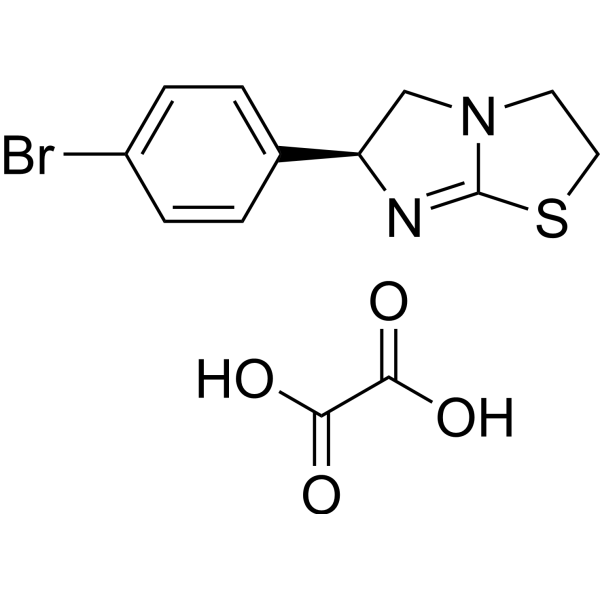
(-)-p-Bromotetramisole oxalate
Based on 1 publication(s) in Google Scholar
(-)-p-Bromotetramisole oxalate (L-p-Bromotetramisole oxalate) is an alkaline phosphatase inhibitor. (-)-p-Bromotetramisole (oxalate) is applicable to research related to erythroleukemia.
For research use only. We do not sell to patients.
- Purity : 99.78%
- CAS No.: 62284-79-1
- Formula: C13H13BrN2O4S
- Molecular Weight:373.22
-
Storage:
4°C, sealed storage, away from moisture
* In solvent : -80°C, 6 months; -20°C, 1 month (sealed storage, away from moisture)

To place orders, for customer services and technical support, please contact: MedChemExpress USA
Tel: 609-228-6898 E-mail: [email protected] [email protected]


-
 Biological Activity
-
Chemical Information
-
Solvent & Solubility
- Purity & Documentation
- References
-
 Help & FAQs


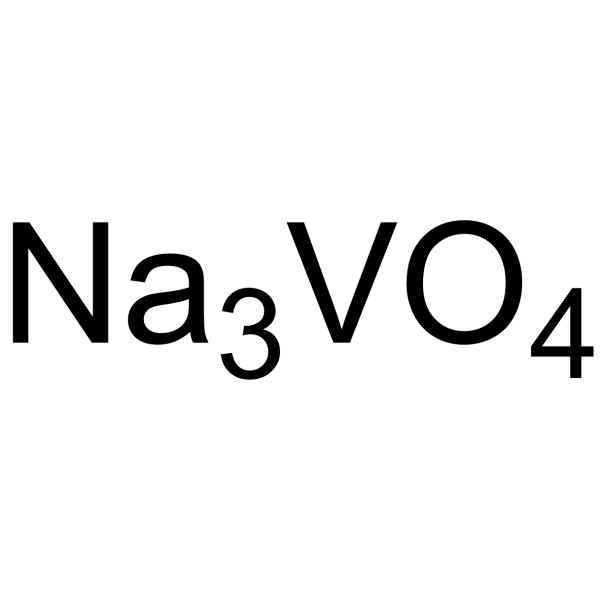
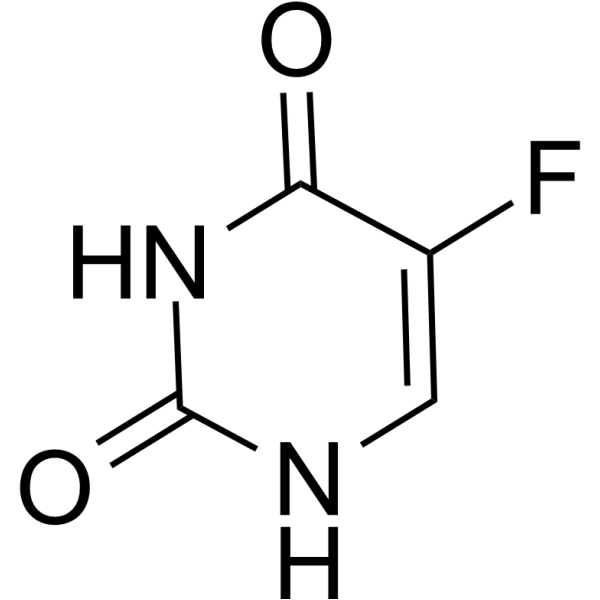
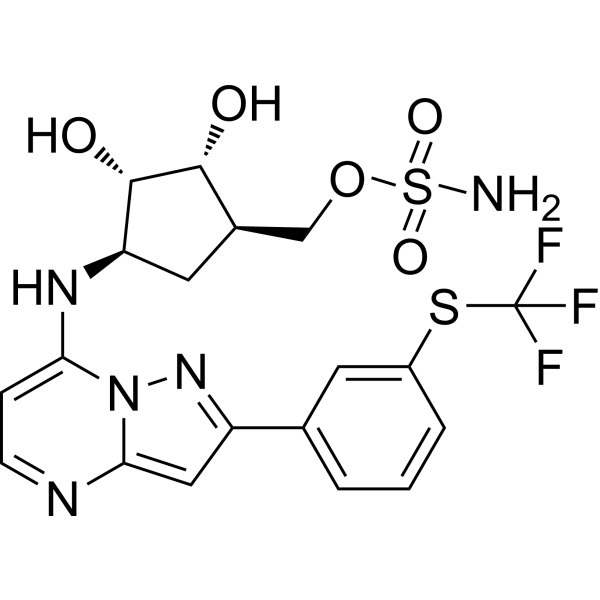
Publications Citing Use of MedChemExpress (MCE) (-)-p-Bromotetramisole oxalate
More

Biological Activity
Description
In Vitro
(-)-p-Bromotetramisole oxalate (0.3-0.4 mM; 5 days) potently inhibits terminal cell division-associated MEL DS-19 cell differentiation induced by 0.7% DMSO (HY-Y0320) or 1.2 mM HMBA (HY-124284), reducing B+ cell levels[1].
(-)-p-Bromotetramisole oxalate (10-100 μM) potently inhibits purified human liver, bone, spleen, and kidney alkaline phosphatase isoenzymes while minimally inhibiting purified human intestinal and placental alkaline phosphatase isoenzymes[2].
MedChemExpress (MCE) has not independently confirmed the accuracy of these methods. They are for reference only.
-
Cell Line:mouse erythroleukemia (MEL) DS-19 cells
-
Concentration:0.3 mM; 0.4 mM
-
Incubation Time:5 days
-
Result:Reduced the percentage of Benzidine-staining, Hemoglobin (HY-P2995)-containing (B+) cells of the inducer-only control at 0.3 mM (0.7% DMSO-induced differentiation).
Reduced 0.7% DMSO-induced B+ cells of the control at 0.4 mM.
Reduced 1.2 mM HMBA-induced B+ cells of the inducer-only control at 0.4 mM.


Chemical Information
-
CAS No. 62284-79-1
-
Appearance Solid
-
Molecular Weight 373.22
-
Formula C13H13BrN2O4S
-
Color White to off-white
-
SMILES
BrC1=CC=C([C@@H]2N=C3SCCN3C2)C=C1.O=C(O)C(O)=O
-
Synonyms
L-p-Bromotetramisole oxalate; 6-Bromolevamisole oxalate
-
Shipping
Room temperature in continental US; may vary elsewhere.
-
Storage
4°C, sealed storage, away from moisture
* In solvent : -80°C, 6 months; -20°C, 1 month (sealed storage, away from moisture)


Publications (1)
-
Journal Impact Factor
-
Most Recent
-
Metabolites
Urinary ATP Levels Are Controlled by Nucleotidases Released from the Urothelium in a Regulated Manner. [Abstract]2022 Dec 24;13(1):30. PMID: 36676954


Solvent & Solubility
In Vitro:
DMSO : ≥ 29 mg/mL (77.70 mM; Hygroscopic DMSO has a significant impact on the solubility of product, please use newly opened DMSO)
H2O : ≥ 25 mg/mL (66.98 mM)
* "≥" means soluble, but saturation unknown.
Please refer to the solubility information to select the appropriate solvent. Once prepared, please aliquot and store the solution to prevent product inactivation from repeated freeze-thaw cycles.
Storage method and period of stock solution: -80°C, 6 months; -20°C, 1 month (sealed storage, away from moisture). When stored at -80°C, please use it within 6 months. When stored at -20°C, please use it within 1 month.
* Note: If you choose water as the stock solution, please dilute it to the working solution, then filter and sterilize it with a 0.22 μm filter before use.
Please refer to the solubility information to select the appropriate solvent. Once prepared, please aliquot and store the solution to prevent product inactivation from repeated freeze-thaw cycles.
Storage method and period of stock solution: -80°C, 6 months; -20°C, 1 month (sealed storage, away from moisture). When stored at -80°C, please use it within 6 months. When stored at -20°C, please use it within 1 month.
* Note: If you choose water as the stock solution, please dilute it to the working solution, then filter and sterilize it with a 0.22 μm filter before use.
Concentration (start) × Volume (start) = Concentration (final) × Volume (final)
In Vivo:
Select the appropriate dissolution method based on your experimental animal and administration route.
- For the following dissolution methods, please ensure to first prepare a clear stock solution using an In Vitro approach and then sequentially add co-solvents:
- To ensure reliable experimental results, the clarified stock solution can be appropriately stored based on storage conditions. As for the working solution for In Vivo experiments, it is recommended to prepare freshly and use it on the same day.
- The percentages shown for the solvents indicate their volumetric ratio in the final prepared solution. If precipitation or phase separation occurs during preparation, heat and/or sonication can be used to aid dissolution.
Add each solvent one by one: 10% DMSO 90% (20% SBE-β-CD in Saline)
Solubility: ≥ 2.5 mg/mL (6.70 mM); Clear solution
This protocol yields a clear solution of ≥ 2.5 mg/mL (saturation unknown).
Taking 1 mL working solution as an example, add 100 μL DMSO stock solution (25.0 mg/mL) to 900 μL 20% SBE-β-CD in Saline, and mix evenly.
Preparation of 20% SBE-β-CD in Saline (4°C, storage for one week): 2 g SBE-β-CD powder is dissolved in 10 mL Saline, completely dissolve until clear.
Add each solvent one by one: 10% DMSO 40% PEG300 5% Tween-80 45% Saline
Solubility: ≥ 2.08 mg/mL (5.57 mM); Clear solution
This protocol yields a clear solution of ≥ 2.08 mg/mL (saturation unknown).
Taking 1 mL working solution as an example, add 100 μL DMSO stock solution (20.8 mg/mL) to 400 μL PEG300, and mix evenly; then add 50 μL Tween-80 and mix evenly; then add 450 μL Saline to adjust the volume to 1 mL.
Preparation of Saline: Dissolve 0.9 g sodium chloride in ddH₂O and dilute to 100 mL to obtain a clear Saline solution.
In Vivo Dissolution Calculator
Please enter the basic information of animal experiments:
-
-
-
-
Recommended: Prepare an additional quantity of animals to account for potential losses during experiments.
Working solution concentration: 0.22 mg/mL
This product has good water solubility, please refer to the measured solubility data in water/PBS/Saline for details.


Purity & Documentation
-
Data Sheet (277 KB)
-
SDS (393 KB)
- English - EN (393 KB)
- Français - FR (393 KB)
- Deutsch - DE (393 KB)
- Norwegian - NO (393 KB)
- Español - ES (393 KB)
- Swedish - SV (393 KB)
- Italian - IT (393 KB)
- Korean - KR (393 KB)
- Portuguese - PT (393 KB)
-
Handling Instructions (2659 KB)
References
[1]. Scher BM, et al. The phosphatase inhibitors, orthovanadate and levamisole, inhibit induction of erythroid differentiation and abrogate the associated inhibition of glycolysis. Int J Oncol. 1998;12(5):987-996. [Content Brief]
[2]. Van Belle H, et al. L-p-Bromotetramisole, a new reagent for use in measuring placental or intestinal isoenzymes of alkaline phosphatase in human serum. Clin Chem. 1977 Mar;23(3):454-9. [Content Brief]


Complete Stock Solution Preparation Table
Please refer to the solubility information to select the appropriate solvent. Once prepared, please aliquot and store the solution to prevent product inactivation from repeated freeze-thaw cycles.
Storage method and period of stock solution: -80°C, 6 months; -20°C, 1 month (sealed storage, away from moisture). When stored at -80°C, please use it within 6 months. When stored at -20°C, please use it within 1 month.
| Optional Solvent | Concentration Solvent Mass | 1 mg | 5 mg | 10 mg | 25 mg |
|---|---|---|---|---|---|
| H2O / DMSO | 1 mM | 2.6794 mL | 13.3969 mL | 26.7938 mL | 66.9846 mL |
| 5 mM | 0.5359 mL | 2.6794 mL | 5.3588 mL | 13.3969 mL | |
| 10 mM | 0.2679 mL | 1.3397 mL | 2.6794 mL | 6.6985 mL | |
| 15 mM | 0.1786 mL | 0.8931 mL | 1.7863 mL | 4.4656 mL | |
| 20 mM | 0.1340 mL | 0.6698 mL | 1.3397 mL | 3.3492 mL | |
| 25 mM | 0.1072 mL | 0.5359 mL | 1.0718 mL | 2.6794 mL | |
| 30 mM | 0.0893 mL | 0.4466 mL | 0.8931 mL | 2.2328 mL | |
| 40 mM | 0.0670 mL | 0.3349 mL | 0.6698 mL | 1.6746 mL | |
| 50 mM | 0.0536 mL | 0.2679 mL | 0.5359 mL | 1.3397 mL | |
| 60 mM | 0.0447 mL | 0.2233 mL | 0.4466 mL | 1.1164 mL |
* Note: If you choose water as the stock solution, please dilute it to the working solution, then filter and sterilize it with a 0.22 μm filter before use.


(-)-p-Bromotetramisole oxalate Related Classifications
HY-19695 Related Classifications
 Powered by Bioz
Keywords
- (-)-p-Bromotetramisole
- 62284-79-1
- L-p-Bromotetramisole
- 6-Bromolevamisole
- Phosphatase
- human placental alkaline phosphatase
- erythroleukemia cells
- human liver alkaline phosphatase
- alkaline phosphatase
- intestinal alkaline phosphatase
- human bone alkaline phosphatase
- human spleen alkaline phosphatase
- MEL DS-19 cell
- mammalian alkaline phosphatases
- human kidney alkaline phosphatase
- Inhibitor
- inhibitor
- inhibit