1. Search Result
Search Result
Results for "

GRA

" in MedChemExpress (MCE) Product Catalog:

6

Inhibitors & Agonists

1

Fluorescent Dyes

2

Biochemical Assay Reagents

1

Natural
Products

Cat. No. Product Name Target Research Areas Chemical Structure
  • HY-W088065

    Environmental Pollutants DNA/RNA Synthesis Others
    Sodium formate acts as a key promoter for heterogeneous nucleation of ZIF crystals and thin film synthesis. It is also recognized as a GRAS substance by the FDA, and serves as a cosmetic preservative and food additive. Sodium formate has low acute oral toxicity (acute oral LD50=7410 mg/kg and acute intravenous LD50=807 mg/kg in mice), with no heritable or carcinogenic effects, but exhibits embryonic developmental toxicity and teratogenicity at high concentrations. Sodium formate may cause moderate irritation to rabbit eyes, is relatively safe to the skin, and does not induce tumor formation in rats in vivo. Sodium formate is rapidly absorbed and oxidized to carbon dioxide in vivo, and forms DNA adducts in specific metabolic deficiency models or upon high-dose exposure .
    Sodium formate
  • HY-50675

    GCGR Metabolic Disease
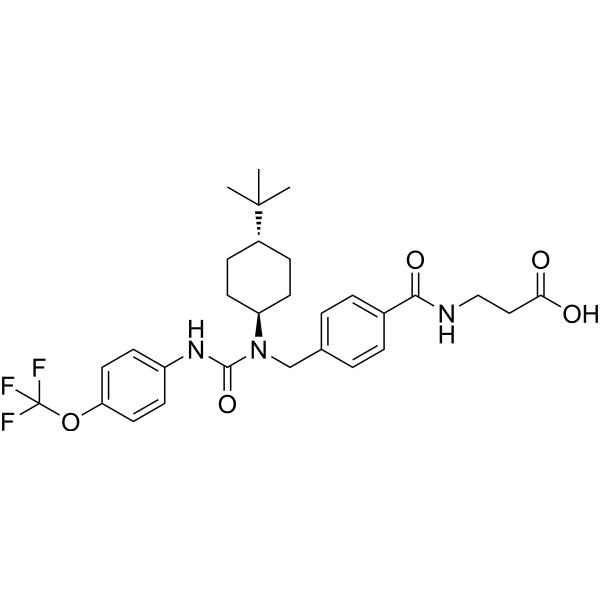
    GRA Ex-25 is an inhibitor of glucagon receptor, with IC50 of 56 and 55 nM for rat and human glucagon receptors, respectively.
    GRA Ex-25
  • HY-Y0286

    Hartshorn salt, 99%

    Environmental Pollutants Biochemical Assay Reagents Others
    Ammonium carbonate (Ammonium carbonate), 99% is a solid amino compound that functions as a buffer, pH regulator, pore-forming agent, and electrocatalytic oxidation substrate. Ammonium carbonate, 99% is a GRAS-grade direct food additive with no restricted daily intake specified by FAO/WHO, and it shows no acute skin toxicity, clinical signs of toxicity, or effects on body weight in rats. Ammonium carbonate, 99% undergoes electrocatalytic oxidation in alkaline solutions with a Pt/C catalyst (carbonate adsorption interferes with activity). Ammonium carbonate, 99% can serve as a fuel for low-temperature polymer fuel cells and anion exchange membrane fuel cells (with performance superior to pure ammonia), and can also form pores in the carrier-free Pt cathode catalyst layer after low-temperature decomposition, thereby enhancing catalyst activity under low-humidity conditions and the performance of proton exchange membrane fuel cells .
    Ammonium carbonate, 99%
  • HY-N2417

    Bacterial Infection
    Stearyl glycyrrhetinate, a major component in licorice extract, has a MIC against S. aureus strains of more than 256 mg/L. Stearyl glycyrrhetinate has antibacterial effects .
    Stearyl glycyrrhetinate
  • HY-129953F

    PGF2α-biotin

    Biochemical Assay Reagents Prostaglandin Receptor Others
    Prostaglandin F2α-biotin (PGF2α-biotin) is a biotinylated form of Prostaglandin F2α (HY-12956). Prostaglandin F2α-biotin can be used in the study of the mechanism of action of prostaglandins. In addition, Prostaglandin F2α-biotin can be detected in the ethanolic extract of Hawm Gra Dang Ngah rice .
    Prostaglandin F2α-biotin
  • HY-W099995

    Environmental Pollutants Biochemical Assay Reagents Others
    2-Phenylethyl propionate is an aromatic compound with sweet, fruity and floral notes, which acts as an insect attractant. 2-Phenylethyl propionate is widely used in cosmetics such as perfumes, shampoos and soaps, as well as non-cosmetic products including detergents and household cleaners. 2-Phenylethyl propionate has been granted GRAS (Generally Recognized As Safe) certification by the U.S. Food and Drug Administration .
    2-Phenylethyl propionate

Inquiry Online

Your information is safe with us. * Required Fields.

Salutation


Country or Region *

Applicant Name *


Organization Name *

Department *


Email Address *


Product Name *

Cat. No.


Requested quantity *

Phone Number *


Remarks

Inquiry Online

Inquiry Information

Product Name:
Cat. No.:
Quantity:
MCE Japan Authorized Agent:

