6 Results for "

HCC1806

" in MedChemExpress (MCE) Product Catalog:
Products (6)

6 Results for "HCC1806" in MCE Product Catalog:

Cat. No.: HY-171789
CAS No.: 2632343-19-0
Research Areas:  

Cancer

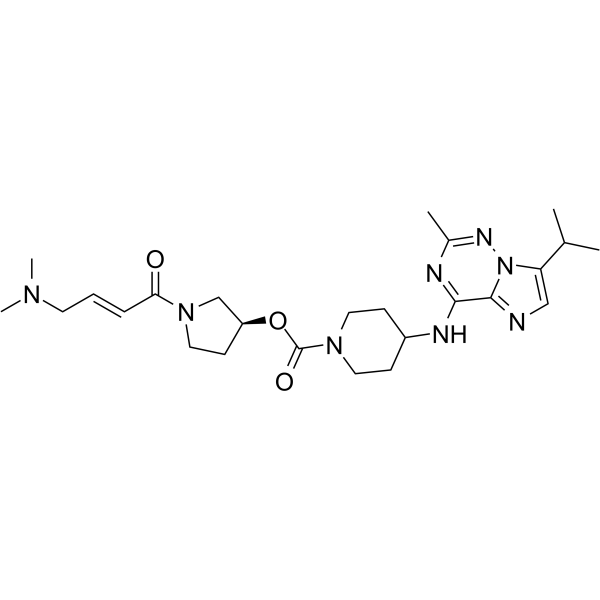
PARG-IN-7 (Example 38) is a Poly ADP-ribose glycohydrolase (PARG) inhibitor (IC50: < 0.1 μM). PARG-IN-7 inhibits cell viability of HCC1806-XRCC1 KD (knock down) cells with an IC50 < 1 μM. PARG-IN-7 can be used for cancer research .
loading...
    loading...
Cat. No.: HY-145389
CAS No.: 2654003-68-4
Target:  

CDK

Research Areas:  

Cancer

SZ-015268 is a CDK7 inhibitor with an IC50 of 23.56 nM. SZ-015268 has extremely significant anti-tumor advantages. SZ-015268 inhibits HCC70, OVCAR-3, HCT116 and HCC1806 cells proliferation with IC50s of 33, 80.56, 12.53, and 61.55 nM, respectively .
loading...
    loading...
Cat. No.: HY-158439
Target:  

JAK STAT

Research Areas:  

Cancer

anti-TNBC agent-7 (Compound 13c) possesses anticancer activity, serving as a molecular probe to recognize and regulate the signal transduction of the USP21/JAK2/STAT3 axis, exhibiting nanomolar-level cytotoxicity against MDA-MB-231 and HCC-1806 cancer cells, effectively combating triple-negative breast cancer (TNBC) .
loading...
    loading...
Cat. No.: HY-162875
CAS No.: 2407163-44-2
Research Areas:  

Cancer

PROTAC BRD4 Degrader-27 is a selective cereblon-mediated BRD4 PROTAC degrader. PROTAC BRD4 Degrader-27 exhibits anticancer activity, induces G1 phase arrest, and inhibits DNA synthesis and colony formation. PROTAC BRD4 Degrader-27 suppresses HCC1806 tumor growth in xenograft mouse models. PROTAC BRD4 Degrader-27 can be used in breast cancer-related research .
loading...
    loading...
Cat. No.: HY-170549
CAS No.: 3116929-46-2
Target:  

VEGFR

Research Areas:  

Cancer

VEGFR-2-IN-60 (compound 5c) is a potent VEGFR-2 inhibitor with an IC50 of 1.07 nM. VEGFR-2-IN-60 exhibits cytotoxic activity against HCC1806, Hela, and A549 cell lines .
loading...
    loading...
Cat. No.: HY-189213
Research Areas:  

Cancer

YZ-17 is a PROTAC degrader targeting PRMT5, with DC50 = 2.2 μM (HCC1806 cells). YZ-17 recruits CRBN E3 ligase and induces PRMT5 degradation through the ubiquitin-proteasome system, inhibiting PRMT5-mediated symmetric dimethylarginine modification. YZ-17 co-degrades the PRMT5 adaptor protein MEP50 via a CRBN-dependent mechanism. YZ-17 induces G1 phase cell cycle arrest and inhibits colony formation in cancer cells. YZ-17 exhibits antiproliferative activity in various cancer cells. YZ-17 shows antitumor efficacy in a triple-negative breast cancer xenograft mouse model. YZ-17 can be used for research on triple-negative breast cancer .
loading...
    loading...

