1. Search Result
Search Result
Results for "

Human protein C

" in MedChemExpress (MCE) Product Catalog:

184

Inhibitors & Agonists

2

Screening Libraries

3

Fluorescent Dyes

2

Biochemical Assay Reagents

25

Peptides

12

Inhibitory Antibodies

24

Natural
Products

1124

Recombinant Proteins

7

Isotope-Labeled Compounds

173

Antibodies

62

Oligonucleotides

Cat. No. Product Name Target Research Areas Chemical Structure
  • HY-148842

    Liposome Others
    C14-4 is an ionizable lipid utilized for the synthesis of lipid nanoparticles (LNPs). C14-4 enhances mRNA delivery, enabling the effective transport of mRNA to primary human T cells, which in turn induces functional protein expression. C14-4 demonstrates high transfection efficiency while maintaining low cytotoxicity .
    C14-4
  • HY-D1025
    C-Phycocyanin
    1 Publications Verification

    C-PC

    Biochemical Assay Reagents Cancer
    C-phycocyanin (C-PC) is a protein pigment which is also widely used as an excellent nutrient supplement for human beings.
    C-Phycocyanin
  • HY-P1856
    Proinsulin C-peptide (human)
    1 Publications Verification

    Insulin Receptor PDGFR MAPKAPK2 (MK2) Cardiovascular Disease Metabolic Disease Inflammation/Immunology
    Proinsulin C-peptide (human) is a peptide consisting of 31 amino acids that links the A and B chains of proinsulin to ensure its correct folding. Proinsulin C-peptide (human) inhibits the high glucose-induced increase in PDGF-β receptor protein expression and the phosphorylation of p42/p44 MAP kinase. Proinsulin C-peptide (human) increases the deformability of erythrocytes derived from type 1 diabetes, inhibits insulin-induced neointimal thickening, and suppresses the proliferation of rat aortic smooth muscle cells cultured under high-glucose conditions .
    Proinsulin C-peptide (human)
  • HY-11010
    AS601245
    5+ Cited Publications

    JNK Neurological Disease Inflammation/Immunology Cancer
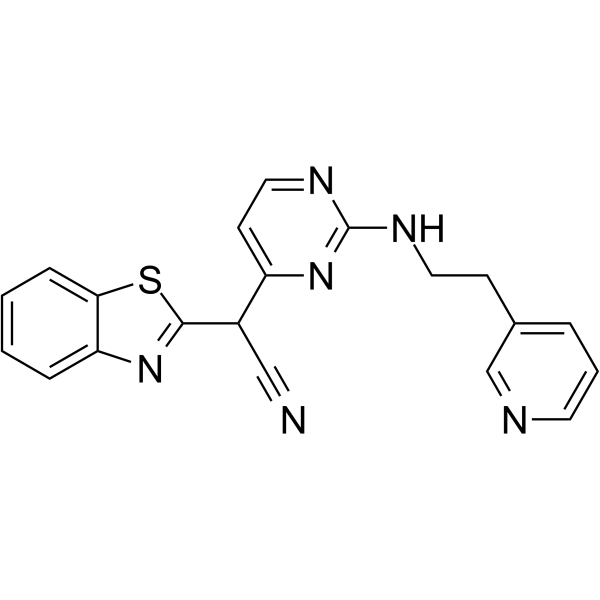
    AS601245 is an orally active, selective, ATP competitive JNK (c-Jun NH2-terminal protein kinase) inhibitor with IC50s of 150, 220, and 70 nM for three JNK human isoforms (hJNK1, hJNK2, and hJNK3), respectively. AS601245 exhibits 10- to 20-fold selectivity over c-src, CDK2, and c-Raf and more than 50- to 100-fold selectivity over a range of Ser/Thr- and Tyr-protein kinases. Neuroprotective properties .
    AS601245
  • HY-N2163

    PDI Cardiovascular Disease
    Mudanpioside C is a protein disulfide isomerase (PDI) inhibitor with a human IC50 of 3.31 μM and human Kd of 3.9 μM. Mudanpioside C suppresses collagen-induced platelet aggregation, interferes with platelet activation, adhesion, and spreading. Mudanpioside C can be used for the research of cardiovascular diseases .
    Mudanpioside C
  • HY-118384
    Sangivamycin
    3 Publications Verification

    NSC 65346; BA-90912

    PKC Nucleoside Antimetabolite/Analog Cancer
    Sangivamycin (NSC 65346), a nucleoside analog, is a potent inhibitor of protein kinase C (PKC) with an Ki of 10 μM. Sangivamycin has potent antiproliferative activity against a variety of human cancers .
    Sangivamycin
  • HY-P1918
    Activated Protein C (390-404), human
    4 Publications Verification

    APC Cardiovascular Disease
    Activated Protein C (390-404), human is a polypeptide fragment of vitamin K-dependent serine protease activated protein C (APC), which inhibits the anticoagulant activity of APC. Activated Protein C (390-404), human inhibits APC-catalyzed inactivation of factor Va .
    Activated Protein C (390-404), human
  • HY-P0312
    c-Myc Peptide TFA
    1 Publications Verification

    c-Myc Cancer
    c-Myc Peptide (TFA) is a synthetic peptide corresponding to the C-terminal amino acids (410-419) of human c-myc protein, and participates in regulation of growth-related gene transcription.
    c-Myc Peptide TFA
  • HY-N0379S22

    Endogenous Metabolite Others
    D-Mannose- 13C6 is a carbohydrate, which plays an important role in human metabolism, especially in the glycosylationof specific proteins .
    D-Mannose-13C6
  • HY-121687

    α-(Hydroxyimino)benzenepropanoic acid

    DNA/RNA Synthesis Cancer
    HIPP (α-(Hydroxyimino)benzenepropanoic acid) is an inhibitor for human C-terminal binding protein (CtBP), with IC50 of 745 nM and a Kd of 1.3 μM .
    HIPP
  • HY-E70370

    Virus Protease Others
    hrv 3c Protease is a protease originated from human rhinoviruses. hrv 3c Protease recognizes the sequence LEVLFQGP and cleaves precisely between the Q and GP residues. hrv 3c Protease can be used to remove additional tags from the target proteins .
    hrv 3c Protease
  • HY-128342
    Complement C5-IN-1
    1 Publications Verification

    Complement System Inflammation/Immunology
    Compound C5-IN-1 (Compound 7) is a selective allosteric inhibitor of complement component protein C5. Compound C5-IN-1 prevents C5 from being cleaved by C5 convertase, inhibits the cleavage of C5 into C5a and C5b, and thus blocks the formation of membrane attack complex (MAC). Compound C5-IN-1 has an IC50 of 0.77 μM and 5 nM in 50% human whole blood and 2% human serum to block MAC deposition induced by zymosan, respectively. Compound C5-IN-1 can be used to study diseases related to complement overactivation, such as paroxysmal nocturnal hemoglobinuria (PNH) and atypical hemolytic uremic syndrome (aHUS) .
    Complement C5-IN-1
  • HY-P2148

    Bacterial Antibiotic Infection Inflammation/Immunology
    P-113 is an antimicrobial peptide (AMP) derived from the human salivary protein histatin 5. P-113 is active against clinically important microorganisms such as Pseudomonas spp., Staphylococcus spp., and C. albicans .
    P-113
  • HY-112968

    APC Cardiovascular Disease
    Human Protein C is activated by α-thrombin or α-thrombin/thrombomodulin complex to a serine protease, namely activated protein C (APC). Human Protein C can selectively inactivate factors Va and VIIIa and is a potent anticoagulant .
    Human protein C
  • HY-P5125

    PKC Others
    Z-Arg-SBzl is a substrate of both bovine and activated human protein C .
    Z-Arg-SBzl
  • HY-P991629

    Ser/Thr Protease Inflammation/Immunology
    C1 Esterase Inhibitor (Human) is a C1 Esterase inhibitor derived from human plasma. C1 Esterase Inhibitor (Human), a glycoprotein, is a serum protease inhibitor (serpin) that binds covalently and inactivates C1r, C1s, and mannan-binding protein-associated proteases (MASPs). C1 Esterase Inhibitor (Human) has anti-inflammatory effects. C1 Esterase Inhibitor (Human) can be used to prevent angioedema attacks associated with hereditary angioedema .
    C1 Esterase Inhibitor (Human)
  • HY-P3385

    SCB-313

    Drug Derivative Apoptosis Cancer
    Rilunermin alfa (SCB-313) is a recombinant fusion protein composed of the human C-propeptide of alpha1(I) collagen (Trimer-Tag) to the C-terminus of the mature human tumor necrosis factor (TNF)-related apoptosis-inducing ligand (TRAIL; Apo2L). Rilunermin alfa has potential pro-apoptotic and antineoplastic activities .
    Rilunermin alfa
  • HY-174728

    mRNA Inflammation/Immunology
    Human CXCR1 mRNA encodes the human C-X-C motif chemokine receptor 1 (CXCR1) protein, a member of the G-protein-coupled receptor family. CXCR1 is a receptor for interleukin 8 (IL8). It binds to IL8 with high affinity, and transduces the signal through a G-protein activated second messenger system.
    Human CXCR1 mRNA
  • HY-P991676

    DS-2325A

    Kallikrein Inflammation/Immunology
    Eflumenibep alfa is a Kallikrein 5 inhibitor with anti-inflammatory activity. Eflumenibep alfa is a fusion protein that combines human SPINK2 with the human IgG1 Fc fragment at the C-terminus .
    Eflumenibep alfa
  • HY-P991678

    XENP-27564; XMAB-27564

    Interleukin Related Inflammation/Immunology
    Efpixileukin alfa is a fusion protein that combines human IL-2 variant fused at the C-terminus to human immunoglobulin G1 (IgG1) Fc fragment. Efpixileukin alfa is an immunomodulator .
    Efpixileukin alfa
  • HY-P4798

    Human PTHrP(107-111) amide

    PTHR Others
    Osteostatin (1-5) amide (human, bovine, dog, horse, mouse, rabbit, rat) (Human PTHrP (107-111) amide) is a C-terminal parathyroid hormone-related protein fragment that can inhibit bone resorption .
    Osteostatin (1-5) amide (human, bovine, dog, horse, mouse, rabbit, rat)
  • HY-E70658

    CDK Cancer
    CDK12 R722C/CycK Recombinant Human Active Protein Kinase is a cyclin-dependent kinase and regulates the expression of genes involved in DNA repair and is required for the maintenance of genomic stability .
    CDK12 R722C/CycK Recombinant Human Active Protein Kinase
  • HY-E70696

    EGFR Cancer
    EGFR is a driver of tumorigenesis. EGFR is mainly found in an auto-inhibited, dimerization-incompetent, state at the plasma membrane (PM). Ligand binding promotes receptor dimerization, which determines a series of structural rearrangements that are conveyed to the cytoplasmic domain allowing the formation of asymmetric dimers between the two juxtaposed catalytic domains. EGFR has multiple mutants. EGFR C797S/L858R Recombinant Human Active Protein Kinase is a recombinant EGFR C797S/L858R protein that can be used to study EGFR C797S/L858R-related functions .
    EGFR C797S/L858R Recombinant Human Active Protein Kinase
  • HY-P991680

    TNF Receptor Inflammation/Immunology
    Elipunercept is a fusion protein that combines human TNFRSF1B extracellular domain fragment (1-235) fused at the C-terminus to a human IgG1 Fc fragment. Elipunercept is an immunomodulator .
    Elipunercept
  • HY-101962

    Insulin Receptor Metabolic Disease
    HNMPA is a membrane impermeable insulin receptor tyrosine kinase inhibitor. HNMPA inhibits serine and tyrosine autophosphorylation by the human insulin receptor. HNMPA has no effect on protein kinase C or cyclic AMP-dependent protein kinase activities
    HNMPA
  • HY-174761

    mRNA Inflammation/Immunology
    Human CCL21 mRNA encodes the human C-C motif chemokine ligand 21 (CCL21) protein, a chemokine that can inhibit hemopoiesis and stimulate chemotaxis. CCL21 is chemotactic in vitro for thymocytes and activated T cells, but not for B cells, macrophages, or neutrophils. It may also play a role in mediating homing of lymphocytes to secondary lymphoid organs.
    Human CCL21 mRNA
  • HY-N8200

    Phosphatase Monoamine Oxidase 5-HT Receptor Inflammation/Immunology
    Cassiaside B2 is a protein tyrosine phosphatase 1B (PTP1B) and human monoamine oxidase A (hMAO-A) inhibitor. Cassiaside B2 possesses antiallergic and is a 5-HT2C receptor agonist . ..
    Cassiaside B2
  • HY-153934

    GHR Endocrinology
    Tetrazole-C15-(N-acetylsulfamoyl)butanoic acid (Ligand 1) improves the pharmacokinetic properties of therapeutic peptides and proteins through non-covalent binding with human serum albumin (HSA). Tetrazole-C15-(N-acetylsulfamoyl)butanoic acid can be used for synthesis of long-acting human growth hormone (HGH) analog somapacitan .
    Tetrazole-C15-(N-acetylsulfamoyl)butanoic acid
  • HY-E70660

    CDK Cancer
    CDK13/CycK Recombinant Human Active Protein Kinase is a RNA polymerase II C-terminal domain kinases. CDK13 interacts with the splicing factor SRSF1 and to regulate alternative splicing of HIV .
    CDK13/CycK Recombinant Human Active Protein Kinase
  • HY-P1918A

    APC Cardiovascular Disease
    Activated Protein C (390-404), human TFA, a peptide of the activated protein C (a vitamin K-dependent serine protease), potently inhibits APC anticoagulant activity .
    Activated Protein C (390-404), human TFA
  • HY-E70814

    FGFR Cancer
    FGFR2 is a receptor tyrosine kinase that is involved in many human cancers such as intrahepatic cholangiocarcinomas and hepatocellular carcinomas. FGFR2 C491S is a mutant of FGFR3. FGFR2 C491S Recombinant Human Active Protein Kinase is a recombinant FGFR2 C491S protein that can be used to study FGFR2 C491S-related functions .
    FGFR2 C491S Recombinant Human Active Protein Kinase
  • HY-E70785

    Trk Receptor Cancer
    TRKA is a member of the tropomyosin receptor kinase (TRK) family, and its primary binding ligand is nerve growth factor (NGF). TRKA G667C is a mutant of TRKA. TRKA G667C Recombinant Human Active Protein Kinase is a recombinant TRKA G667C protein that can be used to study TRKA G667C-related functions .
    TRKA G667C Recombinant Human Active Protein Kinase
  • HY-E70768

    RET Cancer
    Rearranged during transfection (RET) is a transmembrane receptor protein tyrosine kinase (PTK) activated normally by forming ternary complexes with its cognate ligands and co-receptors. RET alterations by point mutations and gene fusions were found in diverse cancers. RET G810C is a mutant of RET. RET G810C Recombinant Human Active Protein Kinase is a recombinant RET G810C protein that can be used to study RET G810C-related functions .
    RET G810C Recombinant Human Active Protein Kinase
  • HY-E70642

    Anaplastic lymphoma kinase (ALK) Cancer
    Anaplastic lymphoma kinase (ALK) is a receptor tyrosine kinase in the insulin receptor superfamily. ALK can be used for the study of non-small cell lung carcinoma (NSCLC). ALK has multiple mutants. ALK C1156Y Recombinant Human Active Protein Kinase is a recombinant ALK C1156Y protein that can be used to study ALK C1156Y-related functions .
    ALK C1156Y Recombinant Human Active Protein Kinase
  • HY-E70808

    Btk Inflammation/Immunology Cancer
    Bruton's tyrosine kinase (BTK) plays a vital role in B-cell antigen receptor (BCR) signalling transduction pathway. BTK can be used for the study of lymphomas and autoimmune diseases. BTK has multiple mutants. BTK C481R Recombinant Human Active Protein Kinase is a recombinant BTK C481R protein that can be used to study BTK C481R-related functions .
    BTK C481R Recombinant Human Active Protein Kinase
  • HY-E70695

    EGFR Cancer
    EGFR is a driver of tumorigenesis. EGFR is mainly found in an auto-inhibited, dimerization-incompetent, state at the plasma membrane (PM). Ligand binding promotes receptor dimerization, which determines a series of structural rearrangements that are conveyed to the cytoplasmic domain allowing the formation of asymmetric dimers between the two juxtaposed catalytic domains. EGFR has multiple mutants. EGFR C797S Recombinant Human Active Protein Kinase is a recombinant EGFR C797S protein that can be used to study EGFR C797S-related functions .
    EGFR C797S Recombinant Human Active Protein Kinase
  • HY-E70733

    JAK Cancer
    JAK1 belongs to Janus family kinases (JAK) family. JAK mediates the Stat activation by cytokines. Jak1 is involved in IL-6-stimulated Stat3 activity. JAK1S729C mutations is proved to be activating mutations in vitro. JAK1 S729C Recombinant Human Active Protein Kinase is a recombinant JAK1 S729C protein that can be used to study JAK1 S729C-related functions .
    JAK1 S729C Recombinant Human Active Protein Kinase
  • HY-E70704

    EGFR Cancer
    EGFR is a driver of tumorigenesis. EGFR is mainly found in an auto-inhibited, dimerization-incompetent, state at the plasma membrane (PM). Ligand binding promotes receptor dimerization, which determines a series of structural rearrangements that are conveyed to the cytoplasmic domain allowing the formation of asymmetric dimers between the two juxtaposed catalytic domains. EGFR has multiple mutants. EGFR G719C Recombinant Human Active Protein Kinase is a recombinant EGFR G719C protein that can be used to study EGFR G719C-related functions .
    EGFR G719C Recombinant Human Active Protein Kinase
  • HY-E70755

    c-Met/HGFR Cancer
    Mesenchymal-to-epithelial transition (MET) is a receptor tyrosine kinase for hepatocyte growth factor (HGF). MET overactivation is strongly associated with angiogenesis, cellular motility, growth, and invasion. Aberrant MET signaling can drive tumorigenesis in several cancer types through various molecular mechanisms, including MET amplification, MET exon 14 skipping mutation, MET overexpression, and MET fusions. MET Y1230C is a mutant of MET. MET Y1230C Recombinant Human Active Protein Kinase is a recombinant MET Y1230C protein that can be used to study MET Y1230C-related functions .
    MET Y1230C Recombinant Human Active Protein Kinase
  • HY-E70698

    EGFR Cancer
    EGFR is a driver of tumorigenesis. EGFR is mainly found in an auto-inhibited, dimerization-incompetent, state at the plasma membrane (PM). Ligand binding promotes receptor dimerization, which determines a series of structural rearrangements that are conveyed to the cytoplasmic domain allowing the formation of asymmetric dimers between the two juxtaposed catalytic domains. EGFR has multiple mutants. EGFR d746-750/C797S Recombinant Human Active Protein Kinase is a recombinant EGFR d746-750/C797S protein that can be used to study EGFR d746-750/C797S-related functions .
    EGFR d746-750/C797S Recombinant Human Active Protein Kinase
  • HY-174542

    mRNA Cancer
    Human PRKCB mRNA encodes the human protein kinase C beta (PRKCB) protein, a member of Protein kinase C (PKC) family. PRKCB has been reported to be involved in many different cellular functions, such as B cell activation, apoptosis induction, endothelial cell proliferation, and intestinal sugar absorption.
    Human PRKCB mRNA
  • HY-174543

    mRNA Cancer
    Human PRKCA mRNA encodes the human protein kinase C alpha (PRKCA) protein, a member of Protein kinase C (PKC) family. PRKCA has been reported to play roles in many different cellular processes, such as cell adhesion, cell transformation, cell cycle checkpoint, and cell volume control.
    Human PRKCA mRNA
  • HY-174726

    mRNA Inflammation/Immunology
    Human CXCR3 mRNA encodes the human C-X-C motif chemokine receptor 3 (CXCR3) protein, G protein-coupled receptor. Chemokines bind to CXCR3 protein can induce cellular responses that are involved in leukocyte traffic, integrin activation, cytoskeletal changes and chemotactic migration.
    Human CXCR3 mRNA
  • HY-174768

    mRNA Inflammation/Immunology
    Human CCL15 mRNA encodes the human C-C motif chemokine ligand 15 (CCL15) protein, a chemotactic for T cells and monocytes, and acts through C-C chemokine receptor type 1 (CCR1).
    Human CCL15 mRNA
  • HY-174769

    mRNA Inflammation/Immunology
    Human CCL14 mRNA encodes the human C-C motif chemokine ligand 14 (CCL14) protein, a cytokine that induces changes in intracellular calcium concentration and enzyme release in monocytes.
    Human CCL14 mRNA
  • HY-174724

    mRNA Inflammation/Immunology
    Human CXCR5 mRNA encodes the human C-X-C motif chemokine receptor 5 (CXCR5) protein, a multi-pass membrane protein that belongs to the CXC chemokine receptor family. CXCR5 is involved in B-cell migration into B-cell follicles of spleen and Peyer patches.
    Human CXCR5 mRNA
  • HY-174742

    mRNA Inflammation/Immunology
    Human CCR7 mRNA encodes the human C-C motif chemokine receptor 7 (CCR7) protein, a member of the G protein-coupled receptor family. CCR7 has been shown to control the migration of memory T cells to inflamed tissues, as well as stimulate dendritic cell maturation.
    Human CCR7 mRNA
  • HY-174753

    mRNA Inflammation/Immunology
    Human CCL3L1 mRNA encodes the human C-C motif chemokine ligand 3 like 1 (CCL3L1) protein. It is a ligand for CCR1, CCR3 and CCR5.
    Human CCL3L1 mRNA
  • HY-P5125A

    PKC Others
    Z-Arg-SBzl TFA is a substrate of both bovine and activated human protein C .
    Z-Arg-SBzl TFA
  • HY-174727

    mRNA Inflammation/Immunology
    Human CXCR2 mRNA encodes the human C-X-C motif chemokine receptor 2 (CXCR2) protein, a member of the G-protein-coupled receptor family. CXCR2 is a receptor for interleukin 8 (IL8). It binds to IL8 with high affinity, and transduces the signal through a G-protein activated second messenger system. This receptor also binds to chemokine (C-X-C motif) ligand 1 (CXCL1/MGSA), a protein with melanoma growth stimulating activity, and has been shown to be a major component required for serum-dependent melanoma cell growth.
    Human CXCR2 mRNA

Inquiry Online

Your information is safe with us. * Required Fields.

Salutation


Country or Region *

Applicant Name *


Organization Name *

Department *


Email Address *


Product Name *

Cat. No.


Requested quantity *

Phone Number *


Remarks

Inquiry Online

Inquiry Information

Product Name:
Cat. No.:
Quantity:
MCE Japan Authorized Agent:

