6 Results for "

LOS

" in MedChemExpress (MCE) Product Catalog:
Products (6)

6 Results for "LOS" in MCE Product Catalog:

Cat. No.: HY-W018587
CAS No.: 26040-51-7
TBPH is a brominated flame retardant. TBPH enhances hepatic steatosis, inflammation, and fibrosis in mice with nonalcoholic steatohepatitis (NASH). TBPH induces dysregulation of phospholipid metabolism, reducing cardiolipin (CL) and phosphatidylserine (PS) levels. TBPH leads to impaired endoplasmic reticulum-mitochondria (ER-Mito) contacts, subsequently causing mitochondrial dysfunction. TBPH induces lung injury through an inflammatory response mediated by mitochondria-derived ds-DNA. TBPH can be used to study the role of MFN2-mediated ER-mitochondria contacts in lipid metabolism homeostasis .
loading...
    loading...
Cat. No.: HY-E70050
CAS No.: 37217-28-0
Target:  

Glycosyltransferase

Research Areas:  

Others

beta-1,3-Galactosyltransferase (CgtB) (GM1-synthase) is an enzyme that required for sialylated lipooligosaccharide (LOS SIAL) production, is often used in biochemical studies. beta-1,3-Galactosyltransferase (CgtB) catalyzes the addition of a galactose molecule, which is required for GM1-like LOS SIAL structure production .
loading...
    loading...
Cat. No.: HY-U00121A
CAS No.: 268548-31-8
Target:  

5-HT Receptor

Research Areas:  

Metabolic Disease

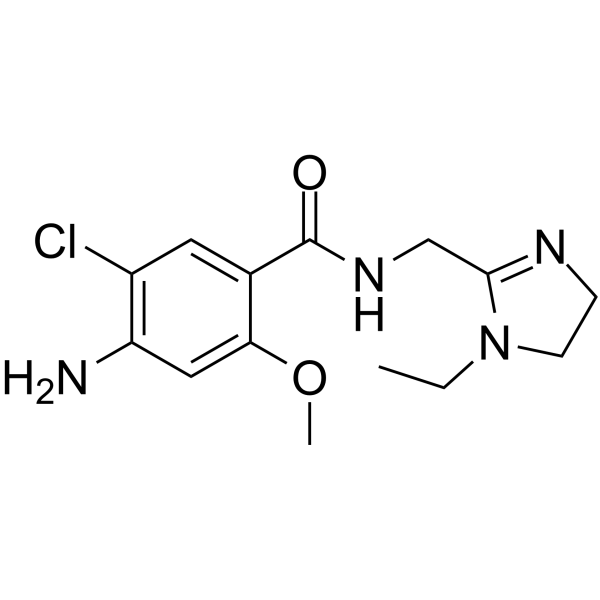
Lintopride hydrochloride, a benzamide, is a potent 5HT-4 antagonist with moderate 5HT-3 antagonist properties. Lintopride hydrochloride increases gastric emptying, stimulates antral and duodenal motility and accelerates intestinal transit in animal. Lintopride hydrochloride significantly increases the lower oesophageal sphincter (LOS) basal tone .
loading...
    loading...
Cat. No.: HY-131310
CAS No.: 111004-08-1
Target:  

Endogenous Metabolite

Research Areas:  

Metabolic Disease

9(S)-HpOTrE is a monohydroperoxy polyunsaturated fatty acid produced by the action of 5-lipoxygenase (5-LO) on α-linolenic acid. It can be further metabolized to colnelenic acid by a divinyl ether synthase activity found in garlic and potato microsomal fractions. 9(S)-HpOTrE also serves as a substrate for further oxidation by both soybean and potato LOs, resulting in the formation of 9,16-dihydroperoxy acid.The suicide inactivation of LOs when 9(S)-HpOTrE is used as a substrate is thought to occur via formation of an unstable epoxide.
loading...
    loading...
Cat. No.: HY-U00121
CAS No.: 107429-63-0
Target:  

5-HT Receptor

Research Areas:  

Metabolic Disease

Lintopride, a benzamide, is a potent 5HT-4 antagonist with moderate 5HT-3 antagonist properties. Lintopride increases gastric emptying, stimulates antral and duodenal motility and accelerates intestinal transit in animal. Lintopride significantly increases the lower oesophageal sphincter (LOS) basal tone .
loading...
    loading...
Cat. No.: HY-D1056I
Synonyms: LPS, from Akkermansia muciniphila
Lipopolysaccharides, from Akkermansia muciniphila (LPS, from Akkermansia muciniphila) are lipopolysaccharide endotoxins derived from Akkermansia muciniphila and are TLR-4 activators. Unlike typical LPS, Lipopolysaccharides, from Akkermansia muciniphila are R-type LPS or lipooligosaccharides (LOS), lacking the O-antigen domain and consisting only of a core oligosaccharide and a lipid A. Lipopolysaccharides, from Akkermansia muciniphila can activate TLR4 and TLR2, and may inhibit the TLR4/NF-κB pathway, thereby alleviating LPS-induced acute kidney injury .
It is recommended to prepare a solution with concentration ≥2 mg/mL. Vortex thoroughly for more than 10 minutes. Due to the adsorption characteristics of LPS, silanized container or low adsorption centrifuge tubes should be used for aliquoting and storage, and mix thoroughly before use.
loading...
    loading...

