14 Results for "

Lactobacillus casei

" in MedChemExpress (MCE) Product Catalog:
Products (14)

14 Results for "Lactobacillus casei" in MCE Product Catalog:

1
1 Cited Publications
Cat. No.: HY-120536
CAS No.: 13080-21-2
Purity:  ≥98.0%
Target:  

Bacterial

Research Areas:  

Infection

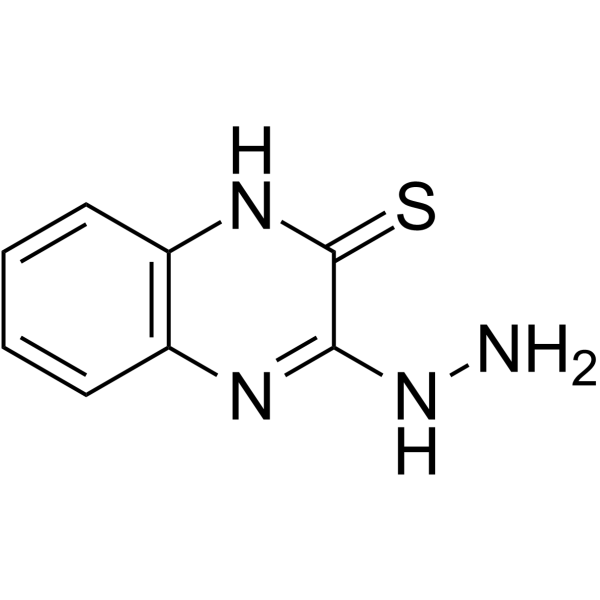
HPi1 is a potent, selective and orally active antimicrobial against Helicobacter pylori with an IC50 of 0.24 μM and an MIC of 0.08-0.16 μg/mL. HPi1 is inactive against other bacteria, including the gut commensals Lactobacillus casei, Lactobacillus reuteri, and Bifidobacterium longum .
loading...
    loading...
Cat. No.: HY-W096159
CAS No.: 53906-36-8
D-Biotinol is an orally active alcohol analogue of D-Biotin (HY-B0511). D-Biotinol can replace D-Biotin to restore the biotin deficiency induced by egg whites in rats. D-Biotinol can be used for the study of biotin deficiency disorders .
loading...
    loading...
Cat. No.: HY-107863
CAS No.: 308066-66-2
Purity:  99.45%
Synonyms: Oligolevulose
Fructooligosaccharides (Oligolevulose) are a class of orally active dietary fibers and prebiotics. Fructooligosaccharides exist in foods such as breast milk, wheat, honey, onions, garlic and bananas. Fructooligosaccharides resist hydrolysis by the body's digestive enzymes and stimulate the growth of beneficial intestinal bacteria through colonic fermentation. Fructooligosaccharides significantly prevent bone loss in the femur and lumbar spine .
loading...
    loading...
Cat. No.: HY-139410
CAS No.: 9005-46-3
Sodium caseinates is a kind of sodium salts of major milk proteins, which act as protein-based biopolymers and innate immune system activators. Sodium caseinates induce granulopoiesis, activation and differentiation, promote the production of M-CSF, and increase serum levels of G-CSF and GM-CSF. Sodium caseinates inhibit the proliferation and reduce the viability of leukemia macrophage-like cells, thereby significantly improving the survival rate of mice inoculated with leukemia cells. Sodium caseinates can serve as carriers for probiotics in edible films and exhibit anti-Listeria activity. Sodium caseinates effectively protect vitamin A from degradation, enhance its stability, bioaccessibility and bioavailability, and regulate protein digestibility when complexed with vitamin A. Sodium caseinates can be applied to research related to acute monocytic leukemia and vitamin A deficiency .
loading...
    loading...
Cat. No.: HY-E70029
Target:  

Glycosidase

Research Areas:  

Others

alpha-1,6-Fucosidase (LpAlfC(E274A)) (EC 3.2.1.51) cleaves branched non-reducing terminal fucose, linked α(1-6) to the core N-acetylglucosamine of N-linked oligosaccharides. alpha-1,6-Fucosidase (LpAlfC(E274A)) is useful for determining core fucosylation .
loading...
    loading...
Cat. No.: HY-P1997
CAS No.: 34787-28-5
Synonyms: Desferrichrome; DFC; N-Desferriferrichrome
Target:  

JNK Apoptosis

Research Areas:  

Infection Cancer

Ferrichrome Iron-free (Desferrichrome; DFC; N-Desferriferrichrome) is the ligand form of iron-loaded Ferrichrome when it is not bound to Fe 3+. Ferrichrome Iron-free induces apoptosis in gastric cancer cells by activating the JNK-DDIT3 apoptotic axis. As an iron chelator, Ferrichrome Iron-free enables dual-modal imaging of HER2 via conjugation with SiR and Trastuzumab (HY-P9907). Ferrichrome Iron-free can be used in the research of gastric cancer and HER2-overexpressing cancers .
loading...
    loading...
Cat. No.: HY-126878
CAS No.: 78520-72-6
Target:  

Antifolate

Research Areas:  

Infection Cancer

11-Oxahomoaminopterin shows antifolate activity and inhibits Lactobacillus casei DHFFZ with antimicrobial and antitumor activities .
loading...
    loading...
Cat. No.: HY-W142014
CAS No.: 102783-47-1
Target:  

Thymidylate Synthase

Research Areas:  

Cancer

N,O-Didansyl-L-tyrosine cyclohexylammonium is a potent selective thymidylate synthase (TS) inhibitor, acts on TS of Escherichia coli, Lactobacillus casei and human with the IC50 values of 5.0, 3.4 and 119 μM, respectively .
loading...
    loading...
Cat. No.: HY-122518
CAS No.: 51989-25-4
Target:  

Bacterial

Research Areas:  

Inflammation/Immunology

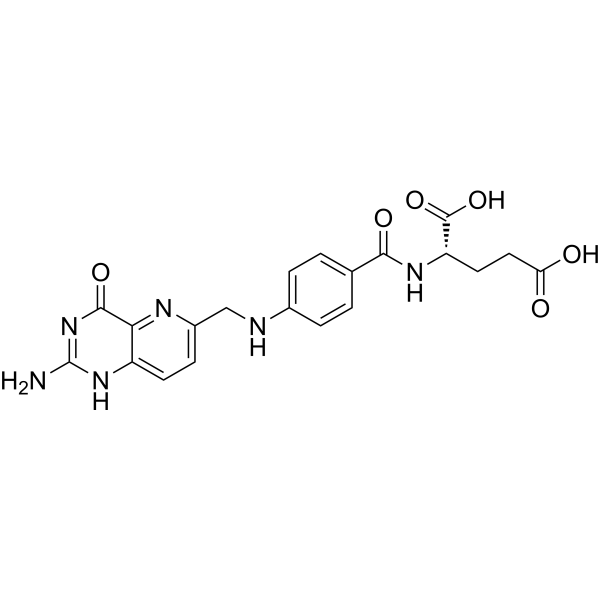
8-Deazafolic acid is an antimicrobial drug for the folate-dependent bacteria, Streptococcus faecium (ATCC 8043) and Lactobacillus casei (ATCC 74691). 8-Deazafolic acid has activity against lymphoid leukemia L1210 in mice .
loading...
    loading...
Cat. No.: HY-131518
CAS No.: 7611-43-0
Lycomarasmin has the inhibitory effect of lactobacillus casei, and it is a plant toxin .
loading...
    loading...
Cat. No.: HY-P11138
Synonyms: Lac705α
Research Areas:  

Infection

Lactocin 705α (Lac705α) is a peptide component of Lactocin 705. Lactocin 705α can interact with zwitterionic DPPC bilayers. Lactocin 705α can induce the dehydration of the bilayer interfacial region. Lactocin 705α can be used in the research of bacterial infections .
loading...
    loading...
Cat. No.: HY-121785
CAS No.: 54931-98-5
Target:  

Bacterial

Research Areas:  

Infection Cancer

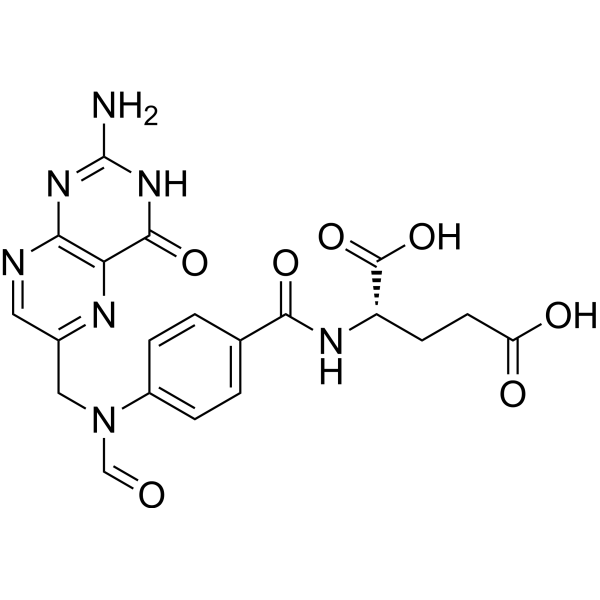
10-Thiofolic acid is a potent antibacterial and antitumor agent. 10-Thiofolic acid inhibits the growth of Streptococcus faecium (ATCC 8043) and Lactobacillus casei (ATCC 7469). 10-Thiofolic acid has the potential for the research of leukemia .
loading...
    loading...
Cat. No.: HY-W096159R
CAS No.: 53906-36-8
D-Biotinol (Standard) is the analytical standard of D-Biotinol (HY-W096159). This product is intended for research and analytical applications. D-Biotinol is an orally effective alcohol analogue of D-Biotin (HY-B0511). D-Biotinol can replace D-biotin to restore the biotin deficiency induced by egg whites in rats. D-Biotinol can be used for the study of biotin deficiency disorders.
loading...
    loading...
Cat. No.: HY-184417
CAS No.: 3085883-97-9
Target:  

Bacterial

Research Areas:  

Infection

Energy-coupling factor-IN-1 is an energy-coupling factor (ECF) transporter inhibitor with an IC50 of 42.84 μM against ECF-FolT2. Energy-coupling factor-IN-1 binds to the interface between the S component and the ECF module, and inhibits the uptake of folic acid and pantothenic acid via the target transporter. Energy-coupling factor-IN-1 acts as a bactericidal agent, exerting rapid and sustained activity for 24 h against Enterococcus faecium, while also acting against Gram-positive bacteria including drug-resistant strains. Energy-coupling factor-IN-1 improves the survival rate of zebrafish embryos infected with Enterococcus faecium. Energy-coupling factor-IN-1 can be used in studies of Gram-positive bacterial infections .
loading...
    loading...
  • 1

