12 Results for "

Membrane-targeting

" in MedChemExpress (MCE) Product Catalog:
Products (12)

12 Results for "Membrane-targeting" in MCE Product Catalog:

Cat. No.: HY-158408
CAS No.: 3062992-25-7
Target:  

ULK Mitophagy TSPO

Research Areas:  

Neurological Disease

NZ-66 is a ULK1-Recruiting Chimera (ULKREC) and heterobifunctional chimeric molecule composed of a BL-918-derived ULK1 agonist linked to a mitochondrial outer membrane-targeting TSPO ligand via a six-carbon hexane linker. NZ-66 is a mitophagy inducer recruits ULK1 to mitochondria to induce ULK1-dependent mitophagy, enhanced by mitochondrial insult, independently of the PRKN/PINK axis. NZ-66 can be used for the research of parkinson’s disease .
loading...
    loading...
Cat. No.: HY-W154333
CAS No.: 87459-72-1
Target:  

Bacterial

Research Areas:  

Infection

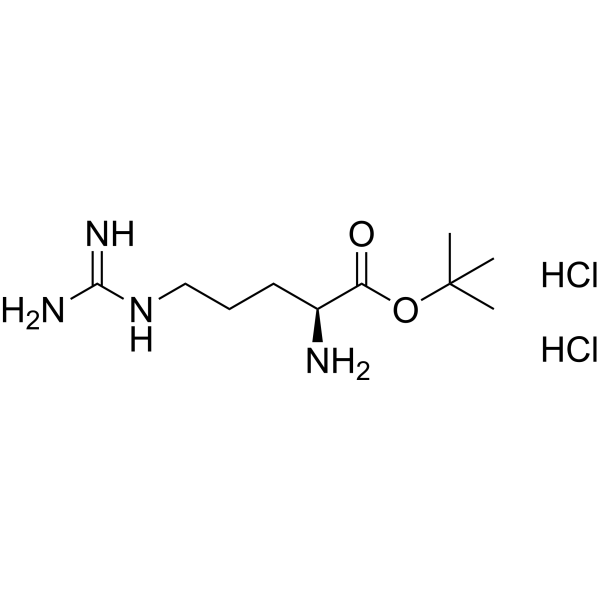
H-Arg-OtBu (dihydrochloride) is a membrane-targeting antimicrobial. H-Arg-OtBu (dihydrochloride) targets the negatively charged bacterial membrane via a combination of electrostatic and hydrophobic interactions. H-Arg-OtBu (dihydrochloride) can be used for bacterial infections diseases research .
loading...
    loading...
Cat. No.: HY-P2548
CAS No.: 176042-83-4
Target:  

EGFR

Research Areas:  

Others

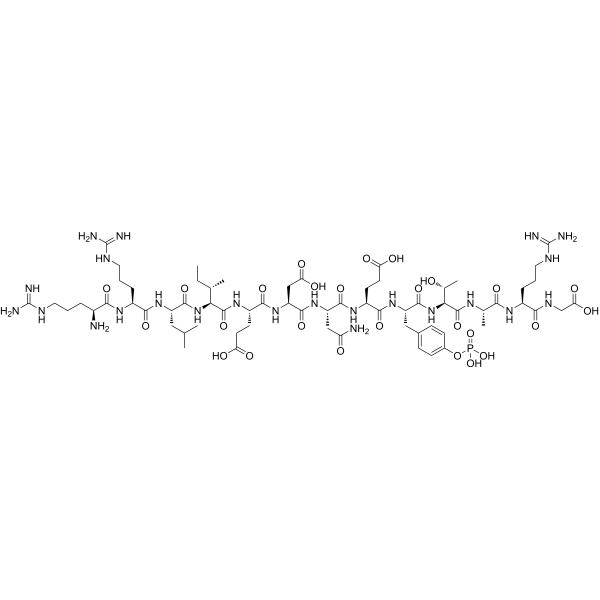
pp60 (v-SRC) Autophosphorylation Site, Phosphorylated is the phosphorylated peptide of an EGFR substrate. pp60 (v-SRC) Autophosphorylation Site, Phosphorylated can be used for the screening of EGFR Kinase inhibitors via phosphorylated-substrate quantification .
loading...
    loading...
Cat. No.: HY-152102
Target:  

Fluorescent Dye

Research Areas:  

Cancer

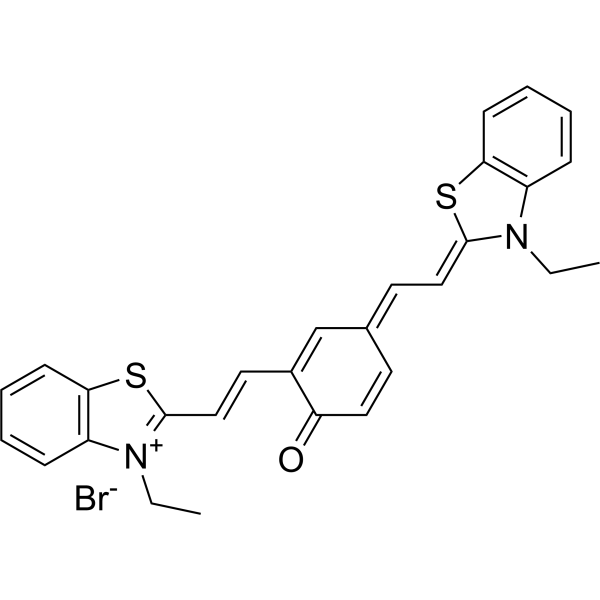
BTCy is a near-infrared (NIR) fluorescence probe with polarity-responsive and cell plasma membrane-targeting properties. BTCy can be used for in vivo imaging of tumor tissue (λex = 561 nm, λem = 600-700 nm) .
loading...
    loading...
Cat. No.: HY-161922
Target:  

Bacterial

Research Areas:  

Infection

Antibacterial agent 235 (compound thy2I) shows antibacterial activity with minimum inhibitory concentration (MIC) values ranging from 0.5 μg/mL to 8 μg/mL. Antibacterial agent 235 could kill both gram-positive and gram-negative bacteria via a membrane-targeting mechanism of action with a low frequency of resistance .
loading...
    loading...
Cat. No.: HY-173239
Target:  

Bacterial

Research Areas:  

Infection

Antibacterial agent 274 (Compound 18b) is a membrane-targeting antibacterial agent that demonstrates a MIC of 8 μg/mL against Acinetobacter baumannii ATCC 17978. By disrupting bacterial membrane integrity, it induces intracellular ROS accumulation and causes leakage of DNA and proteins, thereby exhibiting potent antibacterial activity. This compound is suitable for research applications targeting Gram-negative bacterial infections .
loading...
    loading...
Cat. No.: HY-173238
Research Areas:  

Infection

Antibacterial Agent 273 (Compound 15e) is a membrane-targeting antimicrobial agent that disrupts bacterial cell membranes, exhibiting a MIC of 4 μg/mL against Staphylococcus aureus. By compromising membrane integrity, it induces leakage of intracellular nucleic acids and proteins, suppresses bacterial metabolic activity, and triggers the accumulation of reactive oxygen species (ROS). Antibacterial Agent 273 is suitable for research on infections caused by Staphylococcus aureus .
loading...
    loading...
Cat. No.: HY-161988
CAS No.: 3055131-42-2
Target:  

Bacterial

Research Areas:  

Infection Inflammation/Immunology

Antimicrobial agent-34 (compound 4h) is an antibacterial agent (MIC = 1–4 μg/mL), with a clogP value of 9.14. Antimicrobial agent-34 has good plasma stability (HC50 of 131.1 μg/mL) and good membrane selectivity (HC50/MIC is 65.6), with rapid sterilization capability. Antimicrobial agent-34 destroys the integrity of bacterial cell membranes, induces an increase in intracellular reactive oxygen species, and leaks protein and DNA, ultimately leading to bacterial death. Antimicrobial agent-34 demonstrates significant in vivo antibacterial potency in a mouse sepsis model infected with Staphylococcus aureus ATCC43300 .
loading...
    loading...
Cat. No.: HY-168852
Target:  

Bacterial

Research Areas:  

Infection

Antimicrobial agent-37 (compound 6a) is a potent broad-spectrum antimicrobial agent that has a biofilm-destroying effect, acting on bacterial membranes and cracking them .
loading...
    loading...
Cat. No.: HY-D3213
Mem-Cu (II) is a cell membrane-targeted divalent copper ion (Cu 2+) probe .
loading...
    loading...
Cat. No.: HY-179438
Target:  

Bacterial

Research Areas:  

Cancer

Antibacterial agent 302 is an antibacterial agent. Antibacterial agent 302 shows a potent and broad-spectrum antibacterial activity. Antibacterial agent 302 has no significant hemolytic toxicity and cytotoxicity, and a low tendency to induce resistance. Antibacterial agent 302 exerts its antibacterial mechanism by disrupting the integrity of the bacterial cell membranes. Antibacterial agent 302 can be used for the study of bacterial keratitis .
loading...
    loading...
Cat. No.: HY-180672
Target:  

Fungal

Research Areas:  

Infection

Antifungal agent 145 (Compound 14') is a highly effective fungicide. Antifungal agent 145 exhibits MICs against Candida albicans, Candida tropicalis, and Cryptococcus neoformans of 4, 8, and 8 μg/mL respectively. Antifungal agent 145 exerts a potent and rapid bactericidal effect by disrupting the fungal cell membrane, and can effectively inhibit and destroy biofilms. Antifungal agent 145 has improved safety and can be used in antifungal research .
loading...
    loading...
  • 1

