1. Search Result
Search Result
Results for "

OCI-AML3

" in MedChemExpress (MCE) Product Catalog:
Cat. No. Product Name Target Research Areas Chemical Structure
  • HY-153714

    BN-104; BNM-1192; Menin-MLL inhibitor 27

    Epigenetic Reader Domain Potassium Channel Cancer
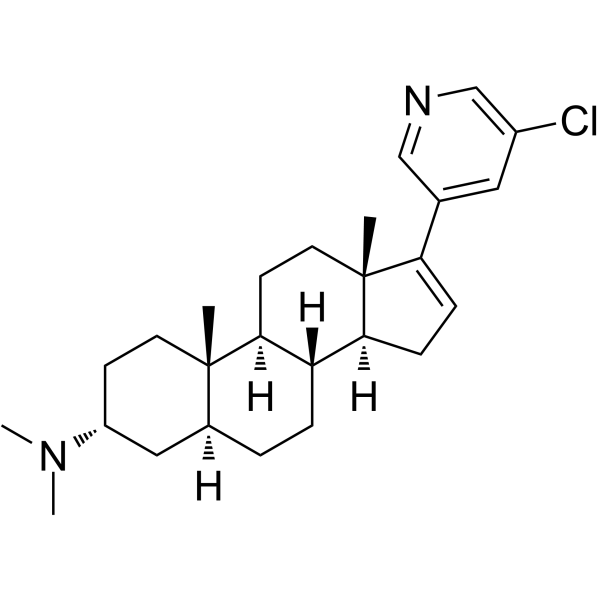
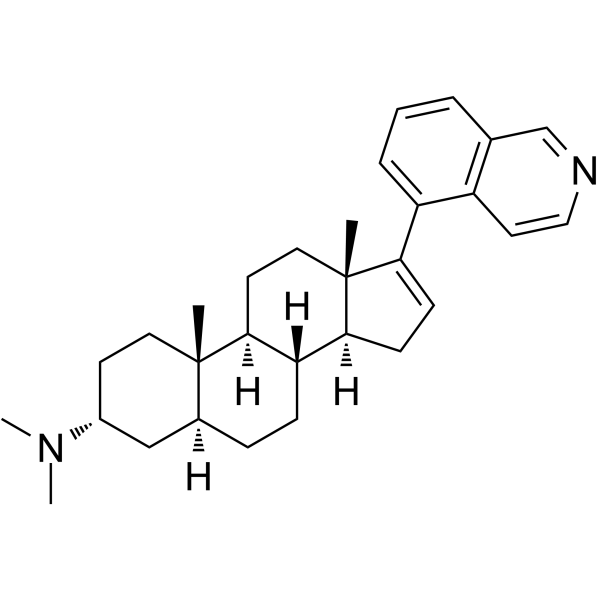
    Zefamenib (BN-104) is an effective selective brain membrane protein inhibitor with oral activity, and it's also a Menin inhibitor, it can block the Menin-MLL interaction and leads to the degradation of Menin protein. Zefamenib is a weak hERG inhibitor, with an IC50 greater than 100 μM. Zefamenib has anti-tumor activity and can be used in cancer research, such as for acute myeloid leukemia .
    Zefamenib
  • HY-172262

    VDAC Bcl-2 Family Apoptosis Cancer
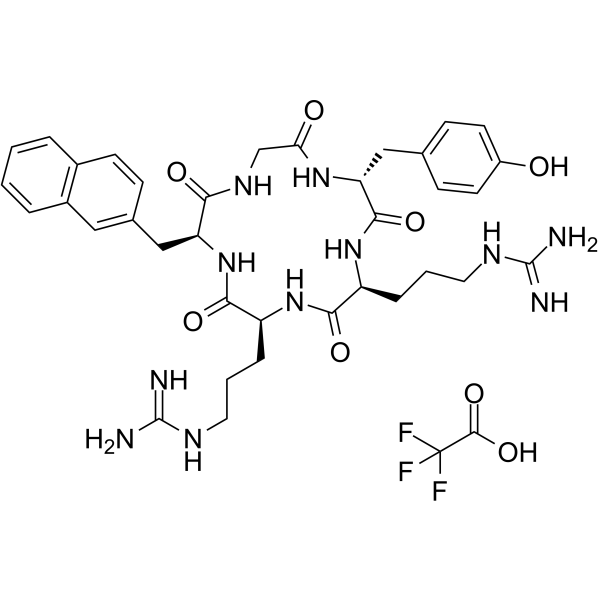
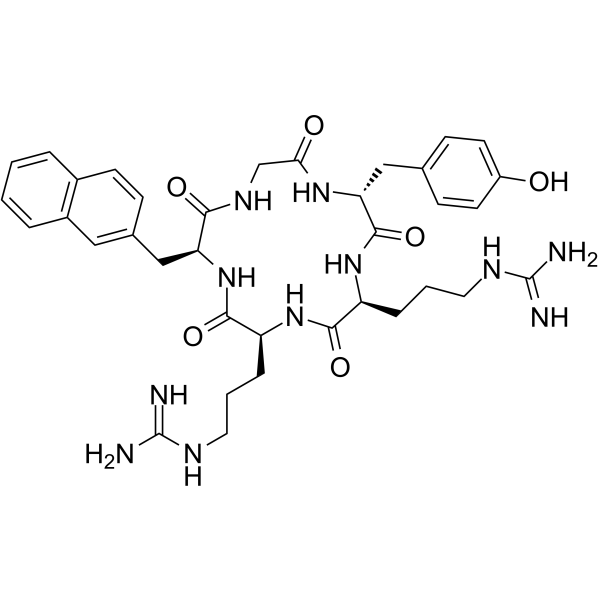
    WEHI-3773 is a VDAC2 ligand and apoptosis modulator. WEHI-3773 directly binds to the β7-β10 region of VDAC2 and disrupts its interaction with BAX and BAK. WEHI-3773 regulates BAX-mediated apoptosis in BAK-deficient cells by modulating conformational activation of BAX, mitochondrial redistribution, and cytochrome c release. WEHI-3773 overcomes Venetoclax (HY-15531) resistance, resensitizes leukemia cells carrying BAX mutations to BH3 mimetics, and enables long-term clonogenic survival of BAK-deficient cells treated with BH3 mimetics. WEHI-3773 is applicable to research related to acute myeloid leukemia .
    WEHI-3773
  • HY-16271
    Kevetrin hydrochloride
    4 Publications Verification

    4-Isothioureidobutyronitrile hydrochloride; thioureidobutyronitrile hydrochloride; thioureido butyronitrile hydrochloride

    MDM-2/p53 Apoptosis Cancer
    Kevetrin hydrochloride is a potent activator of p53, induces apoptosis in TP53 wild-type and mutant acute myeloid leukemia cells. Kevetrin a preferential cytotoxic activity against blast cells .
    Kevetrin hydrochloride
  • HY-122623A

    Apoptosis Cancer
    DB818 dihydrochloride is the dihydrochloride salt form of DB818 (HY-122623). DB818 dihydrochloride is an inhibitor for Homeobox A9 (HOXA9). DB818 dihydrochloride reduces the formation of HOXA9-DNA complexes, inhibits the growth and induces apoptosis in AML cell lines OCI/AML3, MV4-11, and THP-1 .
    DB818 dihydrochloride
  • HY-168936

    PROTACs Epigenetic Reader Domain Apoptosis Cancer
    DP-15 is the degrader for GSPT1 and BRD4 with DC50s of 5.25 nM and 0.48 nM. DP-15 exhibits anti-proliferative activity of AML cells and NHL cells with an IC50 of nanomolar levels, arrests the cell cycle at G1 phase, and induces apoptosis in MOLM13. DP-15 exhibits anti-leukemia activity in MOLM-13 xenograft mouse models . (Pink: ligand for target protein JQ-1 carboxylic acid (HY-78695); Black: linker (HY-W262798); Blue: ligand for E3 ligase Cereblon Thalidomide-5-OH (HY-23095))
    DP-15
  • HY-164840A

    DNA/RNA Synthesis Cancer
    Clofarabine-5'-triphosphate trisodium is the trisodium salt form of Clofarabine-5'-triphosphate (HY-164840). Clofarabine-5'-triphosphate trisodium is the metabolite of Clofarabine (HY-A0005) by deoxycytidine kinase (dCK) phosphorylation. Clofarabine-5'-triphosphate trisodium exhibits cytotoxicity in cancer cells through inhibition of DNA synthesis and DNA repair .
    Clofarabine-5'-triphosphate trisodium
  • HY-172194

    CDK Cancer
    JNJ-3738 (Compound 148) is the inhibitor for CDK7 with a Ki of 21.75 nM. JNJ-3738 inhibits the proliferation of CDK7 WT expressing A549 with pIC50 of 7.37 .
    JNJ-3738
  • HY-179267

    Fat Mass and Obesity-associated Protein (FTO) c-Myc RAR/RXR Apoptosis Cancer
    FTO-IN-16 (Compound 8a-1), a FTO-IN-15 (HY-179266) prodrug, is a potent FTO inhibitor. FTO-IN-16 suppresses acute myeloid leukemia (AML) cell viability, increases m 6A levels, downregulates c-Myc and CEBPA, and upregulates ASB2 and RARA. FTO-IN-16 induces apoptosis. FTO-IN-16 demonstrates strong in vivo efficacy in AML mouse xenografts. FTO-IN-16 can be used for the research of AML .
    FTO-IN-16
  • HY-150025

    DNA Methyltransferase Apoptosis Cancer
    (4aS,8aR)-NPD-001 is a potent and allosteric inhibitor of DNMT3A. (4aS,8aR)-NPD-001 inhibits DNMT3A activity by disrupting protein-protein interactions. (4aS,8aR)-NPD-001 induces apoptosis of acute myeloid leukemia (AML) cell lines. (4aS,8aR)-NPD-001 induces differentiation of distinct AML cell lines including cells with mutated DNMT3A R882 .
    (4aS,8aR)-NPD-001
  • HY-163678

    E3 Ligase Ligand-Linker Conjugates Cancer
    Pomalidomide-CO-C7-NH-CO-C3-COOH is a conjugate of a ligand for E3 ligase and a linker. Pomalidomide-CO-C7-NH-CO-C3-COOH can be used for synthesis of PROTAC degrader ARM165 (HY-163677) .
    Pomalidomide-CO-C7-NH-CO-C3-COOH
  • HY-175473

    FLT3 Apoptosis Cancer
    HI042 is a FMS-like Tyrosine Kinase 3 (FLT3) inhibitor. HI042 shows IC50 values of 0.62 μM for MOLM-13, 0.33 μM for MV4-11, and 0.89 μM for OCI-AML3 cells. HI042 selectively reduces the viability of FLT3-internal tandem duplication (FLT3-|TD) mutations-positive cell lines, induces apoptosis, disrupts cell cycle progression, and diminishes the clonogenic potential. HI042 can be used for the research of acute myeloid leukemia (AML) .
    HI042
  • HY-172399

    Fat Mass and Obesity-associated Protein (FTO) Apoptosis Cancer
    FTO-IN-14 (Compound F97) is the inhibitor for the RNA demethylase Fat mass and obesity-associated protein FTO with IC50 of 0.45 μM. FTO-IN-14 regulates the protein expression of ASB2, RARA and MYC. FTO-IN-14 exhibits antiproliferative activity in AML cancer cells (IC50 for MOLM13, NB4, HEL, OCI-AML3, MV4-11 and MONOMAC6 is 0.7-5.5 μM), induces apoptosis in NB4 cell. FTO-IN-14 exhibits antitumor activity in mouse NB4 xenograft models .
    FTO-IN-14
  • HY-147716

    CDK Cancer
    CDK8-IN-6 (compound 9) is a potent cyclin-dependent kinase 8 (CDK8) inhibitor with an Kd of 13 nM. CDK8-IN-6 shows cytotoxicity for MOLM-13, OCI-AML3, MV4-11, NRK and H9c2 cells with IC50s of 11.2, 7.5, 8.6, 20.5, 12.5-25 µM, respectively. CDK8-IN-6 has the potential for the research of AML-cancer .
    CDK8-IN-6
  • HY-147717

    CDK Cancer
    CDK8-IN-7 (compound 12) is a potent and selective cyclin-dependent kinase 8 (CDK8) inhibitor with an Kd of 3.5 nM. CDK8-IN-7 shows cytotoxicity for MOLM-13, OCI-AML3, MV4-11, NRK and H9c2 cells with IC50s of 5.9, 4.8, 5.4, 16.2, 12.5-25 µM, respectively. CDK8-IN-7 has the potential for the research of AML-cancer .
    CDK8-IN-7
  • HY-164840

    Clofarabine-TP

    DNA/RNA Synthesis Cancer
    Clofarabine-5'-triphosphate is the metabolite of Clofarabine (HY-A0005) by deoxycytidine kinase (dCK) phosphorylation. Clofarabine-5'-triphosphate exhibits cytotoxicity in cancer cells through inhibition of DNA synthesis and DNA repair .
    Clofarabine-5'-triphosphate
  • HY-164839A

    Clofarabine-DP trisodium

    DNA/RNA Synthesis Cancer
    Clofarabine-5'-diphosphate trisodium (Clofarabine-DP trisodium) is the trisodium salt form of Clofarabine-5'-diphosphate (HY-164839). Clofarabine-5'-diphosphate trisodium is the metabolite of Clofarabine (HY-A0005) by deoxycytidine kinase (dCK) phosphorylation. Clofarabine-5'-diphosphate trisodium can be further phorphorylated into Clofarabine-5'-triphosphate, and exhibits cytotoxicity in cancer cells through inhibition of DNA synthesis and DNA repair .
    Clofarabine-5'-diphosphate trisodium
  • HY-164839

    Clofarabine-DP

    DNA/RNA Synthesis Cancer
    Clofarabine-5'-diphosphate (Clofarabine-DP) is the metabolite of Clofarabine (HY-A0005) by deoxycytidine kinase (dCK) phosphorylation. Clofarabine-5'-diphosphate can be further phorphorylated into Clofarabine-5'-triphosphate, and exhibits cytotoxicity in cancer cells through inhibition of DNA synthesis and DNA repair .
    Clofarabine-5'-diphosphate
  • HY-163442A

    Pim Cancer
    PIM3-IN-1 hydrochloride (Compound 19a) is an inhibitor of (PIM2/3), with the highest inhibition level being against PIM3, having an IC50 value in the nanomolar range. PIM3-IN-1 hydrochloride can be used in cancer research .
    PIM3-IN-1 hydrochloride
  • HY-160733

    Epigenetic Reader Domain Cancer
    Menin-MLL-IN-32 (compound 51) is a Menin-MLL interaction inhibitor with an IC50 of 0.042 nM in HTRF assay. Menin-MLL-IN-32 inhibits MEIS1 mRNA expression with an IC50 of 11 nM. Menin-MLL-IN-32 shows anti-proliferative effects, with IC50 values of 8 nM, 24 nM and 1900 nM for MOLM14 cells, OCI-AML3 cells and KO-52 cells, respectively. Menin-MLL-IN-32 can be used for the study of leukemia .
    Menin-MLL-IN-32
  • HY-182793

    Histone Methyltransferase Cancer
    MLL1-IN-1 is an orally active MLL1 inhibitor with an IC50 of 0.043 μM. MLL1-IN-1 induces Menin protein degradation and inhibits the proliferation of leukemia cells. MLL1-IN-1 can induce tumor regression in leukemia-bearing mice. MLL1-IN-1 is useful for research into MLL1-associated leukemia .
    MLL1-IN-1
  • HY-181690

    Epigenetic Reader Domain Cancer
    Menin-MLL-IN-37 is an orally active Menin-MLL protein complex inhibitor with an IC50 of 820.50 nM. Menin-MLL-IN-37 disrupts the interaction between menin and MLL proteins. Menin-MLL-IN-37 induces differentiation of acute myeloid leukemia cells and selectively inhibits the proliferation of MLL-rearranged and DNMT3A/NPM1-mutant leukemia cells. Menin-MLL-IN-37 can be used for the research of acute myeloid leukemia (AML) .
    Menin-MLL-IN-37

Inquiry Online

Your information is safe with us. * Required Fields.

Salutation


Country or Region *

Applicant Name *


Organization Name *

Department *


Email Address *


Product Name *

Cat. No.


Requested quantity *

Phone Number *


Remarks

Inquiry Online

Inquiry Information

Product Name:
Cat. No.:
Quantity:
MCE Japan Authorized Agent:

