1. Search Result
Search Result
Results for "

OPM-2

" in MedChemExpress (MCE) Product Catalog:

10

Inhibitors & Agonists

1

Inhibitory Antibodies

1

Antibodies

1

Click Chemistry

Cat. No. Product Name Target Research Areas Chemical Structure
  • HY-149672

    Bcl-2 Family Apoptosis Cancer
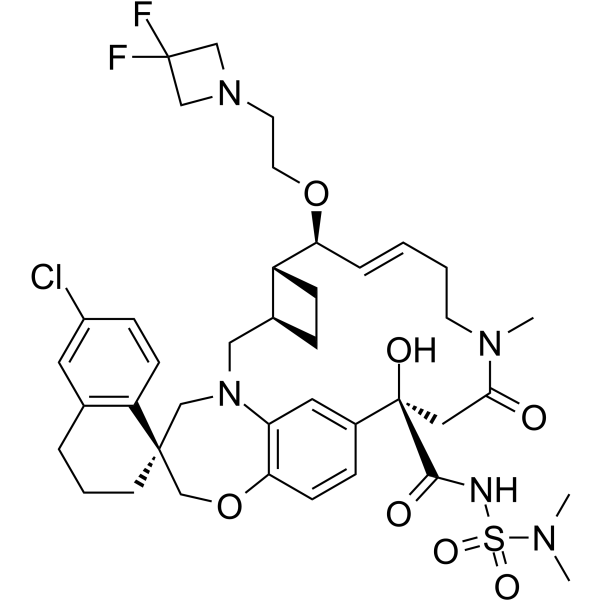
    ABBV-467 is a selective MCL-1 inhibitor (Ki: <0.01 nM). ABBV-467 induces apoptosis. ABBV-467 induces cancer cell death and inhibits tumor growth in models of hematological malignancies, such as multiple myeloma .
    ABBV-467
  • HY-19322B
    PIM-447 dihydrochloride
    5+ Cited Publications

    LGH447 dihydrochloride

    Pim Apoptosis Cancer
    PIM447 dihydrochloride (LGH447 dihydrochloride) is a potent, orally available, and selective pan-PIM kinase inhibitor, with Ki values of 6, 18, and 9 pM for PIM1, PIM2, and PIM3, respectively. PIM447 dihydrochloride displays dual antimyeloma and bone-protective effects. PIM447 dihydrochloride induces apoptosis [2].
    PIM-447 dihydrochloride
  • HY-P99430

    EM901; CC-93269

    CD3 Inflammation/Immunology Cancer
    Alnuctamab (EM901) is a bispecific T-cell engager targeting BCMA and CD3, belonging to an asymmetric two-armed humanized IgG1 antibody. Alnuctamab can simultaneously bind to BCMA expressed on the surface of myeloma cells and CD3 molecules on the surface of T cells, recruiting T cells to kill tumors. Alnuctamab is used for the research of multiple myeloma. Recommend Isotype Controls: Human IgG1 kappa, Isotype Control (HY-P99001) [2] .
    Alnuctamab
  • HY-107194

    FGFR c-Myc DNA/RNA Synthesis Caspase Reactive Oxygen Species (ROS) Cancer
    NSC12 is an orally active pan-FGF trap. NSC12 inhibits the interaction between FGF2/FGFR. NSC12 suppresses the phosphorylation of FGFR3. NSC12 reduces c-Myc levels, induces DNA damage, triggers the cleavage of Caspase 3, and promotes ROS production. NSC12 exhibits anticancer activity against lung cancer and multiple myeloma [2].
    NSC12
  • HY-146445

    Epigenetic Reader Domain Histone Acetyltransferase Cancer
    P300 bromodomain-IN-1 (Compoun 1u) is a potent p300 (EP300) bromodomain inhibitor with an IC50 of 49 nM. P300 bromodomain-IN-1 suppresses the expression of c-Myc and induces G1/G0 phase arrest and apoptosis in OPM-2 cells .
    P300 bromodomain-IN-1
  • HY-133015

    Bcl-2 Family Cancer
    Mcl-1 inhibitor 3 (compound 1) is a highly potent and orally activate macrocyclic Mcl-1 inhibitor (Ki= 0.061 nM; IC50=19 nM in an OPM-2 cell viability assay). Mcl-1 inhibitor 3 shows good pharmacokinetic properties and excellent in vivo efficacy without toxicity .
    .
    Mcl-1 inhibitor 3
  • HY-148203

    Bcl-2 Family Cancer
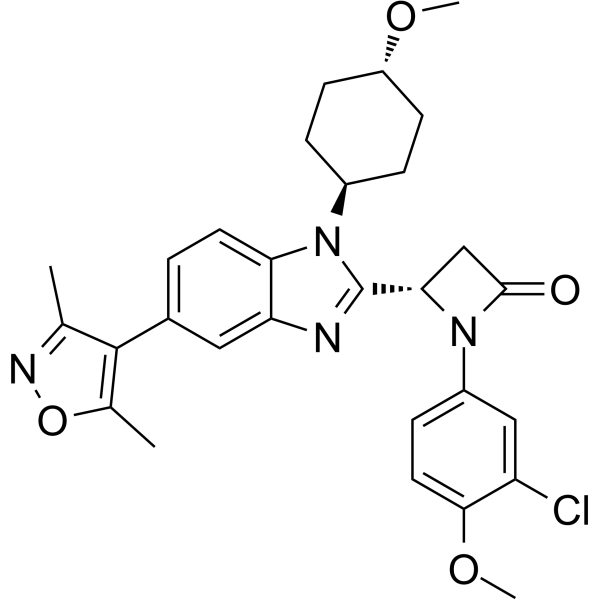
    Mcl-1 inhibitor 9 (example 2) is a myeloid cell leukemia 1 (Mcl-1) inhibitor with IC50 value of 0.21889 nM. Mcl-1 inhibitor 9 shows anti-tumor activity .
    Mcl-1 inhibitor 9
  • HY-180804

    Epigenetic Reader Domain Cancer
    CZL-077 is a potent, selective, and orally active p300/CBP bromodomain (BRD) inhibitor (p300 IC50 = 0.034 μM, CBP IC50 = 0.052 μM) exhibiting high selectivity over the BRDs of BET proteins (BRD2/3/4). CZL-077 inhibits cell growth with IC50 values of 0.024 μM and 5.6 μM in OPM-2 and 22RV1 cells, respectively. CZL-077 shows antitumor efficacy in OPM-2 and 22RV1 xenograft mouse models. CZL-077 can be used for multiple myeloma and prostate cancer research .
    CZL-077
  • HY-181669

    Histone Acetyltransferase c-Myc Cancer
    P300-IN-6 is an orally active histone acetyltransferase p300 HAT domain inhibitor with human IC50 values of 7 nM. P300-IN-6 suppresses c-Myc expression, decreases H3K18ac and H3K27ac levels, and inhibits cancer cell proliferation.P300-IN-6 suppresses tumor growth in xenograft mouse models.P300-IN-6 can be used for the research of multiple myeloma .
    P300-IN-6
  • HY-181849

    Histone Methyltransferase Cancer
    MS2928 is a selective SETD8 inhibitor with an IC50 of 0.14 μM against SETD8 methyltransferase activity. MS2928 reduces cellular H4K20me1 levels and inhibits proliferation of SETD8-overexpressing multiple myeloma cells. MS2928 inhibits tumor growth in xenograft mouse models of SETD8-overexpressing multiple myeloma. MS2928 can be used for the study of SETD8 biological functions and multiple myeloma .
    MS2928

Inquiry Online

Your information is safe with us. * Required Fields.

Salutation


Country or Region *

Applicant Name *


Organization Name *

Department *


Email Address *


Product Name *

Cat. No.


Requested quantity *

Phone Number *


Remarks

Inquiry Online

Inquiry Information

Product Name:
Cat. No.:
Quantity:
MCE Japan Authorized Agent:

