13 Results for "

PDPK1

" in MedChemExpress (MCE) Product Catalog:
Products (13)

13 Results for "PDPK1" in MCE Product Catalog:

2
2 Cited Publications
Cat. No.: HY-12063
CAS No.: 1191951-57-1
Purity:  98.09%
Target:  

Akt Apoptosis

Research Areas:  

Cancer

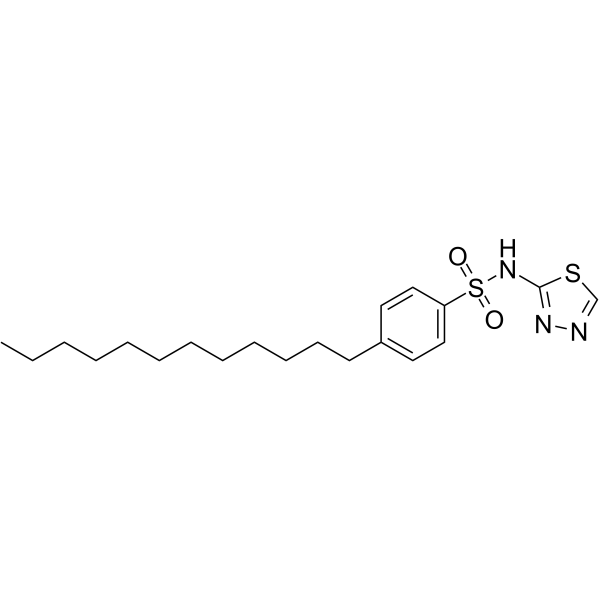
PHT-247 is an inhibitor of the pleckstrin homology (PH) domain of Akt, and it is also an inhibitor of PDPK1 with Kis of 2.7 µM and 5.2 µM and for Akt and PDPK1, respectively.
loading...
    loading...
1
1 Cited Publications
Cat. No.: HY-123467
CAS No.: 28957-08-6
Purity:  99.68%
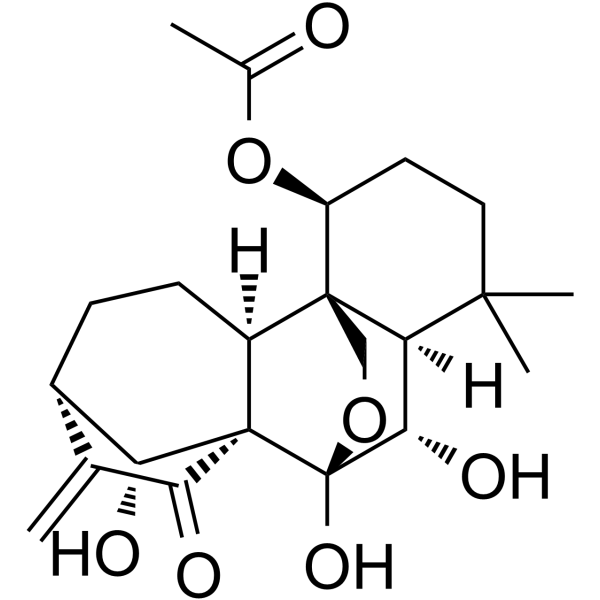
Lasiokaurin is an anticancer agent. Lasiokaurin can be isolated from Rabdosia rubescens (Hemsl.) H. Hara. Lasiokaurin inhibits the function of the PDPK1-AKT axis, with a Kd value of 75.93 μM for PDPK1. Lasiokaurin inhibits mTOR, STAT3, MAPK and NF-κB. Lasiokaurin reduces the mRNA and protein expression levels of PLK1. Lasiokaurin decreases DNA synthesis levels, induces cell Apoptosis, and regulates Autophagy processes. Lasiokaurin inhibits tumor growth in xenograft models. Lasiokaurin can be used in research related to nasopharyngeal carcinoma, triple-negative breast cancer [1] .
loading...
    loading...
Cat. No.: HY-RS10287
Research Areas:  

Others

PDPK1 Human Pre-designed siRNA Set A contains three designed siRNAs for PDPK1 gene (Human), as well as a negative control, a positive control, and a FAM-labeled negative control.

loading...
    loading...
Cat. No.: HY-RS17027
Research Areas:  

Others

Pdpk1 Mouse Pre-designed siRNA Set A contains three designed siRNAs for Pdpk1 gene (Mouse), as well as a negative control, a positive control, and a FAM-labeled negative control.

loading...
    loading...
Cat. No.: HY-RS23470
Research Areas:  

Others

Pdpk1 Rat Pre-designed siRNA Set A contains three designed siRNAs for Pdpk1 gene (Rat), as well as a negative control, a positive control, and a FAM-labeled negative control.

loading...
    loading...
Cat. No.: HY-W719359
PHT-427-d4 is the deuterium labeled PHT-427 (HY-12063). PHT-247 is an inhibitor of the pleckstrin homology (PH) domain of Akt, and it is also an inhibitor of PDPK1 with Kis of 2.7 μM and 5.2 μM and for Akt and PDPK1, respectively.
loading...
    loading...
Cat. No.: HY-P86174
Synonyms: PDPK1; PDK1; 3-phosphoinositide-dependent protein kinase 1; hPDK1

Host:  

Rabbit

Application:  

WB, IHC-P, ICC/IF, IP, ELISA

Reactivity:  

Human, Mouse, Rat

loading...
    loading...
Cat. No.: HY-P86089
Synonyms: PDPK1; PDK1; 3-phosphoinositide-dependent protein kinase 1; hPDK1

Host:  

Rabbit

Application:  

WB, ICC/IF, IP, ELISA

Reactivity:  

Human, Mouse, Rat

loading...
    loading...
Cat. No.: HY-P81824
Synonyms: PDPK1; PDK1; 3-phosphoinositide-dependent protein kinase 1; hPDK1

Host:  

Rabbit

Application:  

WB

Reactivity:  

Human, Mouse, Rat

loading...
    loading...
Cat. No.: HY-P701738
Purity:  ≥ 90%, as determined by reducing SDS-PAGE.
Synonyms: PDPK1; PkB Kinase Like Gene 1; 3-Phosphoinositide Dependent Protein Kinase 1; PkB Kinase; PDK1; PRO0461; 3-Phosphoinositide-Dependent Protein Kinase 1; HPDK1; Non-Specific Serine/Threonine Protein Kinase
Species:  
Human
Source:  
Sf9 insect cells
loading...
    loading...
Cat. No.: HY-P81824A
Synonyms: PDPK1; PDK1; 3-phosphoinositide-dependent protein kinase 1; hPDK1

Host:  

Rabbit

Application:  

WB

Reactivity:  

Human, Mouse, Rat

loading...
    loading...
Cat. No.: HY-P701739
Purity:  ≥ 90%, as determined by reducing SDS-PAGE.
Synonyms: PDPK1; PkB Kinase Like Gene 1; 3-Phosphoinositide Dependent Protein Kinase 1; PkB Kinase; PDK1; PRO0461; 3-Phosphoinositide-Dependent Protein Kinase 1; HPDK1; Non-Specific Serine/Threonine Protein Kinase
Species:  
Human
Source:  
Sf9 insect cells
loading...
    loading...
Cat. No.: HY-N11231
CAS No.: 7176-02-5
Fucoxanthinol, a carotenoid, is a deacetylated Fucoxanthin (HY-N2302) metabolite with oral activity, and inhibits rat pancreatic lipase with an IC50 of 764 nM. Fucoxanthinol reduces expression of Bcl-2, Bcl-xL, survivin, XIAP, cIAP2, cyclin D1, cyclin D2, cyclin E, CDK4, CDK6, β-catenin, JunD, PPARγ, and induces GADD45α expression. Fucoxanthinol activates caspase-3, caspase-8, caspase-9, Nrf2/Keap1/ARE pathway, and inhibits activation of Akt, NF-κB, AP-1, PDPK1, GSK3β phosphorylation. Fucoxanthinol induces apoptosis, G0/G1 cell cycle arrest, inhibits cancer cell viability, proliferation, migration, invasiveness, tumour growth, adipocyte differentiation, oxidative stress, neurotoxicity, triglyceride absorption, angiogenesis, and obesity-induced inflammation. Fucoxanthinol can be used for the research of osteosarcoma, leukemia, lymphoma, adult T-cell leukemia, prostate cancer, colon cancer, breast cancer, hypertriglyceridaemia, Alzheimer’s disease, Parkinson’s disease, obesity, insulin resistance, malignant melanoma, and type II diabetes [1] .
loading...
    loading...
  • 1

