10 Results for "

SNAIL/SLUG

" in MedChemExpress (MCE) Product Catalog:
Products (10)

10 Results for "SNAIL/SLUG" in MCE Product Catalog:

Cat. No.: HY-B1647
CAS No.: 10045-86-0
Ferric phosphate is used as food and feed supplement, particularly in bread enrichment. Ferric phosphate is also used as a fertilizer and as a molluscicide for a variety of slugs and snails including Deroceras reticulatum, D.laeve, Arion subfuscus .
loading...
    loading...
Cat. No.: HY-157435
CAS No.: 3034889-94-3
Purity:  98.14%
Research Areas:  

Cancer

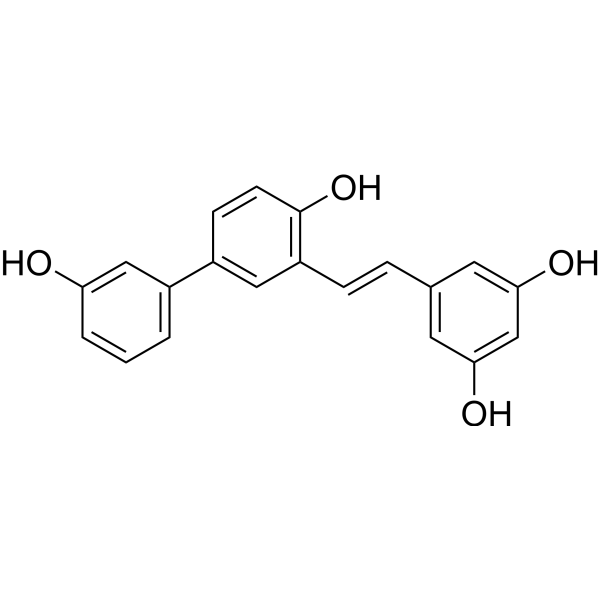
PELI1-IN-1 (compound 3d) is a potent inhibitor of PELI1, E3 ubiquitin ligase. PELI1-IN-1 has anti-tumPELI1-IN-1, a Resveratrol (HY-16561) derivative, is an orally active PELI1 Inhibitor (Kd = 8.2 μM). PELI1-IN-1 markedly interrupts the interaction of PELI1 and SNAIL/SLUG, and inhibits the K63-polyubiquitization of SNAIL/SLUG by PELI1, subsequently downregulating the protein levels of epithelial-mesenchymal transition (EMT) effectors SNAIL/SLUG. PELI1-IN-1 significantly reduces the level of SNAIL, SLUG and Vimentin without affecting the PELI1 expression. PELI1-IN-1 targets the FHA domain of PELI1 and disrupts the interaction, leading to the anti-metastasis of TNBC cells in vitro and in vivo. PELI1-IN-1 shows no evident toxicity in vivo .
loading...
    loading...
Cat. No.: HY-N10449
CAS No.: 20004-62-0
Resistomycin, a pentacyclic polyketide antibiotic, possesses anticancer activity and induces apoptosis .
loading...
    loading...
Cat. No.: HY-N15267
CAS No.: 64280-22-4
Ovalitenone is a flavonoid compound that can be isolated from the plant Millettia peguensis. It shows no cytotoxic effects on lung cancer H460 and A549 cells, but it significantly inhibits anchorage-independent growth, CSC-like phenotypes, colony formation, and the migration and invasion capabilities of cancer cells. Ovalitenone can significantly reduce the levels of N-cadherin, snail, and slug, while increasing E-cadherin, thus inhibiting the EMT pathway. Additionally, Ovalitenone suppresses the signaling pathways regulated by focal adhesion kinase (FAK), ATP-dependent tyrosine kinase (AKT), mammalian target of rapamycin (mTOR), and cell division cycle 42 (Cdc42) .
loading...
    loading...
Cat. No.: HY-B1870R
CAS No.: 108-62-3
Research Areas:  

Infection

Metaldehyde (Standard) is the analytical standard of Metaldehyde. This product is intended for research and analytical applications. Metaldehyde is a commonly used pesticide for mollusks such as slugs and snails.
loading...
    loading...
Cat. No.: HY-P83845
Synonyms: SLUG; WS2D; SLUGH1; SNAIL2

Host:  

Mouse

Application:  

WB, IHC-P, ICC/IF, FC, ELISA

Reactivity:  

Human

loading...
    loading...
Cat. No.: HY-P83845A
Synonyms: SLUG; WS2D; SLUGH1; SNAIL2

Host:  

Mouse

Application:  

WB, IHC-P, ICC/IF, FC, ELISA

Reactivity:  

Human

loading...
    loading...
Cat. No.: HY-P86359
Synonyms: Zinc finger protein SNAI2 (Neural crest transcription factor SLUG; Protein SNAIL homolog 2)

Host:  

Rabbit

Application:  

WB, ICC/IF, IP, ELISA

Reactivity:  

Human, Mouse

loading...
    loading...
Cat. No.: HY-P85368
Synonyms: SNAI2; SLUG; SLUGH; Zinc finger protein SNAI2; Neural crest transcription factor SLUG; Protein SNAIL homolog 2

Host:  

Mouse

Application:  

WB, ELISA

Reactivity:  

Human

loading...
    loading...
Cat. No.: HY-184654
CAS No.: 2169267-60-9
MR-39 is a FPR2 agonist (EC50 = 3.9 μM). MR-39 activates FPR2 to promote neuroinflammation resolution (downregulates IL-1β and TNF-α, modulates NF-κB), upregulates synaptic proteins (synaptic proteins) and improves dendritic spine morphology. MR-39 inhibits MAPK/ERK and AKT phosphorylation in glioblastoma, induces S-phase arrest, and suppresses migration, angiogenesis, and hypoxic adaptation. MR-39 reduces Aβ plaque burden via inhibiting MyD88/NF-κB and NLRP3 inflammasome. MR-39 can be used for research on autism spectrum disorder, Alzheimer's disease, and glioblastoma .
loading...
    loading...

