

1. Search Result
Search Result
Results for "

TAA

" in MedChemExpress (MCE) Product Catalog:

11

Inhibitors & Agonists

1

Inhibitory Antibodies

3

Natural
Products

1

Oligonucleotides

Cat. No. Product Name Target Research Areas Chemical Structure
  • HY-Y0698
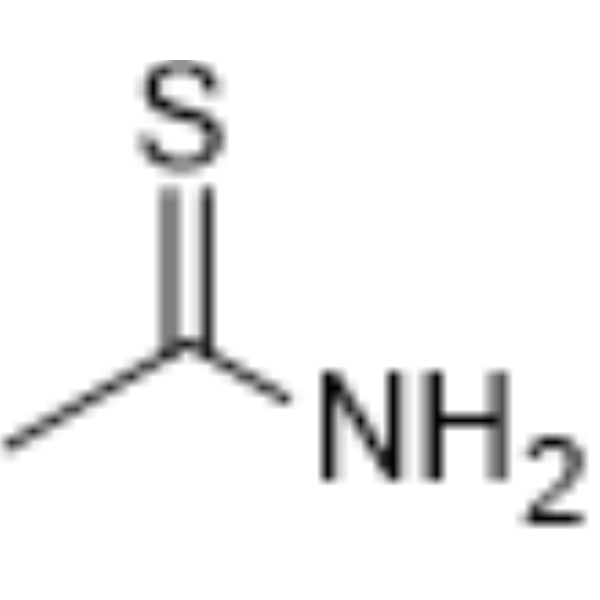
    Thioacetamide
    4 Publications Verification

    Acetothioamide; TAA; Thiacetamide

    Necroptosis Neurological Disease Inflammation/Immunology Cancer
    Thioacetamide (TAA) is an indirect hepatotoxin and causes parenchymal cell necrosis. Thioacetamide requires metabolic activation by microsomal CYP2E1 to thioacetamide-S-oxide initially and then to thioacetamide-S-dioxide, which is a highly reactive metabolite, and its reactive metabolites covalently bind to proteins and lipids thereby causing oxidative stress and centrilobular necrosis. Thioacetamide can induce chronic liver fibrosis, encephalopathy and other events model .
    Thioacetamide
  • HY-148130

    RG6091; RO7248824

    E1/E2/E3 Enzyme Others
    Rugonersen (RG6091; RO7248824) is a locked-nucleic acid (LNA)- modified antisense oligonucleotides (ASOs), and results in reduction of ubiquitin-protein ligase E3A (UBE3A) silencing. Angelman syndrome (AS) is a severe neurodevelopmental disorder caused by the loss of neuronal E3 ligase UBE3A, Rugonersen has been used for AS reasearch .
    Rugonersen
  • HY-N1131
    Triacetonamine
    1 Publications Verification

    2,2,6,6-Tetramethyl-4-piperidone

    Others Metabolic Disease
    Triacetonamine (2,2,6,6-Tetramethyl-4-piperidone) is used as an intermediate for the synthesis of pharmaceutical products, pesticides and photostabilizers for polymers. Triacetonamine has oral activity and can induce acute liver failure (ALF) in rats .
    Triacetonamine
  • HY-N2358

    Others Inflammation/Immunology
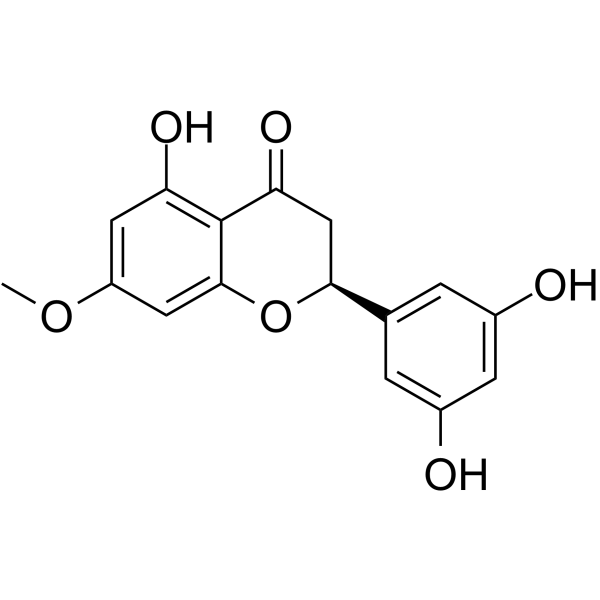
    Blumeatin, isolated from Blumea balsamifera DC, could protect liver against injury induced by CCl4 and thioacetamide (TAA) .
    Blumeatin
  • HY-W013411A
    Locostatin
    3 Publications Verification

    UIC-1005

    Raf G Protein-coupled Receptor Kinase (GRK) Cancer
    Locostatin (UIC-1005) is a potent RKIP inhibitor. Locostatin binds Raf kinase inhibitor RKIP protein and disrupts the interaction of RKIP with Raf-1 kinase and G protein-coupled receptor kinase 2. Locostatin inhibits cell proliferation and migration. Locostatin can be used to synthesize chemical probes toward PEBP-proteins. Locostatin aggravates thioacetamide (HY-Y0698)-induced acute liver failure in mice .
    Locostatin
  • HY-N1131A
    Triacetonamine hydrochloride
    1 Publications Verification

    2,2,6,6-Tetramethyl-4-piperidone hydrochloride

    Drug Intermediate Metabolic Disease
    Triacetonamine (2,2,6,6-Tetramethyl-4-piperidone) hydrochloride is used as an intermediate for the synthesis of pharmaceutical products, pesticides and photostabilizers for polymers. Triacetonamine hydrochloride has oral activity and can induce acute liver failure (ALF) in rats .
    Triacetonamine hydrochloride
  • HY-N1131B
    Triacetonamine monohydrate
    1 Publications Verification

    2,2,6,6-Tetramethyl-4-piperidone monohydrate

    Others Metabolic Disease
    Triacetonamine (2,2,6,6-Tetramethyl-4-piperidone) monohydrate is used as an intermediate for the synthesis of pharmaceutical products, pesticides and photostabilizers for polymers. Triacetonamine hydrochloride has oral activity and can induce acute liver failure (ALF) in rats .
    Triacetonamine monohydrate
  • HY-Y0698R

    Acetothioamide (Standard); TAA (Standard); Thiacetamide (Standard)

    Necroptosis Reference Standards Inflammation/Immunology
    Thioacetamide (Standard) is the analytical standard of Thioacetamide (HY-Y0698). This product is intended for research and analytical applications. Thioacetamide (TAA) is an indirect hepatotoxin and causes parenchymal cell necrosis. Thioacetamide requires metabolic activation by microsomal CYP2E1 to thioacetamide-S-oxide initially and then to thioacetamide-S-dioxide, which is a highly reactive metabolite, and its reactive metabolites covalently bind to proteins and lipids thereby causing oxidative stress and centrilobular necrosis. Thioacetamide can induce chronic liver fibrosis, encephalopathy and other events model .
    Thioacetamide (Standard)
  • HY-149403

    Anaplastic lymphoma kinase (ALK) Others
    J-1048 is an activin receptor-like kinase 5 (ALK5) inhibitor. J-1048 can inhibit TAA-induced liver fibrosis in mice by explicitly blocking the TGF-β/Smad signaling pathway .
    J-1048
  • HY-176218

    Drug Derivative Inflammation/Immunology
    TTTE is a sulfone bischalcone derivative. TTTE has major anti-necrotic, anti-inflammatory and anti-fibrotic activities. TTTE exerts regulatory effects by downregulating key molecules such as Caspase-3, TNF-α, NF-κB and TGF-β. TTTE can be used in the study of liver injury .
    TTTE
  • HY-145855

    TGF-β Receptor Inflammation/Immunology
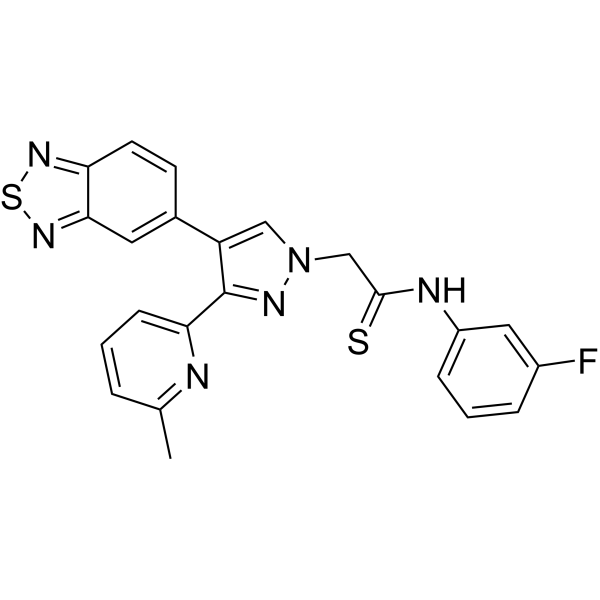
    J-1063 is a potent, selective and orally active ALK5 inhibitor with an IC50 of 0.039 µM. J-1063 shows anti-fibrotic effect by the inhibition of inflammatory infiltration, collagen deposition, and hepatocytes necrosis. J-1063 has the potential for the research of liver fibrosis .
    J-1063

Inquiry Online

Your information is safe with us. * Required Fields.

Salutation


Country or Region *

Applicant Name *


Organization Name *

Department *


Email Address *


Product Name *

Cat. No.


Requested quantity *

Phone Number *


Remarks

Inquiry Online

Inquiry Information

Product Name:
Cat. No.:
Quantity:
MCE Japan Authorized Agent:

