
6 Results for "

TCR pathways

" in MedChemExpress (MCE) Product Catalog:
Products (6)

6 Results for "TCR pathways" in MCE Product Catalog:

4
4 Cited Publications
Cat. No.: HY-P99129

Research Areas:  

Inflammation/Immunology

Anti-Mouse CD8a Antibody (53-6.7) is an anti-mouse CD8a IgG2a antibody inhibitor derived from host Rat. Anti-Mouse CD8a Antibody (53-6.7) binds to CD8αβ stabilizes a conformation with a higher affinity for interaction with MHC class I. Anti-Mouse CD8a Antibody (53-6.7) induces the phosphorylation and activation of TCR proximal signaling pathway components Lck and ZAP70 in polyclonal memory T cells. Anti-Mouse CD8a Antibody (53-6.7) depletes CD8+ T cells and neutralizes cytokine in mice .
loading...
    loading...
1
1 Cited Publications
Cat. No.: HY-136339
CAS No.: 2368841-84-1
Purity:  99.66%
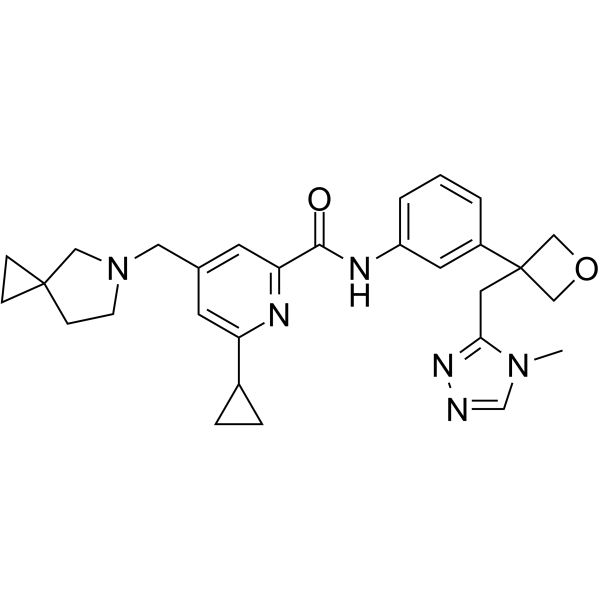
Cbl-b-IN-1 (Example 519) is an inhibitor of Cbl-b, with an IC50 of less than 100 nM. Cbl-b-IN-1 can promote the secretion of cytokines such as IL-2, IFN-γ, and TNF-α, facilitate T cell activation, and enhance the TCR signaling pathway. Cbl-b-IN-1 can be used in research on immunomodulation .
loading...
    loading...
Cat. No.: HY-163372
CAS No.: 3034182-97-0
Target:  

PROTACs MAP4K

Research Areas:  

Cancer

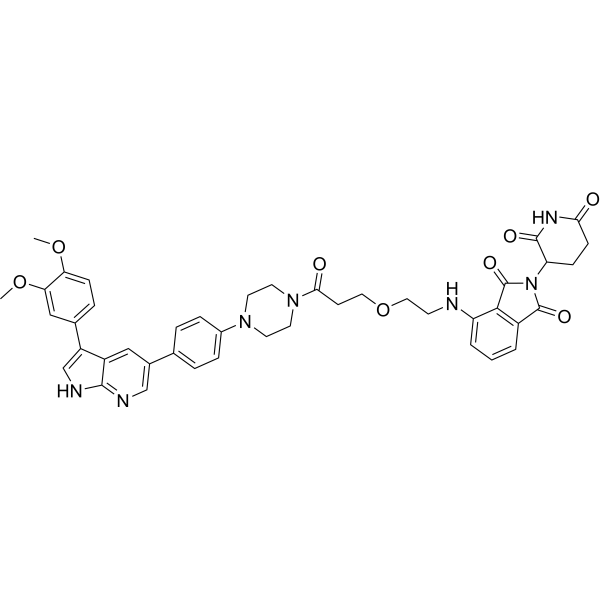
PROTAC HPK1 Degrader-1 (compound B1) is a PROTAC degrader that recruits cereblon to induce HPK1 degradation, with a DC50 of 1.8 nM. PROTAC HPK1 Degrader-1 inhibits HPK1 kinase activity, with an IC50 of 140.5 nM. PROTAC HPK1 Degrader-1 suppresses the phosphorylation of SLP76 protein, with an IC50 of 496.1 nM. PROTAC HPK1 Degrader-1 can be used to investigate non-kinase-dependent signaling of HPK1 in the TCR pathway and cancer-related research .
loading...
    loading...
Cat. No.: HY-155847
CAS No.: 3052262-64-0
Purity:  99.80%
Target:  

Phosphatase PD-1/PD-L1

Research Areas:  

Inflammation/Immunology Cancer

LYP-IN-3 is a selective, orally active and reversible lymphoid-tyrosine phosphatase (LYP) inhibitor (IC50 = 2.55 μM, Ki = 0.93 μM). D34 exhibits high selectivity of PTP1B, PTPN12, PTPN5 and SSH2. LYP-IN-3 regulates the T-cell receptor (TCR) signaling by specifically inhibiting LYP. LYP-IN-3 does not significantly inhibit MC38 cell viability; its anti-tumor effect stems from immune regulation. LYP-IN-3 can significantly upregulate PD-L1 or PD-1 expression in different immune cells. LYP-IN-3 facilitates T-cell infiltration and enhances T-cell functions. LYP-IN-3 synergizes with PD-L1 blockade can significantly improve colorectal tumor regression. LYP-IN-3 can be used for the study of colorectal cancer .
loading...
    loading...
Cat. No.: HY-182238
CAS No.: 3095423-83-6
Research Areas:  

Cancer

HPK1-IN-69 is an orally active HPK1 inhibitor with an IC50 of 1.7 nM. HPK1-IN-69 inhibits the HPK1-mediated TCR signaling pathway, reduces the phosphorylation level of SLP76, and promotes the release of IL-2. HPK1-IN-69 exhibits in vivo anti-tumor activity in mouse models. HPK1-IN-69 can be used for the research of colorectal cancer and MC38 syngeneic tumors .
loading...
    loading...
Cat. No.: HY-133488
CAS No.: 1402703-50-7
Research Areas:  

Inflammation/Immunology Cancer

ST1072 is an inhibitor of CerS4 and CerS6. ST1072 preferentially inhibits CerS6 over CerS4, and reduces the production of C16 ceramide. ST1072 impairs TCR-mediated N-RAS activation, ERK signaling pathway, and the colocalization of CD3/PKCθ. ST1072 decreases the production of IFN-γ as well as the migration of donor cells to target organs. ST1072 regulates immune cell populations and the expression of co-stimulatory molecules. ST1072 can be used in research related to colon cancer, cervical cancer, graft-versus-host disease, and hematologic malignancies .
loading...
    loading...

