




1. Search Result
Search Result
Results for "

anterior pituitary

" in MedChemExpress (MCE) Product Catalog:

22

Inhibitors & Agonists

15

Peptides

3

Natural
Products

3

Recombinant Proteins

2

Antibodies

Targets Recommended:
Cat. No. Product Name Target Research Areas Chemical Structure
  • HY-107953
    Chorionic gonadotrophin
    3 Publications Verification

    hCG; Chorionic gonadotropic hormone

    Endogenous Metabolite Endocrinology Cancer
    Chorionic gonadotrophin (hCG) is a gonadotropin that can be isolated from the anterior pituitary gland. Chorionic gonadotrophin has potential applications in ovarian and follicular development .
    Chorionic gonadotrophin
  • HY-N12634

    PMSG

    Endogenous Metabolite Endocrinology
    Pregnant mare serum gonadotropin (PMSG) is a gonadotropin used to promote follicular development and ovulation in animals. PMSG exerts its regulatory effects by stimulating changes in blood hormones, gonadotropins, and cytoplasmic estradiol receptors in the anterior pituitary and hypothalamus. PMSG is commonly used in livestock to improve reproductive efficiency and can also be utilized for research on estrous cycle regulation .
    Pregnant mare serum gonadotropin
  • HY-107916
    Thyrotropin
    1 Publications Verification

    TSH; Pretiron

    TSH Receptor PKC Apoptosis Metabolic Disease Inflammation/Immunology Endocrinology Cancer
    Thyrotropin (TSH, Pretiron) is a thyroid-stimulating hormone produced by thyrotrope cells in the anterior pituitary gland. Thyrotropin regulates the endocrine function of the thyroid. Thyrotropin induces transcriptional regulation of TH-gatekeeper genes in tanycytes through the Tshr/Gαq/PKC pathway. Thyrotropin prevents Apoptosis. Thyrotropin has an association of low levels with increased bone remodeling, reduced bone mass and a high fracture risk in mice. Thyrotropin is promising for research of skeletal remodeling, hyperthyroidism .
    Thyrotropin
  • HY-P0086
    Corticotropin-releasing factor (human)
    3 Publications Verification

    Human CRF; Human corticotropin-releasing factor

    CRFR Neurological Disease
    Corticotropin-releasing factor human (Human CRF) stimulates the synthesis and secretion of adrenocorticotropin in the anterior pituitary.
    Corticotropin-releasing factor (human)
  • HY-106373
    Adrenocorticotropic hormone
    1 Publications Verification

    ACTH; Adrenocorticotrophic hormone

    Androgen Receptor Reactive Oxygen Species (ROS) Mitochondrial Metabolism Interleukin Related TNF Receptor Metabolic Disease Inflammation/Immunology
    Adrenocorticotropic hormone (ACTH; Adrenocorticotrophic hormone) is a polypeptide tropic hormone produced by the anterior pituitary gland. Adrenocorticotropic hormone stimulates cortisol secretion from the adrenal cortex via the hypothalamic-pituitary-adrenal (HPA) axis. Adrenocorticotropic hormone regulates cortisol and androgen production. Adrenocorticotropic hormone can promote the development of spermatogenesis. Adrenocorticotropic hormone can relieve acute inflammation in gout models by inhibiting the polarization of macrophages to M1 type, inhibiting ROS and proinflammatory factor production and protecting mitochondrial function. Adrenocorticotropic hormone can be used for the researches of inflammation, endocrinology, metabolic disease, such as gout and nephrotic syndrome .
    Adrenocorticotropic hormone
  • HY-P2618

    Kallikrein Others
    Pro-Phe-Arg-AMC acetate is a substrate for human glandular kallikrein 2. Pro-Phe-Arg-AMC acetate can be used for the quantitative detection of enzyme activity .
    Pro-Phe-Arg-AMC acetate
  • HY-132184

    5,6-EET; (±)5,6-EpETrE

    Adrenergic Receptor Calcium Channel Endocrinology
    5,6-Epoxyeicosatrienoic acid (5,6-EET; (±)5,6-EpETrE) is a fully racemic version of the enantiomeric forms biosynthesized from arachidonic acid by cytochrome P450 enzymes. In solution, 5,6-Epoxyeicosatrienoic acid degrades into 5,6-DiHET and 5,6-δ-lactone, which can be converted to 5,6-DiHET and quantified by GC-MS. In neuroendocrine cells, such as the anterior pituitary and pancreatic islets, 5,6-Epoxyeicosatrienoic acid has been implicated in the mobilization of calcium and hormone secretion. 5,6-Epoxyeicosatrienoic acid is an inhibitor of T-type voltage-gated calcium channels (Cav3) that inhibits isoforms Cav3.1, Cav3.2 (IC50=0.54 μM), and Cav3. and decreases nifedipine-resistant phenylephrine-induced vasoconstriction in isolated mouse mesenteric arteries via Cav3.2 blockade when used at a concentration of 3 μM. In addition, it is a substrate of COX-1 and COX-2.
    5,6-Epoxyeicosatrienoic acid
  • HY-137199

    Kallikrein Others
    Pro-Phe-Arg-AMC is a substrate for human glandular kallikrein 2. Pro-Phe-Arg-AMC can be used for the quantitative detection of enzyme activity .
    Pro-Phe-Arg-AMC
  • HY-P0246

    Endogenous Metabolite Metabolic Disease
    Mastoparan, a tetradecapeptide which is a component of wasp venom, stimulates release of prolactin from cultured rat anterior pituitary cells.
    Mastoparan
  • HY-P0089A

    Growth Hormone Releasing Factor human TFA; Somatorelin (1-44) amide (human) TFA

    GHR Endocrinology
    Human growth hormone-releasing factor TFA (Growth Hormone Releasing Factor human TFA) is a hypothalamic polypeptide and stimulates GH production and release by binding to the GHRH Receptor (GHRHR) on cells in the anterior pituitary .
    Human growth hormone-releasing factor TFA
  • HY-P1174

    GnRH Receptor Endocrinology
    GnRH Associated Peptide (GAP) (1-13), human is an amino acid peptide fragment derived from GnRH. GAP can increase the secretion of luteinizing hormone (LH) and follicle-stimulating hormone (FSH) in rat anterior pituitary cells. GAP also inhibit the secretion of prolactin .
    GnRH Associated Peptide (GAP) (1-13), human
  • HY-B0265A

    (R)-BAY-e 9736

    Calcium Channel Cardiovascular Disease Neurological Disease
    (R)-Nimodipine ((R)-BAY-e 9736) is an orally active, blood-brain barrier-permeable L-type calcium channel blocker with an IC50 of 5 nM. (R)-Nimodipine inhibits corticosterone release by blocking calcium channels on the hypothalamic-pituitary-adrenal axis, thereby reversing immobilization stress-induced memory impairment and behavioral abnormalities. (R)-Nimodipine is widely used in studies related to aneurysmal subarachnoid hemorrhage, cerebral ischemia, epilepsy, age-related degenerative neurological diseases, and alcohol intoxication .
    (R)-Nimodipine
  • HY-106373A
    Adrenocorticotropic hormone TFA
    1 Publications Verification

    ACTH TFA; Adrenocorticotrophic hormone TFA

    Androgen Receptor Reactive Oxygen Species (ROS) Mitochondrial Metabolism Interleukin Related TNF Receptor Metabolic Disease Inflammation/Immunology
    Adrenocorticotropic hormone (ACTH; Adrenocorticotrophic hormone) TFA is a polypeptide tropic hormone produced by the anterior pituitary gland. Adrenocorticotropic hormone TFA stimulates cortisol secretion from the adrenal cortex via the hypothalamic-pituitary-adrenal (HPA) axis. Adrenocorticotropic hormone TFA regulates cortisol and androgen production. Adrenocorticotropic hormone TFA can promote the development of spermatogenesis. Adrenocorticotropic hormone TFA can relieve acute inflammation in gout models by inhibiting the polarization of macrophages to M1 type, inhibiting ROS and proinflammatory factor production and protecting mitochondrial function. Adrenocorticotropic hormone TFA can be used for the researches of inflammation, endocrinology, metabolic disease, such as gout and nephrotic syndrome .
    Adrenocorticotropic hormone TFA
  • HY-P0089

    Growth Hormone Releasing Factor human; Somatorelin (1-44) amide (human)

    GHR Endocrinology
    Human growth hormone-releasing factor (Growth Hormone Releasing Factor human) is a hypothalamic polypeptide and stimulates GH production and release by binding to the GHRH Receptor (GHRHR) on cells in the anterior pituitary .
    Human growth hormone-releasing factor
  • HY-P4413

    Androgen Receptor Endocrinology
    (Des-Glu5)-ACTH (1-24) (human, bovine, rat) is an analogue of Adrenocorticotropic hormone (ACTH; HY-106373). ACTH is a polypeptide tropic hormone produced by the anterior pituitary gland, regulating cortisol and androgen production .
    (Des-Glu5)-ACTH (1-24) (human, bovine, rat)
  • HY-P3567

    Melanocortin Receptor Neurological Disease
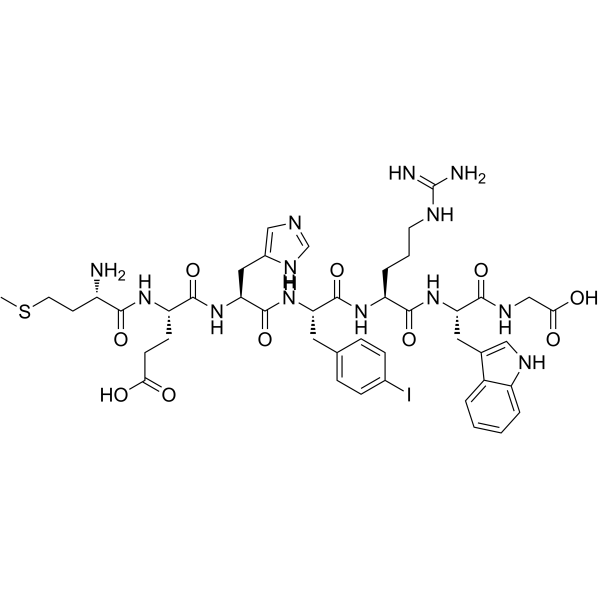
    (p-Iodo-Phe7)-ACTH (4-10) is a adrenocorticotrophic hormone (ACTH) derivative, which is produced and secreted by the anterior pituitary gland. (p-Iodo-Phe7)-ACTH (4-10) serves as a melanocortin (MC) receptor antagonist and inhibits α-melanocyte-stimulating hormone (α-MSH)-induced excessive grooming behavior in rats .
    (p-Iodo-Phe7)-ACTH (4-10)
  • HY-P1905

    GnRH Receptor Endocrinology
    [Gln8]-C517 (LH-RH), chicken is an avian hypothalamic peptide, which stimulates release of gonadotropins from anterior pituitary, thus regulating reproductive functions.
    [Gln8]-C517 (LH-RH), chicken
  • HY-P4012

    Vasopressin Receptor Endocrinology
    [Asu1,6-Arg8]Vasopressin is an vasopressin agonist which potentiates cyclic AMP accumulation and ACTH release induced by corticotropin-releasing factor (CRF) in rat anterior pituitary cells in culture .
    [Asu1,6-Arg8]Vasopressin
  • HY-P4456

    Adrenergic Receptor Endocrinology
    (Des-His6)-ACTH (1-24) (human, bovine, rat) is an analogue of Adrenocorticotropic hormone (ACTH; HY-106373). ACTH is a polypeptide tropic hormone produced by the anterior pituitary gland, regulating cortisol and androgen production .
    (Des-His6)-ACTH (1-24) (human, bovine, rat)
  • HY-P3685

    CRFR Endocrinology
    [Met(O)21] Corticotropin Releasing Factor, ovine is a corticotropin releasing factor isolated from ovine hypothalamic extracts. Corticotropin releasing factor (CRF) is a hypothalamic hormone, which stimulates the secretion of adrenocorticotrophic hormone (ACTH) .
    [Met(O)21] Corticotropin Releasing Factor, ovine
  • HY-119247

    CRFR Neurological Disease
    NBI 30545 is a blood-brain barrier permeable CRF1R antagonist with a Ki value of 3.4 nM for the human receptor. NBI 30545 inhibits CRF-stimulated intracellular cAMP accumulation and ACTH release. NBI 30545 can be used in the research of depression, anxiety disorders and stress-related diseases .
    NBI 30545
  • HY-120247

    Vasopressin Receptor P-glycoprotein Others
    TASP0434299 (Compound 10) is a labeled ligand for the vasopressin V1b receptor. TASP0434299 exhibits high binding affinity for human and murine V1B receptors, with IC50 values of 0.526 nM and 0.641 nM, respectively, and shows potent antagonistic activity against the human V1B receptor with an IC50 of 0.639 nM. TASP0434299 is a substrate for human and rhesus monkey P-glycoprotein, resulting in low brain uptake in rhesus monkeys. TASP0434299 binds to V1B receptors in rat and monkey pituitary tissues in a saturable and specific manner both in vitro and in vivo. When radiolabeled with tritium or 11C, TASP0434299 serves as a prototype V1B receptor radiotracer to visualize V1B receptor in the pituitary gland of anesthetized monkeys via positron emission tomography .
    TASP0434299

Inquiry Online

Your information is safe with us. * Required Fields.

Salutation


Country or Region *

Applicant Name *


Organization Name *

Department *


Email Address *


Product Name *

Cat. No.


Requested quantity *

Phone Number *


Remarks

Inquiry Online

Inquiry Information

Product Name:
Cat. No.:
Quantity:
MCE Japan Authorized Agent:

