

19 Results for "

archaea

" in MedChemExpress (MCE) Product Catalog:
Products (19)

19 Results for "archaea" in MCE Product Catalog:

2
2 Cited Publications
Cat. No.: HY-Y0882
CAS No.: 5470-11-1
Target:  

Monoamine Oxidase

Research Areas:  

Cardiovascular Disease

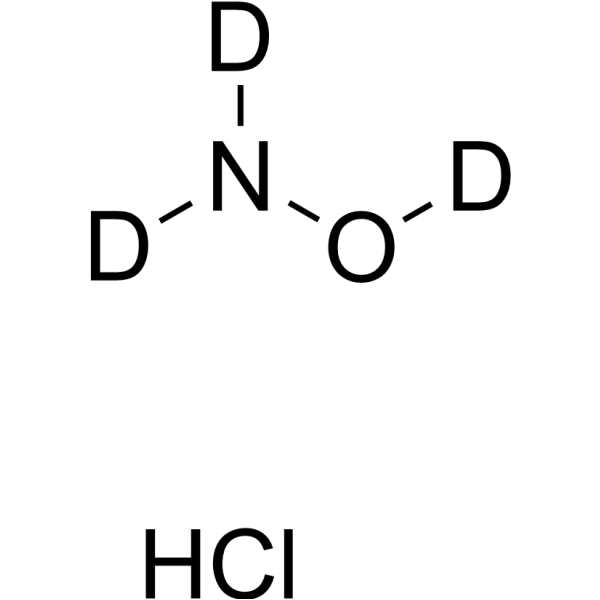
Hydroxylamine hydrochloride is a selective Monoamine oxidase (MAO) inhibitor used for inhibiting of platelet aggregation. Hydroxylamine hydrochloride is an intermediate of nitrogen cycle in aerobic ammonium oxidizers microorganisms, such as ammonium oxidizing bacteria (AOB), ammonium oxidizing archaea (AOA) and complete ammonium oxidizing bacteria (comammox). Hydroxylamine hydrochloride impacts NO and N2O emissions by aerobic ammonium oxidizers microorganisms and inhibits nitrite oxidizing bacteria (NOB) activity .
loading...
    loading...
2
2 Cited Publications
Cat. No.: HY-113047
CAS No.: 5627-05-4
Purity:  99.58%
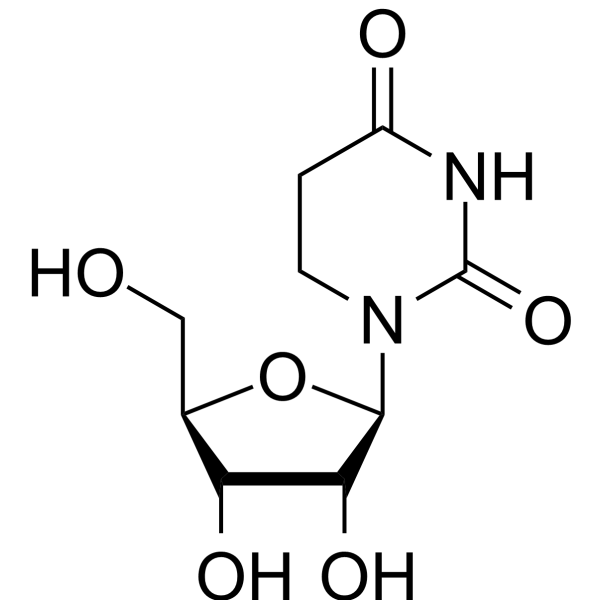
5,6-Dihydrouridine is a modified base found in conserved positions in the D-loop of tRNA in Bacteria, Eukaryota, and some Archaea.
loading...
    loading...
Cat. No.: HY-Y0882S1
CAS No.: 15588-23-5
Hydroxylamine-d3 (hydrochloride) is the deuterium labeled Hydroxyamine hydrochloride. Hydroxylamine hydrochloride is a selective Monoamine oxidase (MAO) inhibitor used for inhibiting of platelet aggregation. Hydroxylamine hydrochloride is an intermediate of nitrogen cycle in aerobic ammonium oxidizers microorganisms, such as ammonium oxidizing bacteria (AOB), ammonium oxidizing archaea (AOA) and complete ammonium oxidizing bacteria (comammox). Hydroxylamine hydrochloride impacts NO and N2O emissions by aerobic ammonium oxidizers microorganisms and inhibits nitrite oxidizing bacteria (NOB) activity .
loading...
    loading...
Cat. No.: HY-W019334
CAS No.: 202842-98-6
Synonyms: 3,4-DMPP
Target:  

Bacterial

Research Areas:  

Others

3,4-Dimethylpyrazole phosphate (3,4-DMPP) is a nitrification inhibitor and microbial community regulator, whose activity is dose- and soil pH-dependent. 3,4-Dimethylpyrazole phosphate inhibits ammonia monooxygenase, ammonia-oxidizing bacteria, as well as ammonia-oxidizing archaea and nitrite-oxidizing bacteria. 3,4-Dimethylpyrazole phosphate alters the community composition of prokaryotes, fungi and ammonia-oxidizing bacteria. 3,4-Dimethylpyrazole phosphate reduces nitrate leaching, nitrous oxide emission and soil nitrate accumulation, and enhances nitrogen use efficiency and crop yield in agricultural production. 3,4-Dimethylpyrazole phosphate is applicable to agriculture-related research .
loading...
    loading...
Cat. No.: HY-P2887
CAS No.: 9027-42-3
Target:  

Endogenous Metabolite

Research Areas:  

Others

Acetate kinase (ACK) is an enzyme widely distributed in bacteria and archaea. In the presence of ATP and divalent cations, it catalyzes the phosphorylation of acetate and promotes the production of acetyl-CoA. Often used in biochemical research .
loading...
    loading...
Cat. No.: HY-114327
CAS No.: 14689-84-0
Synonyms: R15P
D-Ribose 1,5-diphosphate (R15P) is a metabolic intermediate and enzyme substrate. Purified Tk-E2b2 converts D-Ribose 1,5-diphosphate into Ribulose-1,5-bisphosphate, with a specific activity of 32.3 μmol min -1 mg -1[1] .
loading...
    loading...
Cat. No.: HY-W114327
CAS No.: 113886-71-8
Target:  

DNA/RNA Synthesis

Research Areas:  

Others

N4-Acetyl-2'-O-methylcytidine (ac4Cm) is an RNA with dual acetylation and methoxidation modifications found in thermophilic archaea. N4-Acetyl-2'-O-methylcytidine has been implicated in the adaptability of archaea in extreme environments, enhancing RNA stability through dual modification .
loading...
    loading...
Cat. No.: HY-W855075A
CAS No.: 53501-94-3
Research Areas:  

Others

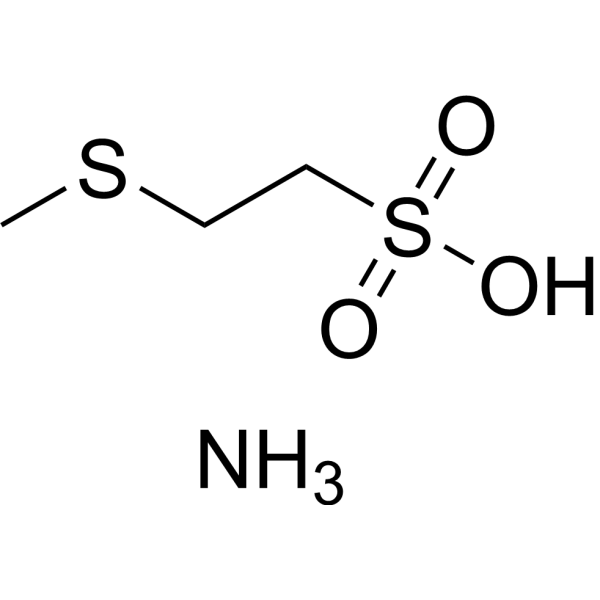
Methyl-coenzyme M can reversibly synthesize methane in methanogenic, ANME-1 and ANME-2 archaea under the catalysis of methyl-coenzyme M Reductase .
loading...
    loading...
Cat. No.: HY-163269
CAS No.: 2413282-48-9
Target:  

Bacterial

Research Areas:  

Others

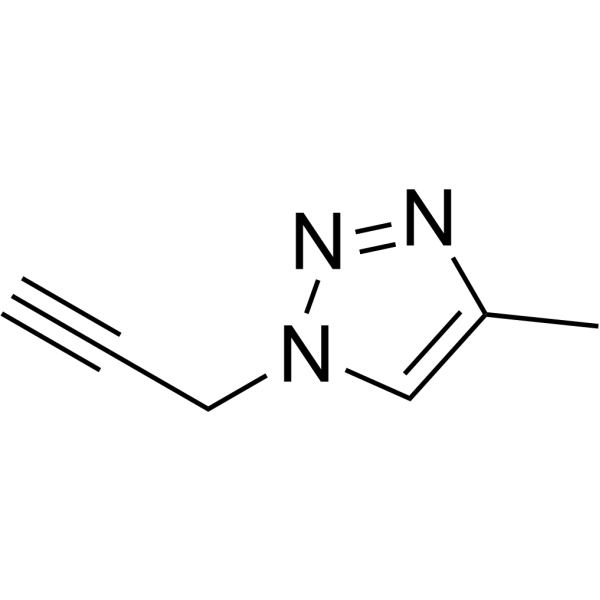
MPT is a novel and highly efficient nitrification inhibitor. MPT inhibits ammoniaoxidizing bacteria and archaea .
loading...
    loading...
Cat. No.: HY-113047R
CAS No.: 5627-05-4
5,6-Dihydrouridine (Standard) is the analytical standard of 5,6-Dihydrouridine. This product is intended for research and analytical applications. 5,6-Dihydrouridine is a modified base found in conserved positions in the D-loop of tRNA in Bacteria, Eukaryota, and some Archaea.
loading...
    loading...
Cat. No.: HY-P3257A
CAS No.: 173585-07-4
Synonyms: ADP-dependent hexokinase, pyrococcus furiosus
Target:  

Glucokinase

ADP-Specific glucokinase, pyrococcus furiosus is an ADP-specific glucose kinase expressed in thermophilic archaea. ADP-Specific glucokinase, pyrococcus furiosus can catalyze glucose into glucose-6-phosphate, which promotes glycolysis. ADP-Specific glucokinase, pyrococcus furiosus can activate T cells and enhance the phagocytic activity of macrophages. ADP-Specific glucokinase, pyrococcus furiosus can be used in research on metabolic diseases, neurological disorders, and tumors .
loading...
    loading...
Cat. No.: HY-P3257B
Synonyms: ADP-Dependent hexokinase, thermococcus litoralis
Target:  

Glucokinase

ADP-Specific glucokinase, thermococcus litoralis is an ADP-specific glucose kinase expressed in thermophilic archaea. ADP-Specific glucokinase, thermococcus litoralis can catalyze glucose into glucose-6-phosphate, which promotes glycolysis. ADP-Specific glucokinase, thermococcus litoralis can activate T cells and enhance the phagocytic activity of macrophages. ADP-Specific glucokinase, thermococcus litoralis can be used in research on metabolic diseases, neurological disorders, and tumors .
loading...
    loading...
Cat. No.: HY-E71617
Research Areas:  

Others

2-Phospho-L-lactate guanylyltransferase (EC 2.7.7.68) is involved in the biosynthesis of coenzyme F420, a redox-active cofactor found in all methanogenic archaea, as well as some eubacteria.
loading...
    loading...
Cat. No.: HY-E71618
Research Areas:  

Others

2-Phospho-L-lactate transferase (EC 2.7.8.28) is involved in the biosynthesis of coenzyme F420, a redox-active cofactor found in all methanogenic archaea, as well as some eubacteria.
loading...
    loading...
Cat. No.: HY-W720429
CAS No.: 73477-63-1
Target:  

Drug Metabolite

Research Areas:  

Metabolic Disease

2,5-Diamino-6-hydroxy-4-(5-phosphoribosylamino)pyrimidine is a metabolite in the biosynthesis pathway (purine metabolism process) of Riboflavin (HY-B0456) .
loading...
    loading...
Cat. No.: HY-E71326
Research Areas:  

Others

β-Ribofuranosylphenol 5'-phosphate synthase (EC 2.4.2.54) is involved in biosynthesis of tetrahydromethanopterin in archaea. It was initially thought to use 4-aminobenzoate as a substrate, but was later shown to utilize 4-hydroxybenzoate. The activity is dependent on Mg2+ or Mn2+.
loading...
    loading...
Cat. No.: HY-Y0882S
CAS No.: 40711-48-6
Hydroxylamine- 15N hydrochloride is the 15N-labeled Hydroxylamine hydrochloride (HY-Y0882). Hydroxylamine hydrochloride is a selective Monoamine oxidase (MAO) inhibitor used for inhibiting of platelet aggregation. Hydroxylamine hydrochloride is an intermediate of nitrogen cycle in aerobic ammonium oxidizers microorganisms, such as ammonium oxidizing bacteria (AOB), ammonium oxidizing archaea (AOA) and complete ammonium oxidizing bacteria (comammox). Hydroxylamine hydrochloride impacts NO and N2O emissions by aerobic ammonium oxidizers microorganisms and inhibits nitrite oxidizing bacteria (NOB) activity .
loading...
    loading...
Cat. No.: HY-150033
CAS No.: 105018-76-6
Sorgoleone is a photosystem II inhibitor found in sorghum. Sorgoleone binds to the QB niche of the D1 protein, inhibits photosynthetic electron transport, and does not affect photosystem I reactions. Sorgoleone reduces radicle elongation and stunts growth. Sorgoleone inhibits CO2-dependent oxygen evolution, photosynthetic O2 evolution, and mitochondrial respiration. Sorgoleone can be used as a herbicide .
loading...
    loading...
Cat. No.: HY-W154247
CAS No.: 103313-38-8
Target:  

Bacterial

Research Areas:  

Infection

IP6C is a specific inhibitor and phage sensitizer targeting type II Thoeris systems. IP6C competitively binds to histidine in the catalytic pocket of ThsB, blocks the production of the His-ADPR alarm signal and inhibits ThsA activation, thereby relieving bacterial stasis of phage replication. IP6C selectively resensitizes drug-resistant bacteria carrying type II Thoeris systems (such as Pseudomonas aeruginosa) to phage lysis, without affecting other bacteria, and shows no toxicity to mice and human cell lines. IP6C significantly improves the survival rate of infected mice, and can be used to overcome bacterial phage defense mechanisms and study Pseudomonas aeruginosa infections .
Thoeris system: (named after the Egyptian goddess of fertility and protection), is a widespread anti-phage immune defense system in bacteria and archaea. Thoeris system belongs to the "Abortion Infection (Abi)" mechanism of bacteria: when an individual bacterium detects phage invasion, it initiates a suicide program and dies, thereby blocking phage replication and spread, and protecting the surrounding bacterial population from infection.
loading...
    loading...
  • 1

