


1. Search Result
Search Result
Results for "

assembling peptide

" in MedChemExpress (MCE) Product Catalog:

24

Inhibitors & Agonists

1

Fluorescent Dye

2

Biochemical Assay Reagents

33

Peptides

1

Natural
Products

2

Oligonucleotides

Cat. No. Product Name Target Research Areas Chemical Structure
  • HY-P0163
    Gramicidin
    5+ Cited Publications

    Bacterial Antibiotic Infection
    Gramicidin is an antimicrobial peptide assembling as channels in membranes and increasing their permeability towards cations.
    Gramicidin
  • HY-W441011

    Liposome Neurological Disease Inflammation/Immunology Cancer
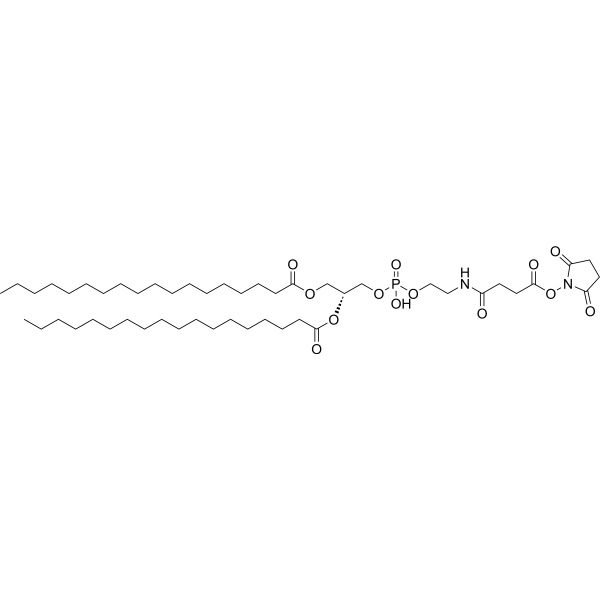
    DSPE-NHS is a bioconjugation phospholipid molecule with two hydrophobic lipid tails. DSPE-NHS is a self-assembling reagent which forms lipid bilayer in aqueous solution. The NHS-ester is reactive with N-terminal of protein/peptide or other amine molecule to form a stable amide linkage. DSPE-NHS labels antibodies. DSPE-NHS can be used to prepare liposomes as agent nanocarrier .
    DSPE-NHS
  • HY-P10294

    Amyloid-β Others
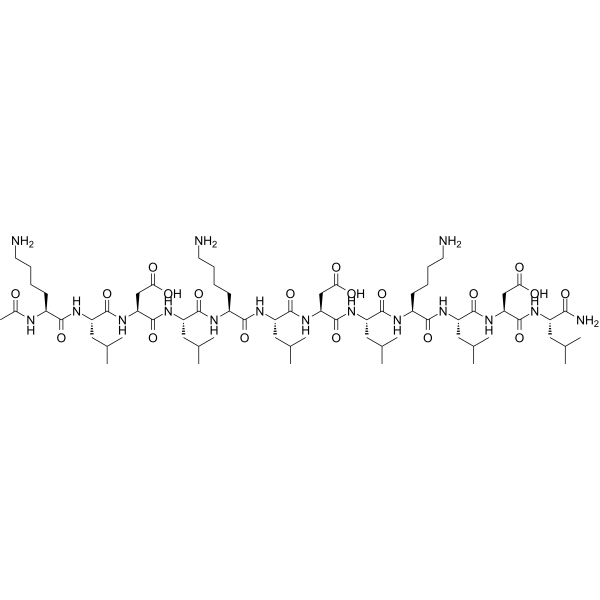
    Oligopeptide P11-4 is an α-peptide that can be self-assembled into β-sheet amyloids with a hydrogel appearance at low pH. Oligopeptide P11-4 can be used in biomimetic mineralization, enamel regeneration and oral care agent .
    Oligopeptide P11-4
  • HY-P2632

    RADA16

    Biochemical Assay Reagents Neurological Disease
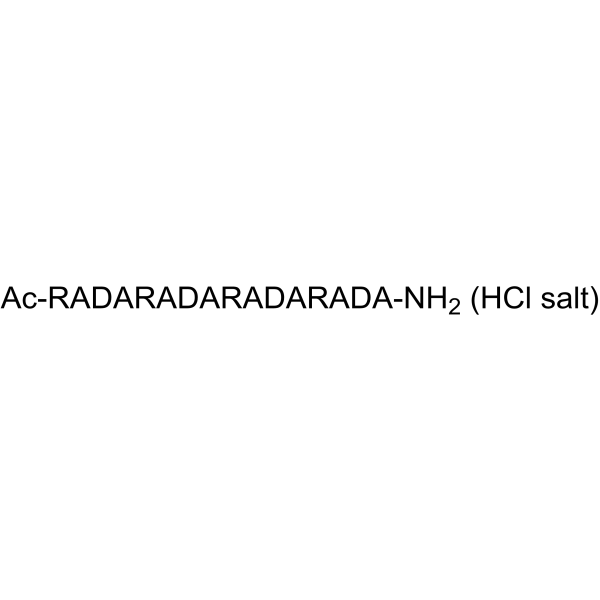
    RAD16-I (RADA16) is a non-directed self-assembling peptide hydrogel. Under physiological conditions, RAD16-I spontaneously forms a three-dimensional nanofiber network that mimics the extracellular matrix, and possesses excellent properties such as high water content, biocompatibility and degradability. RAD16-I serves as an ideal scaffold for three-dimensional cell culture. RAD16-I not only maintains cell viability and induces self-organization, but also supports cell adhesion, proliferation, differentiation and insulin secretion, effectively stabilizes islet clusters and promotes directed differentiation of the cardiac lineage. RAD16-I can construct a cell-friendly nano-microenvironment for research related to diseases such as myocardial infarction and diabetes .
    RAD16-I
  • HY-P10709A

    Biochemical Assay Reagents Cardiovascular Disease Cancer
    CREKA peptide acetate is a short peptide sequence, belonging to self-assembling peptides (SAPs), which can self-assemble into functional nanostructures, typically nanofibers, under physiological conditions. CREKA peptide acetate can be used to target tumor cells and tumor vasculature, exhibiting antitumor activity .
    CREKA peptide acetate
  • HY-P10701

    Biochemical Assay Reagents Inflammation/Immunology Cancer
    Q11 peptide is a β-sheet-forming peptide that plays an important role in self-assembly and targeted applications. As a scaffold peptide, Q11 peptide can display immunogenic epitopes and is widely used in peptide-based immune vaccine research. Additionally, Q11 peptide can be conjugated with MUC1 glycopeptides for the study of self-assembling, adjuvant-free MUC1 glycopeptide vaccines. Q11 peptide holds great potential for research in the field of cancer immunology .
    Q11 peptide
  • HY-P10659

    EGFR Cancer
    Self-assembling peptide pY1 is a peptide that assemblies around cancer cells and targets EGFR. When co-cultured with Ovalbumin (OVA), pY1 can effectively block the endocytosis of OVA .
    Self-assembling peptide pY1
  • HY-P11309

    Biochemical Assay Reagents Neurological Disease
    QL6 peptide is a self-assembling peptide. QL6 peptide can self-assembles into β-sheets bridging the cavity at neutral pH and improves the inhibitory environment by reducing inflammation and tissue scaring. QL6 peptide can be used for synthesis nanofiber scaffolds for spinal cord injuries (SCI) research .
    QL6 peptide
  • HY-P10699

    Biochemical Assay Reagents Others
    MAX1 is a self-assembling peptide used to prepare hydrogels .
    MAX1
  • HY-P10712

    Biochemical Assay Reagents Others
    Nap-GFFY, a naphthylacetic acid modifi ed tetrapeptide of GFFY, is a self-assembling fiber peptide .
    Nap-GFFY
  • HY-P10686

    EGFR Cancer
    CH401 peptide is a HER2-derived antigen peptide. After being bound to the artificial viral capsid by a self-assembled β-cyclic peptide, CH401 peptide is encapsulated in a lipid bilayer containing the lipid adjuvant α-GalCer, and can be studied as a self-adjuvant anti-breast cancer vaccine candidate .
    CH401 peptide
  • HY-P10675

    Biochemical Assay Reagents Metabolic Disease
    Peptide K is a self-assembling peptide fiber that can be used to prepare fibrous nanocomposite hydrogels. The fibrous nanocomposite hydrogels have a dynamic network that adapts to cells and enhances cell-matrix and cell-cell interactions, thus significantly promoting the mechanotransduction, metabolic energy, and osteogenesis of encapsulated stem cells .
    Peptide K
  • HY-141460

    Ile-Ala; L-Isoleucyl-L-alanine

    Biochemical Assay Reagents Others
    H-Ile-Ala-OH (Ile-Ala; L-Isoleucyl-L-alanine) is a linear aliphatic dipeptide and self-reactive cyclization reagent that self-assembles into amorphous films or spherical structures from specific solvents. H-Ile-Ala-OH also serves as a precursor for the synthesis of the cyclic peptide cyclo (L-isoleucyl-L-alanine) (HY-N9251). H-Ile-Ala-OH undergoes solid-state cyclization when heated above 206 °C, and its initiation temperature is closely related to the size of side-chain substituents .
    H-Ile-Ala-OH
  • HY-P10705

    Biochemical Assay Reagents Cancer
    KGFRWR is a short peptide sequence, belonging to self-assembling peptides (SAPs), which can self-assemble into functional nanostructures, typically nanofibers, under physiological conditions. KGFRWR can be used to target tumor cells and tumor vasculature, exhibiting antitumor activity .
    KGFRWR
  • HY-P10702

    Biochemical Assay Reagents Others
    SAF-p1 is a self-assembling fiber peptide that can form sticky-ended heterodimers by assembling with SAF-p2 (HY-P10703) through complementary amino acid sequences. These heterodimers further self-assemble into long-chain fiber structures. SAF-p1 is promising for the development of nanomaterials in the biomedical field .
    SAF-p1
  • HY-P10703

    Biochemical Assay Reagents Others
    SAF-p2 is a self-assembling fiber peptide that can form sticky-ended heterodimers by assembling with SAF-p2 (HY-P10702) through complementary amino acid sequences. These heterodimers further self-assemble into long-chain fiber structures. SAF-p2 is promising for the development of nanomaterials in the biomedical field .
    SAF-p2
  • HY-P6079A

    Biochemical Assay Reagents Others
    Ac-IHIHIYI-NH2 TFA is an amyloid self-assembling peptide variant that can be used as a bioactive nanomaterial with esterase activity .
    Ac-IHIHIYI-NH2 TFA
  • HY-P10706

    Biochemical Assay Reagents Others
    Ac-ILVAGK-NH2 is a self-assembling peptide that helps human H1 embryonic stem cells maintain their pluripotency .
    Ac-ILVAGK-NH2
  • HY-P11055

    Bacterial Infection
    IKFQFHFD is a pH-responsive and self-assembling peptide. IKFQFHFD is biocompatible at neutral pH and becomes an antimicrobial peptide-like molecular structure only at acidic pH. IKFQFHFD can be used for chronic wounds (venous ulcers, diabetic ulcers, and pressure ulcers) induced by biofilm infections research .
    IKFQFHFD
  • HY-149865

    Phosphatase Fluorescent Dye Cancer
    TPE-1p is a cascade-activated AIEgen-peptide probe. TPE-1p self-assembles in aqueous solution to exhibit bright fluorescence in response to alkaline phosphatase (ALP) and ChT-L. TPE-1p can be utilized to noninvasively assess the inhibition efficiency of a ChT-L inhibitor in cells .
    TPE-1p
  • HY-156087G

    Apoptosis Necroptosis Cancer
    Cholicamideβ (GMP) is a GMP grade of Cholicamideβ. Cholicamideβ (compound 6) is a self-assembling, small molecule, cancer vaccine adjuvant. Cholicamideβ can form virus-like particles with low cytotoxicity. Cholicamideβ, upon binding to peptide antigens, enhances antigen presentation by dendritic cells and induces antigen-specific T cells. Cholicamideβ can induce apoptosis and necrosis .
    Cholicamideβ (GMP)
  • HY-156087

    Apoptosis Necroptosis Cancer
    Cholicamideβ (GMP) is a GMP grade of Cholicamideβ. Cholicamideβ (compound 6) is a self-assembling, small molecule, cancer vaccine adjuvant. Cholicamideβ can form virus-like particles with low cytotoxicity. Cholicamideβ, upon binding to peptide antigens, enhances antigen presentation by dendritic cells and induces antigen-specific T cells. Cholicamideβ can induce apoptosis and necrosis .
    Cholicamideβ
  • HY-P11468

    Bacterial Antibiotic Cardiovascular Disease Infection
    wkwkwNGwkwkw-NH2 is a self-assembling β-hairpin antimicrobial peptide. wkwkwNGwkwkw-NH2 self-assembles into nanofibers. wkwkwNGwkwkw-NH2 interacts with LPS on the surface of the bacterial membrane and then disrupts the bacterial outer membrane, inner membrane, and cytoplasmic membrane to exert its antibacterial effects. wkwkwNGwkwkw-NH2 has high antibacterial activity and low hemolytic activity. wkwkwNGwkwkw-NH2 significantly reduces the S. aureus ATCC 25923 load at the skin wound. wkwkwNGwkwkw-NH2 displays synergistic effects when combined with antibiotics. wkwkwNGwkwkw-NH2 facilitates wound healing .
    wkwkwNGwkwkw-NH2
  • HY-P2632C

    Biochemical Assay Reagents Neurological Disease
    RAD16-I, free acid TFA is a derivative of RADA16 (HY-P2632), with no Ac and NH2 modifications at both ends, and it has the same function as RADA16. RAD16-I, free acid TFA is a non-directed self-assembling peptide hydrogel. Under physiological conditions, RAD16-I, free acid TFA spontaneously forms a three-dimensional nanofiber network that mimics the extracellular matrix, and possesses excellent properties such as high water content, biocompatibility and degradability. RAD16-I, free acid TFA serves as an ideal scaffold for three-dimensional cell culture. RAD16-I, free acid TFA not only maintains cell viability and induces self-organization, but also supports cell adhesion, proliferation, differentiation and insulin secretion, effectively stabilizes islet clusters and promotes directed differentiation of the cardiac lineage. RAD16-I, free acid TFA can construct a cell-friendly nano-microenvironment for research related to diseases such as myocardial infarction and diabetes .
    RAD16-I, free acid TFA

Inquiry Online

Your information is safe with us. * Required Fields.

Salutation


Country or Region *

Applicant Name *


Organization Name *

Department *


Email Address *


Product Name *

Cat. No.


Requested quantity *

Phone Number *


Remarks

Inquiry Online

Inquiry Information

Product Name:
Cat. No.:
Quantity:
MCE Japan Authorized Agent:

