
1. Search Result
Search Result
Results for "

embryogenesis

" in MedChemExpress (MCE) Product Catalog:

14

Inhibitors & Agonists

1

Biochemical Assay Reagents

2

Natural
Products

7

Oligonucleotides

Cat. No. Product Name Target Research Areas Chemical Structure
  • HY-W040047

    Endogenous Metabolite Metabolic Disease
    Pregnanediol 3-glucuronide is the main terminal metabolite of Progesterone (HY-N0437). Pregnanediol 3-glucuronide is the metabolite of Progesterone produced in the liver through hydroxylation and glucuronidation, with high hydrophilicity and easy excretion through urine. A decrease in the level of Pregnanediol 3-glucuronide is associated with an increased risk of thyroid cancer, while an increase is associated with the state of pregnancy. Pregnanediol 3-glucuronide is of great significance in the monitoring of female reproductive health, pregnancy assessment, and the diagnosis of endocrine diseases .
    Pregnanediol 3-glucuronide
  • HY-136403

    Phytohormone Others
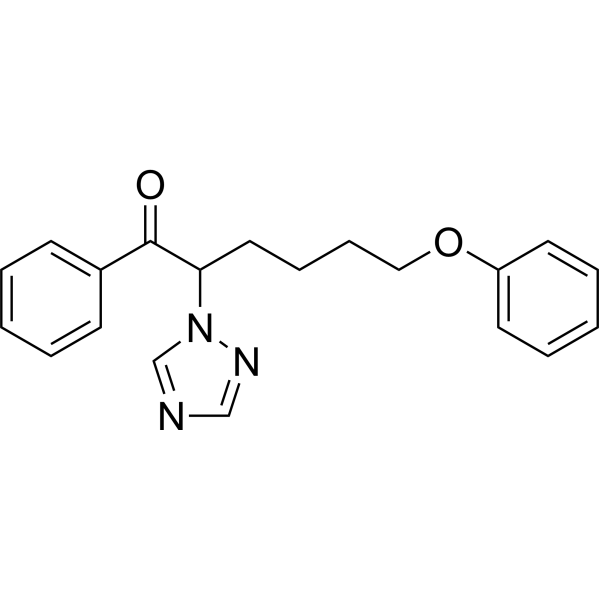
    TIS108 is a triazole-type strigolactone biosynthesis inhibitor. TIS108 inhibits Arabidopsis embryogenesis and root hair growth, and promotes shoot branching. TIS108 can also increase the gibberellin content in Gastrodia elata. TIS108 can be used in the research of plant growth and development as well as plant responses to the environment .
    TIS108
  • HY-141894
    5-Ph-IAA-AM
    2 Publications Verification

    Histone Acetyltransferase Metabolic Disease
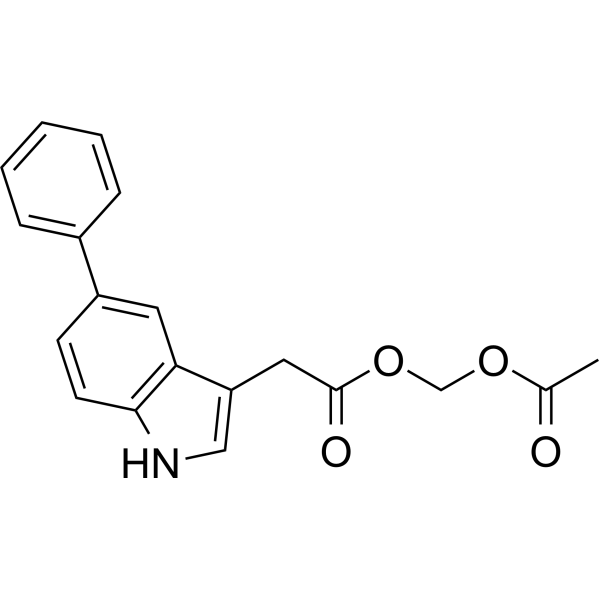
    5-Ph-IAA-AM is an eggshell-permeable 5-Ph-IAA (HY-134653) analog which contains an acetoxymethyl (AM) group. 5-Ph-IAA-AM affords an enhanced protein degradation in laid embryos. 5-Ph-IAA-AM can be used to disclosure the roles of proteins in C. elegans, in particular those that are involved in embryogenesis and development, through temporally controlled protein degradation .
    5-Ph-IAA-AM
  • HY-16637D
    Folic acid disodium
    20+ Cited Publications

    Vitamin B9 disodium; Vitamin M disodium

    Endogenous Metabolite DNA/RNA Synthesis Others Neurological Disease Cancer
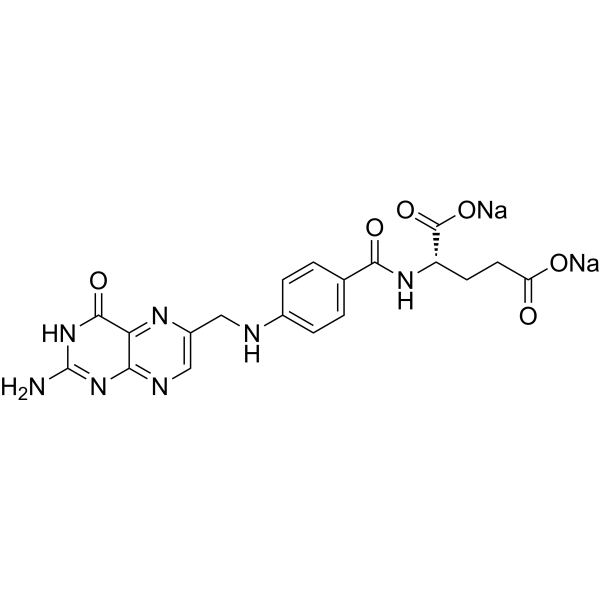
    Folic acid disodium (Vitamin B9 disodium; Vitamin M disodium) is an orally active disodium salt form of Folic acid (HY-16637) with an intrinsic dissolution rate (IDR) of 4.96·10 5 g/s . Folic acid disodium serves as cofactor in single-carbon transfer reactions and exhibits protective effects against neural tube defects, ischemic events, and cancer. Folate acid disodium overload leads to impaired brain development in embryogenesis and promotes growth of precancerous altered cells. Folic acid deficiency leads to megaloblastic anemia .
    Folic acid disodium
  • HY-W711035

    AC 900001

    p38 MAPK PI3K Calcium Channel Reactive Oxygen Species (ROS) Apoptosis Cytochrome P450 Inflammation/Immunology
    Picolinafen is a pyridine-class herbicide that acts as a phytoene desaturase (PDS) inhibitor. Picolinafen effectively controls broadleaf weeds and disrupts carotenoid biosynthesis. Picolinafen exhibits cytotoxicity to porcine trophectoderm (pTr) and luminal epithelial (pLE) cells. Picolinafen induces (ROS accumulation, calcium depletion, and activates (MAPK and PI3K signaling pathways, leading to decreased cell viability, increased apoptosis, impaired migration, and altered expression of implantation-related genes. Picolinafen has an LD50 value of 2.7 mg/kg in mammals and 7 μg/L in fish. Picolinafen exhibits toxic effects during zebrafish embryogenesis [1][2].
    Picolinafen
  • HY-E70144

    EC:2.4.1.101; MGAT1

    Biochemical Assay Reagents Others
    N-Acetylglucosaminyltransferase1 (EC:2.4.1.101, MGAT1) shows typical features of a type II transmembrane protein. N-Acetylglucosaminyltransferase1 is believed to be essential for normal embryogenesis .
    N-Acetylglucosaminyltransferase 1
  • HY-174673

    mRNA Cancer
    Human GATA4 mRNA encodes the human GATA binding protein 4 (GATA4) protein, a member of the GATA family of zinc-finger transcription factors. GATA4 is thought to regulate genes involved in embryogenesis and in myocardial differentiation and function. It is also necessary for normal testicular development.
    Human GATA4 mRNA
  • HY-174589

    mRNA Metabolic Disease
    Human LMX1A mRNA encodes the human LIM homeobox transcription factor 1 alpha (LMX1A) protein, a homeodomain and LIM-domain containing protein. LMX1A is a transcription factor that acts as a positive regulator of insulin gene transcription. It also plays a role in the development of dopamine producing neurons during embryogenesis.
    Human LMX1A mRNA
  • HY-174565

    mRNA Neurological Disease
    Human NRG3 mRNA encodes the human neuregulin 3 (NRG3) protein, a member of the neuregulin gene family. NRG3 has been shown to activate the tyrosine phosphorylation of its cognate receptor, ERBB4, and is thought to influence neuroblast proliferation, migration and differentiation by signalling through ERBB4. NRG3 also promotes mammary differentiation during embryogenesis.
    Human NRG3 mRNA
  • HY-174730

    mRNA Inflammation/Immunology
    Human CXCL12 mRNA encodes the human C-X-C motif chemokine ligand 12 (CXCL12) protein, a stromal cell-derived alpha chemokine member of the intercrine family. CXCL12 functions as the ligand for the G-protein coupled receptor, chemokine (C-X-C motif) receptor 4, and plays a role in many diverse cellular functions, including embryogenesis, immune surveillance, inflammation response, tissue homeostasis, and tumor growth and metastasis.
    Human CXCL12 mRNA
  • HY-174562

    mRNA Cancer
    Human PAX1 mRNA encodes the human paired box 1 (PAX1) protein, a member of the paired box (PAX) family. PAX1 plays a role in pattern formation during embryogenesis and may be essential for development of the vertebral column.
    Human PAX1 mRNA
  • HY-174532

    mRNA Cancer
    Human TGFB3 mRNA encodes the human transforming growth factor beta 3 (TGFB3) protein, a secreted ligand of the TGF-beta superfamily. TGFB3 is involved in embryogenesis and cell differentiation, and may play a role in wound healing.
    Human TGFB3 mRNA
  • HY-174774

    mRNA Cancer
    Human BMPR1B mRNA encodes the human bone morphogenetic protein receptor type 1B (BMPR1B) protein, a family of transmembrane serine/threonine kinases. The ligands of this receptor are BMPs, which are members of the TGF-beta superfamily. BMPs are involved in endochondral bone formation and embryogenesis.
    Human BMPR1B mRNA
  • HY-W036015

    Parasite Infection
    (Z)-7-Tetradecen-2-one acts as a species-specific nematicide. (Z)-7-Tetradecen-2-one induces terminal embryogenesis, morphological abnormalities, irreversible developmental arrest and increases eggshell permeability in *Pristionchus pacificus* embryos. (Z)-7-Tetradecen-2-one exerts olfactory attraction toward *Pristionchus pacificus*. (Z)-7-Tetradecen-2-one can be used to study the symbiotic relationship between hosts and nematodes .
    (Z)-7-Tetradecen-2-one

Inquiry Online

Your information is safe with us. * Required Fields.

Salutation


Country or Region *

Applicant Name *


Organization Name *

Department *


Email Address *


Product Name *

Cat. No.


Requested quantity *

Phone Number *


Remarks

Inquiry Online

Inquiry Information

Product Name:
Cat. No.:
Quantity:
MCE Japan Authorized Agent:

