13 Results for "

human feces

" in MedChemExpress (MCE) Product Catalog:
Products (13)

13 Results for "human feces" in MCE Product Catalog:

1
1 Cited Publications
Cat. No.: HY-W399297
CAS No.: 566-17-6
Synonyms: 7α,12α-Dihydroxycholanoic acid
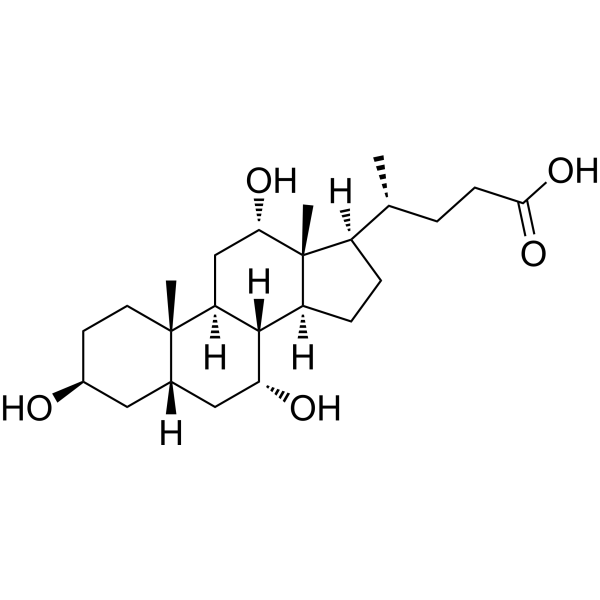
Isodeoxycholic acid (7α,12α-Dihydroxycholanoic acid) is a 3β-hydroxylated secondary bile acid. Isodeoxycholic acid is produced by epimerization of deoxycholic acid by intestinal bacteria. Isodeoxycholic acid is detectable in feces, mainly existing as saponifiable conjugates with long-chain fatty acids. Isodeoxycholic acid participates in the regulation of intestinal physiology .
loading...
    loading...
Cat. No.: HY-W004305
CAS No.: 629-80-1
Synonyms: Palmitaldehyde
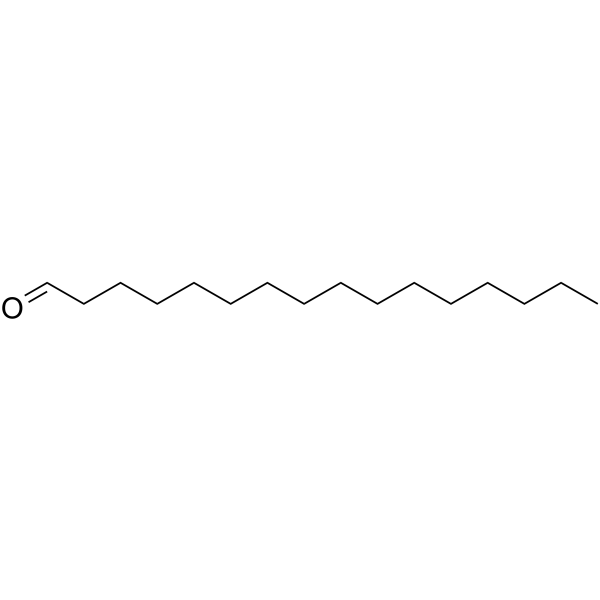
Hexadecanal (Palmitaldehyde) , a volatile long-chain aliphatic aldehyde, is emitted from human feces, skin, and breath. The receptor for hexadecanal(OR37B) is highly conserved across mammals. Hexadecanal may exert its effects by modulating functional connectivity between the brain substrates of social appraisal and the brain substrates of aggressive execution. Also, Hexadecanal is confirmed to be highly deterrent to the ant Lasius niger. Hexadecanal is promising for the research of startle responses and aggression
loading...
    loading...
Cat. No.: HY-132250
CAS No.: 1100692-14-5
Purity:  99.52%
Research Areas:  

Cancer

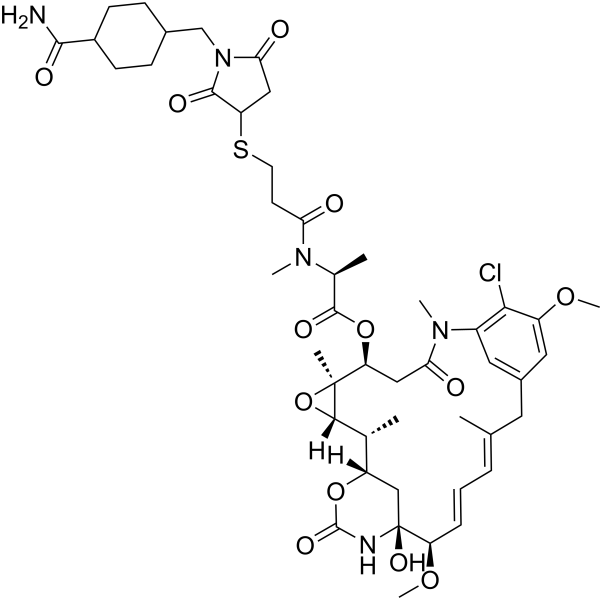
MCC-DM1 is a agent-Linker Conjugates for ADC such as Anti-CD22-MCC-DM1. MCC-DM1 can be detected in rat and human plasma, feces, and other tissues .
loading...
    loading...
Cat. No.: HY-165151
CAS No.: 28925-89-5
Synonyms: Urochrome hydrochloride
Target:  

Endogenous Metabolite

Research Areas:  

Others

Urobilin hydrochloride is the metabolite of Hemoglobin (HY-P2995), that can be excreted through urine and feces in many mammals. Urobilin hydrochloride can be used as an indicator of human waste pollution .
loading...
    loading...
Cat. No.: HY-W585922
CAS No.: 3338-16-7
Target:  

Drug Derivative

Research Areas:  

Others

3β-Cholic acid is a derivative of cholic acid (HY-N0324), and can be found in human feces .
loading...
    loading...
Cat. No.: HY-W006449
CAS No.: 168828-90-8
Target:  

Drug Derivative

Research Areas:  

Others

PNU-105368 is a metabolite of Linezolid (HY-10394) . PNU-105368 exists mainly in the form of the original form and two metabolites in the human body and is excreted through the kidneys and feces .
loading...
    loading...
Cat. No.: HY-W012168
CAS No.: 1205-30-7
Target:  

Carbonic Anhydrase

Research Areas:  

Metabolic Disease

4-Chloro-3-sulfamoylbenzoic acid is a weak inhibitor of human carbonic anhydrase isoforms hCA I, hCA II, hCA IV, and hCA IX, and a synthesis intermediate for carbonic anhydrase inhibitors. 4-Chloro-3-sulfamoylbenzoic acid is the major metabolite of tripamide detected in tissues, urine, and feces of rats and rabbits following Tripamide (HY-106570) administration. 4-Chloro-3-sulfamoylbenzoic acid can be used for the study of carbonic anhydrase inhibition and species differences in drug metabolism .
loading...
    loading...
Cat. No.: HY-117168
CAS No.: 24529-89-3
Purity:  ≥95.0%
Target:  

Endogenous Metabolite

Research Areas:  

Metabolic Disease

1,2-Dilinoleoyl-sn-glycerol is a diacylglycerol (DAG) with linoleic acid (HY-N0729) (18:2) side chains attached at both the sn-1 and sn-2 positions . 1,2-Dilinoleoyl-sn-glycerol can be prepared from L-dilinoleoylphosphatidylcholine via hydrolysis with phospholipase C .
loading...
    loading...
Cat. No.: HY-W004305R
CAS No.: 629-80-1
Synonyms: Palmitaldehyde (Standard)
Hexadecanal (Standard) is an analytical standard for Hexadecanal. This product is intended for research and analytical applications. Hexadecanal (Palmitaldehyde), a volatile, long-chain fatty aldehyde, is released from human feces, skin, and breath. The hexadecanal receptor (OR37B) is highly conserved in mammals. Hexadecanal may exert its effects by modulating functional connectivity between social evaluation brain substrates and aggression execution brain substrates. Hexadecanal has also been shown to have a strong deterrent effect on black ants. Hexadecanal has potential for use in startle response and aggression behavior
loading...
    loading...
Cat. No.: HY-W004305S
CAS No.: 2703602-66-6
Synonyms: Palmitaldehyde-d5
Hexadecanal-d5 (Palmitaldehyde-d5) is deuterium labeled Hexadecanal. Hexadecanal (Palmitaldehyde) , a volatile long-chain aliphatic aldehyde, is emitted from human feces, skin, and breath. The receptor for hexadecanal(OR37B) is highly conserved across mammals. Hexadecanal may exert its effects by modulating functional connectivity between the brain substrates of social appraisal and the brain substrates of aggressive execution. Also, Hexadecanal is confirmed to be highly deterrent to the ant Lasius niger. Hexadecanal is promising for the research of startle responses and aggression
loading...
    loading...
Cat. No.: HY-156126
CAS No.: 1808096-68-5
Target:  

Others

Lentztrehalose C (compound LTC) is a trehalose analogue with high stability in microbial and mammalian cells. It can be detected in the blood of mice and is ultimately excreted in feces and urine. It can induce autophagy in human cancer cells.
loading...
    loading...
Cat. No.: HY-184082
CAS No.: 3784-99-4
Target:  

Parasite

Research Areas:  

Infection

Stilbazium iodide is an orally effective pyridinium quaternary ammonium repellent. Stilbazium (iodide) exhibits broad-spectrum activity against a variety of human and animal intestinal parasites. Stilbazium iodide eliminates both mature and immature worms, reduces egg counts, reddens feces, and causes mild gastrointestinal irritation. Stilbazium iodide can be used in research related to intestinal parasitic infections including pinworm, whipworm, and strongyloidiasis .
loading...
    loading...
Cat. No.: HY-16265A
CAS No.: 2514957-81-2
Research Areas:  

Cancer

JI-101 hydrochloride is an orally active angiogenesis inhibitor and anticancer agent with 55% oral bioavailability in Sprague Dawley rats, high permeability, and no P-gp substrate activity .JI-101 hydrochloride modulates angiogenesis signaling pathways in tumor vessel beds, downregulates EphB4, targets EphB4, VEGFR-2, and PDGFR-β, and inhibits multiple stages of tumor angiogenesis .JI-101 hydrochloride exerts activity against cancer cells and xenografts, exhibits mild to moderate inhibition of CYP3A4, and shows stability in pre-clinical and human liver microsomes .JI-101 hydrochloride undergoes rapid oral absorption in Sprague Dawley rats, has extensive tissue distribution with preferred lung uptake, and is excreted via bile with mono- and di-hydroxy metabolites, with feces as the primary elimination route .JI-101 hydrochloride can be used for the research of ovarian cancer and solid tumors .
loading...
    loading...
  • 1

