11 Results for "

interaction deficits

" in MedChemExpress (MCE) Product Catalog:
Products (11)

11 Results for "interaction deficits" in MCE Product Catalog:

2
2 Cited Publications
Cat. No.: HY-P2259
CAS No.: 1404188-93-7
TAT-GluA2 3Y is a blood-brain barrier-permeable AMPA receptor inhibitory peptide that crosses cell membranes via the HIV-1 TAT protein domain. TAT-GluA2 3Y blocks the endocytosis of AMPA receptors, including the internalization of GluA1/GluA2 subunits, by disrupting interactions with the AP2, Brag2 and Syt3-GluA2 complexes, while also inhibiting long-term depression. TAT-GluA2 3Y blocks hypoxia-mediated AMPAR internalization, alleviates A1R-induced persistent synaptic inhibition, and reduces cerebral ischemic volume, neurological deficits and spatial memory deficits. TAT-GluA2 3Y blocks the effect of NLRP3 deficiency on fear generalization, inhibits amphetamine-induced behavioral/neurochemical sensitization, weakens the unconditioned stimulus-conditioned stimulus association of morphine, and promotes the extinction of morphine CPP. TAT-GluA2 3Y can be used in studies related to fear generalization, ischemic stroke, hypoxia, drug addiction and opioid addiction .
loading...
    loading...
1
1 Cited Publications
Cat. No.: HY-132228
CAS No.: 1929519-13-0
Purity:  99.88%
Synonyms: TAK-041; NBI-1065846
Target:  

GPR139

Research Areas:  

Neurological Disease

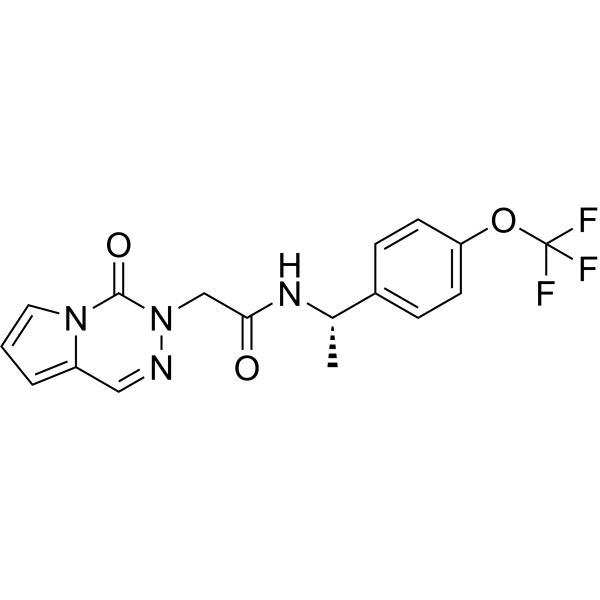
Zelatriazin (TAK-041; NBI-1065846) is a potent and selective GPR139 agonist with an EC50 of 22 nM. Zelatriazin has the potential for the research of negative symptoms associated with schizophrenia .
loading...
    loading...
Cat. No.: HY-172550
CAS No.: 3095336-10-7
Target:  

HCN Channel

Research Areas:  

Neurological Disease

MS7710 is a hyperpolarization-activated cyclic nucleotide-gated (HCN) channel inhibitor with blood-brain barrier permeability and an excellent brain/plasma concentration ratio. MS7710 inhibits HCN channel-mediated Ih current, and reduces the firing frequency and burst activity of dopaminergic neurons in the ventral tegmental area. MS7710 ameliorates chronic social defeat stress-induced deficits in social interaction and impairments in reward-related cognitive flexibility in mice. MS7710 exerts only limited effects on ventral tegmental area dopaminergic neuron activity, social interaction, exploratory behavior, locomotor activity or sucrose preference in control mice. MS7710 is applicable to the research of major depressive disorder .
loading...
    loading...
Cat. No.: HY-P11005
Target:  

Dynamin ATP Synthase

Research Areas:  

Neurological Disease

P259 is a Drp1-Mff inhibitor. P259 distinguishes physiological from pathological fission by specifically inhibiting Drp1-Mff interaction. P259 elongates cell mitochondria and disrupts mitochondrial function and motility. P259 reduces ATP levels and alters mitochondrial structure in the brain, resulting in behavioral deficits in wild-type mice and a short lifespan in Huntington's disease (HD) mice model .
loading...
    loading...
Cat. No.: HY-149651
CAS No.: 2983118-29-0
Purity:  99.80%
Target:  

GPR139

Research Areas:  

Neurological Disease

GPR139 agonist-2 (compound 20a) is a potent GPR139 agonist with an EC50 of 24.7 nM. GPR139 agonist-2 rescues the social interaction deficits and alleviates cognitive deficits in murine schizophrenia models. GPR139 agonist-2 has the potential for antischizophrenia drug research .
loading...
    loading...
Cat. No.: HY-P1847A
Target:  

NF-κB

Research Areas:  

Inflammation/Immunology

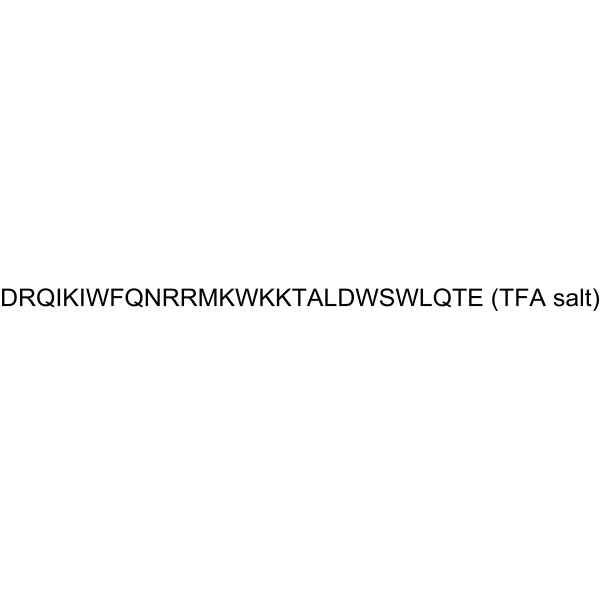
IKKγ NBD Inhibitory Peptide TFA is a highly specific inhibitor NF-κB inhibitor. IKKγ NBD Inhibitory Peptide TFA acts by disrupting the interaction between IKKγ/NEMO-binding domain (NBD) with IKKα and IKKβ, thus blocking TNF-α-induced NF-kB activation. IKKγ NBD Inhibitory Peptide TFA could significantly suppresses inflammation and ameliorate the cerebral ischemia-induced neurological deficits .
loading...
    loading...
Cat. No.: HY-P1847
CAS No.: 372146-18-4
Target:  

NF-κB

Research Areas:  

Cancer

IKKγ NBD Inhibitory Peptide is a highly specific inhibitor NF-κB inhibitor. IKKγ NBD Inhibitory Peptide acts by disrupting the interaction between IKKγ/NEMO-binding domain (NBD) with IKKα and IKKβ, thus blocking TNF-α-induced NF-kB activation. IKKγ NBD Inhibitory Peptide could significantly suppresses inflammation and ameliorate the cerebral ischemia-induced neurological deficits .
loading...
    loading...
Cat. No.: HY-P3355
CAS No.: 2883747-74-6
Target:  

iGluR

Research Areas:  

Neurological Disease

p-fin4 is a peptide inhibitor of STEP Phosphatase-GluA2 AMPA receptor interaction with a Ki of 0.4 μM. p-fin4 restores the memory deficits and displays anxiolytic and antidepressant effects in a scopolamine-treated rat model. p-fin4 is a promising lead compound for novel cognitive enhancers and/or behavioral modulators .
loading...
    loading...
Cat. No.: HY-P3354
Target:  

iGluR

Research Areas:  

Neurological Disease

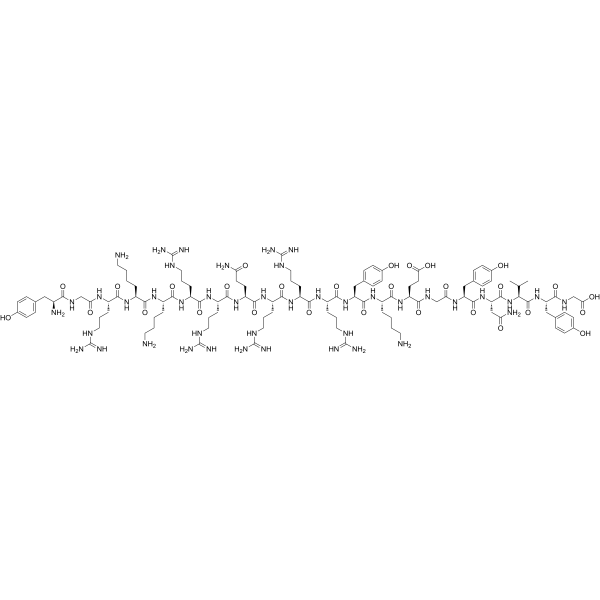
p3Ysh-3 is a peptide inhibitor of STEP Phosphatase-GluA2 AMPA receptor interaction with a Ki of 1.09 μM. p3Ysh-3 restores the memory deficits and displays anxiolytic and antidepressant effects in a scopolamine-treated rat model. p3Ysh-3 is a promising lead compound for novel cognitive enhancers and/or behavioral modulators .
loading...
    loading...
Cat. No.: HY-123661
CAS No.: 1627580-82-8
Target:  

Endogenous Metabolite

Research Areas:  

Neurological Disease

MIPS1455 is a light-activated M1 muscarinic acetylcholine receptor ligand with irreversible binding activity to the allosteric site of the receptor. MIPS1455 is a drug target under investigation for the suppression of cognitive deficits and may become a valuable molecular tool for further investigation of allosteric interactions of the receptor .
loading...
    loading...
Cat. No.: HY-184761
Keap1-Nrf2-IN-30 is an orally active, blood-brain barrier-permeable Keap1-Nrf2 protein-protein interaction inhibitor with a Keap1 Kd value of 157 nM. Keap1-Nrf2-IN-30 selectively inhibits the Keap1-Nrf2 protein-protein interaction, promotes Nrf2 nuclear translocation, suppresses induced ferroptosis, reduces the expression of and p-Tau, and upregulates the expression of GPX4 and SLC7A11. Keap1-Nrf2-IN-30 upregulates the expression of HO-1 and NQO1, alleviates neuronal damage, and improves cognitive and spatial memory deficits. Keap1-Nrf2-IN-30 can be used in the research of Alzheimer's disease .
loading...
    loading...
  • 1