5 Results for "

micellization

" in MedChemExpress (MCE) Product Catalog:
Products (5)

5 Results for "micellization" in MCE Product Catalog:

4
4 Cited Publications
Cat. No.: HY-15435
CAS No.: 75621-03-3
Purity:  99.91%
Research Areas:  

Others

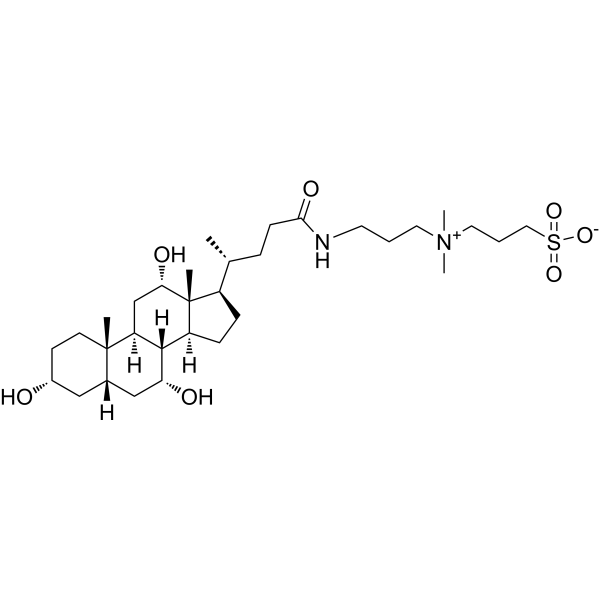
CHAPS is a cholic acid-derived, sulfobetaine-type zwitterionic detergent and micelle-forming agent. CHAPS exhibits properties of weak cationic or nonionic surfactants in different solution systems, undergoes micellization, and forms small, loose hydrophilic aggregates that are temperature-dependent. CHAPS stabilizes mononucleosomes under different ionic strengths, reduces nucleosome sequence specificity, promotes sliding of histone cores along DNA, solubilizes Tamm-Horsfall protein to reduce its interference with urinary exosome isolation, and maintains vesicle structure and the activity of related proteins at the same time. CHAPS is used to recover native folded fusion proteins, enhance the binding capacity of GST fusion proteins, and restore GST enzyme activity. However, CHAPS cannot refold proteins denatured by urea, guanidine hydrochloride or heat, nor can it construct the structure of intrinsically disordered proteins. CHAPS is commonly used in research on the separation and purification of membrane proteins .
loading...
    loading...
4
4 Cited Publications
Cat. No.: HY-15435A
CAS No.: 331717-45-4
Purity:  ≥98.0%
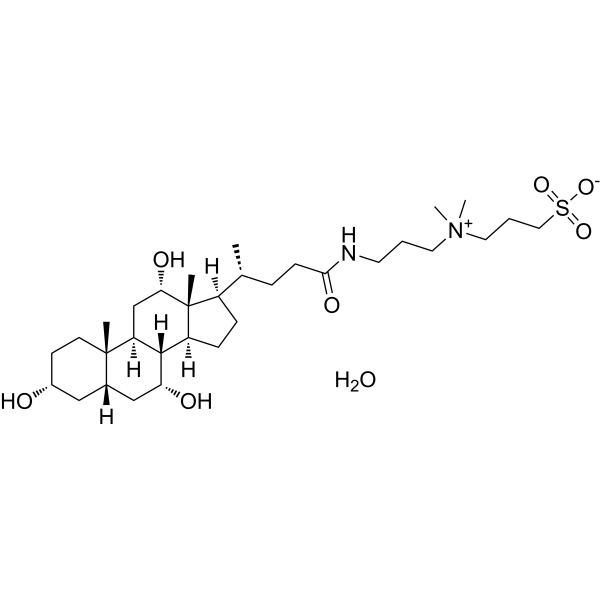
CHAPS hydrate is a cholic acid-derived, sulfobetaine-type zwitterionic detergent and micelle-forming agent. CHAPS hydrate exhibits properties of weak cationic or nonionic surfactants in different solution systems, undergoes micellization, and forms small, loose hydrophilic aggregates that are temperature-dependent. CHAPS hydrate stabilizes mononucleosomes under different ionic strengths, reduces nucleosome sequence specificity, promotes sliding of histone cores along DNA, solubilizes Tamm‑Horsfall protein to reduce its interference with urinary exosome isolation, and maintains vesicle structure and the activity of related proteins at the same time. CHAPS hydrate is used to recover native folded fusion proteins, enhance the binding capacity of GST fusion proteins, and restore GST enzyme activity. However, CHAPS hydrate cannot refold proteins denatured by urea, guanidine hydrochloride or heat, nor can it construct the structure of intrinsically disordered proteins. CHAPS hydrate is commonly used in research on the separation and purification of membrane proteins .
loading...
    loading...
Cat. No.: HY-W096983
CAS No.: 112-00-5
Synonyms: Dodecyltrimethylammonium chloride,for IPC,≥99%
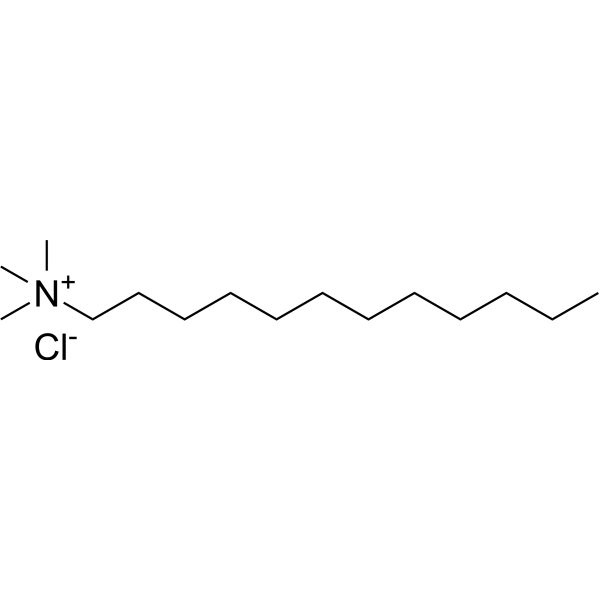
DTAC (Dodecyltrimethylammonium chloride), for IPC, ≥99% is a quaternary ammonium cationic surfactant. DTAC, for IPC, ≥99% can form micelles in aqueous media, which interact with and encapsulate Diclofenac sodium (HY-15037) molecules; the micellization process is entropy-driven at lower temperatures and enthalpy-driven at higher temperatures .
loading...
    loading...
Cat. No.: HY-W040216
CAS No.: 85261-19-4
Synonyms: N-Nonanoyl-N-methylglucamine
MEGA-9 (N-Nonanoyl-N-methylglucamine) is a green, biodegradable glycosyl nonionic surfactant and micelle-forming agent. MEGA-9 acts as a membrane solubilizer, forms vesicles, solubilizes milk fat, eliminates non-specific reactions of test strips, and restores antigen-antibody reactions in cheddar cheese homogenates for the detection of staphylococcal enterotoxin B (SEB) .
loading...
    loading...
Cat. No.: HY-184081
CAS No.: 5118-17-2
Target:  

Bacterial

Research Areas:  

Infection

Furazolium hydrochloride is a broad-spectrum antibacterial agent with inhibitory activity against a variety of Gram-positive and Gram-negative Bacterial strains. In a gelatin-acacia complex coacervate system, Furazolium hydrochloride exhibits protein-binding properties, where protein binding dominates at low concentrations, while micellization occurs at high concentrations. Furazolium hydrochloride does not alter the water permeability of cellulose membranes, and it can induce delayed-type hypersensitivity reactions in guinea pigs, with cross-reactivity observed in animals sensitized with aflatoxin B1. Furazolium hydrochloride can be used in studies related to bacterial infections and local wound infections .
loading...
    loading...

