14 Results for "

piglets

" in MedChemExpress (MCE) Product Catalog:
Products (14)

14 Results for "piglets" in MCE Product Catalog:

Cat. No.: HY-P1714
CAS No.: 1295353-98-8
Synonyms: FE 203799
Target:  

GLP Receptor

Research Areas:  

Metabolic Disease

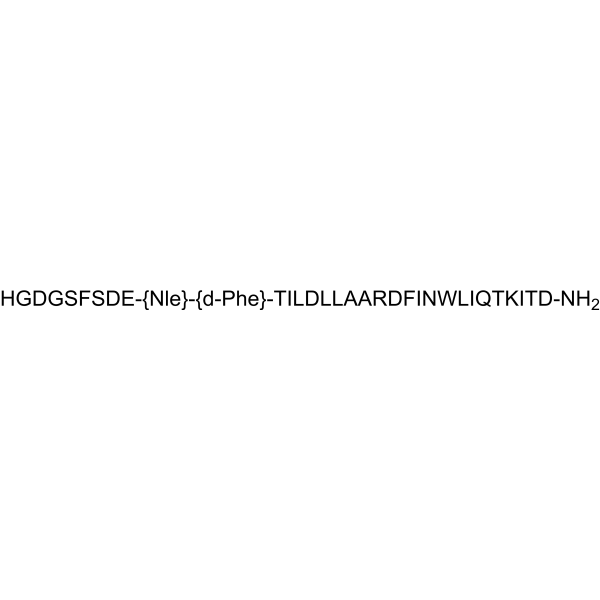
Apraglutide (FE 203799), a synthetic 33-amino-acid peptide and a long-acting GLP-2 analogue, enhances adaptation and linear intestinal growth in a neonatal piglet model of short bowel syndrome with total resection of the ileum .
loading...
    loading...
Cat. No.: HY-B1470
CAS No.: 1649-18-9
Synonyms: R-1929
Azaperone is an antagonist of dopamine D2 receptor (Dopamine D2 Receptor) and α-adrenergic receptor (AR). Azaperone reduces vasomotor tone, mean arterial pressure, hematocrit, hemoglobin concentration, and etorphine-induced duration; induces transient tachycardia followed by bradycardia, splenic uptake of red blood cells, and sedation; alters animal behaviors; and produces sedation with distinct onset and duration in foals. Azaperone is used for sedation and tranquilization in various animals to reduce stress and aggressive behaviors, and serves as a preanesthetic agent .
loading...
    loading...
Cat. No.: HY-N0465
CAS No.: 23696-28-8
Target:  

Antibiotic Bacterial

Research Areas:  

Infection

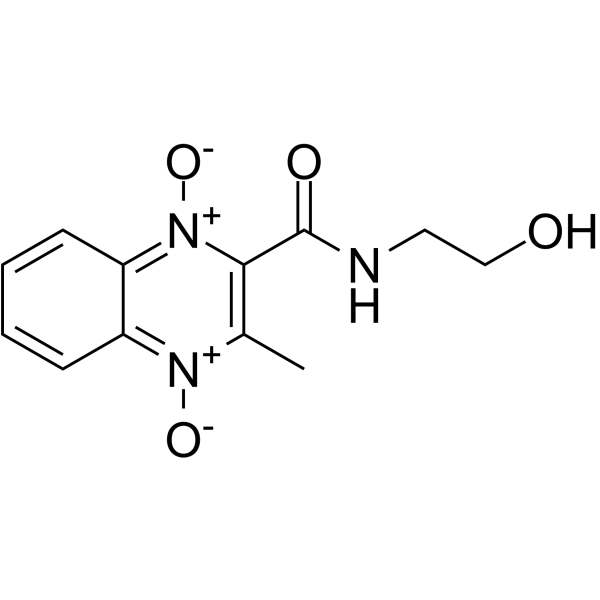
Olaquindox, a quinoxalin derivative, is an orally active antibiotic. Olaquindox stimulates growth and decreases intestinal mucosal immunity of piglets .
loading...
    loading...
Cat. No.: HY-128852
CAS No.: 14215-68-0
Purity:  ≥98.0%
N-Acetyl-D-galactosamine (GalNAc) is a terminal essential amino sugar derived from galactose and forms the antigens of blood group A in humans. N-Acetyl-D-galactosamine (GalNAc) interact with Soya bean agglutinin (SBA), hence decreasing the effects of SBA on cellular membrane permeability and tight junction protein expression in piglets . N-Acetyl-D-galactosamine (GalNAc) inhibits the hemagglutinating activity by the lectin .
loading...
    loading...
Cat. No.: HY-W011165
CAS No.: 52123-30-5
Synonyms: L-Lysyl-L-lysine dihydrochloride
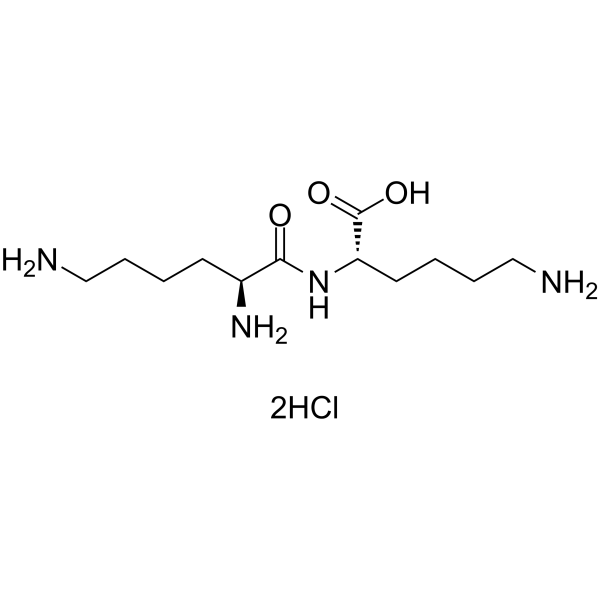
Lysyllysine dihydrochloride (L-Lysyl-L-lysine dihydrochloride) is an orally active PepT1 substrate. Lysyllysine dihydrochloride enhances whole-body protein synthesis, improves intestinal structure, alleviates intestinal mucosal inflammation, and exhibits higher lysine bioavailability in neonatal piglets with PN-induced intestinal atrophy. Lysyllysine dihydrochloride inhibits the growth of axenic cyanobacterial strains and induces their cell lysis. Lysyllysine dihydrochloride can be used in studies related to intestinal atrophy and metabolism .
loading...
    loading...
Cat. No.: HY-P1714A
Synonyms: FE 203799 TFA
Target:  

GLP Receptor

Research Areas:  

Metabolic Disease

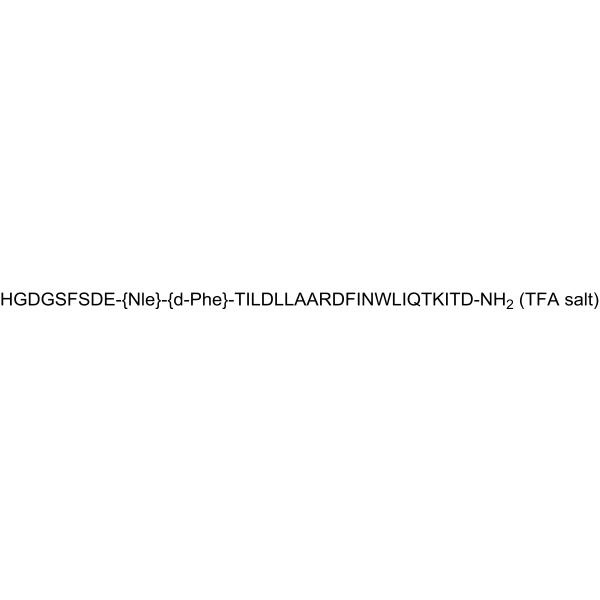
Apraglutide TFA (FE 203799 TFA), a synthetic 33-amino-acid peptide and a long-acting GLP-2 analogue, enhances adaptation and linear intestinal growth in a neonatal piglet model of short bowel syndrome with total resection of the ileum .
loading...
    loading...
Cat. No.: HY-135439
CAS No.: 135938-17-9
Target:  

5-HT Receptor

Research Areas:  

Neurological Disease

SB-203186 is a highly selective 5-HT4 receptor antagonist. SB-203186 exhibits a potent competitive antagonistic effect, with its pKB value being 8.3 in the isolated right atrium model of piglets. SB-203186 can dose-dependently shift the 5-HT-induced tachycardia curve to the right, and does not inhibit the maximum response. SB-203186 is an efficient 5-HT₄ antagonist in pig and human atria, but has no significant inhibitory effect in rat atria. SB-203186 can be used for the study of diseases such as arrhythmias and abnormal myocardial contraction .
loading...
    loading...
Cat. No.: HY-E70193
CAS No.: 37341-53-0
Synonyms: KerA
Research Areas:  

Others

Keratinase (KerA) is an orally active proteolytic enzyme that specifically degrades keratin, and it is mainly secreted by microorganisms such as bacteria, fungi and actinomycetes. Keratinase degrades keratin via reducing disulfide bond cross-links and cleaving peptide bonds, and it can also degrade infectious prion proteins. Keratinase can improve the nutritional bioavailability of keratin-based feed, and it can also be applied in various fields including depilation, proteolytic cleaning, organic fertilizer precursor preparation, cosmetics, bioenergy production, wastewater decolorization, biomolecule extraction, bioremediation, textile biopretreatment and feed processing .
loading...
    loading...
Cat. No.: HY-120791
CAS No.: 13184-13-9
Synonyms: L-Lysyl-L-lysine
Lysyllysine (L-Lysyl-L-lysine ) is an orally active PepT1 substrate. Lysyllysine enhances whole-body protein synthesis, improves intestinal structure, alleviates intestinal mucosal inflammation, and exhibits higher lysine bioavailability in neonatal piglets with PN-induced intestinal atrophy. Lysyllysine inhibits the growth of axenic cyanobacterial strains and induces their cell lysis. Lysyllysine can be used in studies related to intestinal atrophy and metabolism .
loading...
    loading...
Cat. No.: HY-N0465R
CAS No.: 23696-28-8
Research Areas:  

Infection

Olaquindox (Standard) is the analytical standard of Olaquindox. This product is intended for research and analytical applications. Olaquindox, a quinoxalin derivative, is an orally active antibiotic. Olaquindox stimulates growth and decreases intestinal mucosal immunity of piglets .
loading...
    loading...
Cat. No.: HY-N0465S
CAS No.: 1189487-82-8
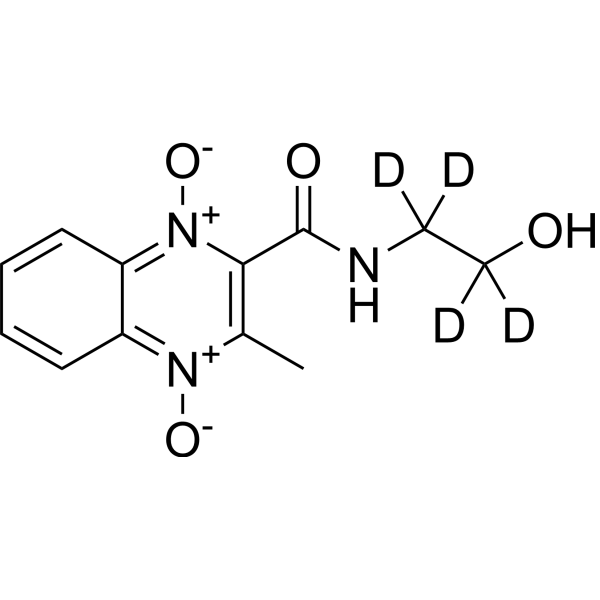
Olaquindox-d4 is the deuterium labeled Olaquindox (HY-N0465) . Olaquindox, a quinoxalin derivative, is an orally active antibiotic. Olaquindox stimulates growth and decreases intestinal mucosal immunity of piglets .
loading...
    loading...
Cat. No.: HY-W747751
Sorbic acid- 13C2 is the 13C-labeled Sorbic acid (HY-N0626). Sorbic acid is an effective, safe, and non-toxic food preservative. It can effectively inhibit most molds, yeasts, and certain bacteria. Sorbic acid is orally active and can enhance the growth performance of economically important animals (Duroc × Landrace × Yorkshire piglets) by activating the insulin-like growth factor system (IGF), and it can also lead to lipid accumulation by disrupting lipid clearance pathways .
loading...
    loading...
Cat. No.: HY-120791A
CAS No.: 73343-51-8
Synonyms: L-Lysyl-L-lysine trihydrochloride
Lysyllysine trihydrochloride (L-Lysyl-L-lysine trihydrochloride) is an orally active PepT1 substrate. Lysyllysine trihydrochloride enhances whole-body protein synthesis, improves intestinal structure, alleviates intestinal mucosal inflammation, and exhibits higher lysine bioavailability in neonatal piglets with PN-induced intestinal atrophy. Lysyllysine trihydrochloride inhibits the growth of axenic cyanobacterial strains and induces their cell lysis. Lysyllysine trihydrochloride can be used in studies related to intestinal atrophy and metabolism .
loading...
    loading...
Cat. No.: HY-N16449
CAS No.: 166100-34-1
Arachidonoylmorpholine is a metabolic regulatory molecule related to arachidonic acid metabolism. The level of Arachidonoylmorpholine will increase when the function of the intestinal flora is disrupted. Arachidonoylmorpholine is promising for research of pig gut health, such as post-weaning diarrhea (PWD) in piglets .
loading...
    loading...
  • 1

