11 Results for "

synaptic loss

" in MedChemExpress (MCE) Product Catalog:
Products (11)

11 Results for "synaptic loss" in MCE Product Catalog:

11
11 Publications Verification
Cat. No.: HY-12355
CAS No.: 1230487-00-9
Purity:  99.95%
Synonyms: BAF-312
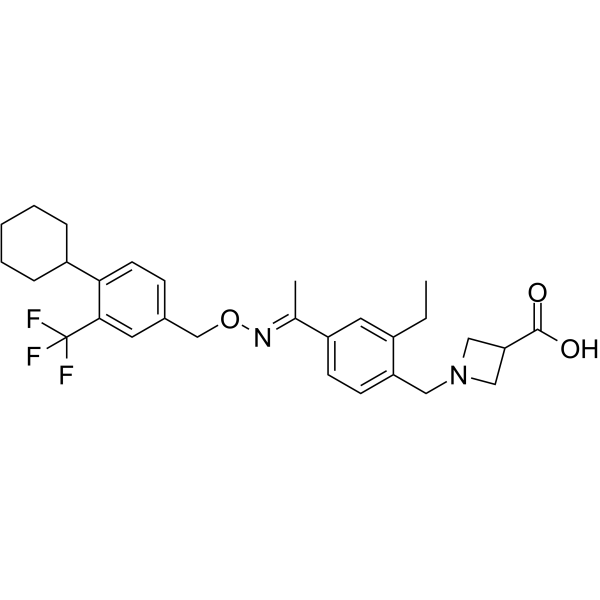
Siponimod (BAF-312) is an orally active, blood-brain barrier penetrant dual agonist of S1P1/S1P5, with EC50 values of 0.39 nM and 0.98 nM, respectively. Siponimod induces S1P1 internalization, activates GIRK channels, inhibits lymphocyte egress, reduces peripheral lymphocyte counts, triggers transient bradycardia, prevents synaptic neurodegeneration, promotes remyelination, alleviates demyelination, and prevents the loss of GABAergic interneurons. Siponimod can be used in research related to multiple sclerosis .
loading...
    loading...
11
11 Publications Verification
Cat. No.: HY-12355A
CAS No.: 1234627-85-0
Purity:  99.64%
Synonyms: BAF-312 hemifumarate
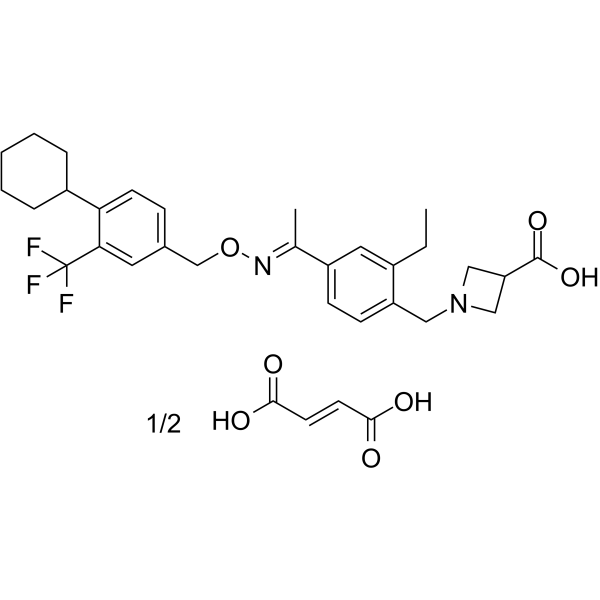
Siponimod (BAF-312) hemifumarate is an orally active, blood-brain barrier penetrant dual agonist of S1P1/S1P5, with EC50 values of 0.39 nM and 0.98 nM, respectively. Siponimod hemifumarate induces S1P1 internalization, activates GIRK channels, inhibits lymphocyte egress, reduces peripheral lymphocyte counts, triggers transient bradycardia, prevents synaptic neurodegeneration, promotes remyelination, alleviates demyelination, and prevents the loss of GABAergic interneurons. Siponimod hemifumarate can be used in research related to multiple sclerosis .
loading...
    loading...
Cat. No.: HY-164288
CAS No.: 2287331-29-5
Synonyms: TDI-006570
TDI-6570 (TDI-006570) is a blood-brain barrier-permeable, orally active cGAS inhibitor with an IC50 of 1.64 μM. TDI-6570 exhibits high gastrointestinal absorption and a long brain half-life in mice, and shows no toxicity to primary neurons. By inhibiting the cGAS-STING-IFN signaling pathway, TDI-6570 reduces STING levels and the activation of TBK1, blocks double-stranded DNA-induced cGAS activation and downstream interferon-stimulated gene expression, thereby reducing tau protein spread and improving synaptic loss. TDI-6570 reverses memory deficits, increases the amplitude of long-term potentiation, enhances the MEF2C transcriptional network, restores PSD-95 and vGAT punctate structures, and significantly improves cognitive resilience. TDI-6570 can be applied to the research of Alzheimer's disease, Parkinson's disease, systemic lupus erythematosus, as well as various central nervous system and autoimmune diseases .
loading...
    loading...
Cat. No.: HY-N15001
CAS No.: 59556-18-2
Gabaculine is an amino acid neurotoxin and blood-brain barrier-permeable GABA transaminase inhibitor, with an IC50 of 1 μM in beef and Pseudomonas ovalis. Gabaculine elevates endogenous synaptic and brain GABA levels and enhances GABA activity. Gabaculine induces sedation, hypothermia, loss of righting reflex, and prevents convulsions in mice. Gabaculine is applicable to research related to neurological disorders .
loading...
    loading...
Cat. No.: HY-12355S
CAS No.: 2104759-32-0
Synonyms: BAF-312-d11
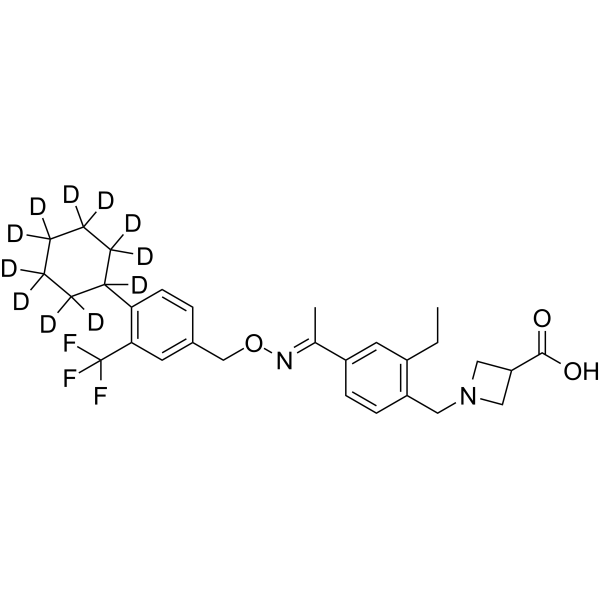
Siponimod-d11 (BAF-312-d11) is deuterium labeled Siponimod (HY-12355). Siponimod is an orally active, blood-brain barrier penetrant dual agonist of S1P1/S1P5, with EC50 values of 0.39 nM and 0.98 nM, respectively. Siponimod induces S1P1 internalization, activates GIRK channels, inhibits lymphocyte egress, reduces peripheral lymphocyte counts, triggers transient bradycardia, prevents synaptic neurodegeneration, promotes remyelination, alleviates demyelination, and prevents the loss of GABAergic interneurons. Siponimod can be used in research related to multiple sclerosis.
loading...
    loading...
Cat. No.: HY-P991535

Target:  

Amyloid-β

Research Areas:  

Neurological Disease

PMN310 is a monoclonal antibody targeting amyloid-β oligomers (AβO). PMN310 prevents AβO-induced memory loss and reduces synaptic loss and inflammation in vivo. PMN310 is potentially useful in Alzheimer's disease research .
loading...
    loading...
Cat. No.: HY-12355R
CAS No.: 1230487-00-9
Synonyms: BAF-312 (Standard)
Siponimod (BAF-312) (Standard) is the analytical standard of Siponimod. This product is intended for research and analytical applications. Siponimod is an orally active, blood-brain barrier penetrant dual agonist of S1P1/S1P5, with EC50 values of 0.39 nM and 0.98 nM, respectively. Siponimod induces S1P1 internalization, activates GIRK channels, inhibits lymphocyte egress, reduces peripheral lymphocyte counts, triggers transient bradycardia, prevents synaptic neurodegeneration, promotes remyelination, alleviates demyelination, and prevents the loss of GABAergic interneurons. Siponimod can be used in research related to multiple sclerosis.
loading...
    loading...
Cat. No.: HY-P991654

Target:  

Amyloid-β

Research Areas:  

Neurological Disease

SAR228810 is a humanized IgG4 monoclonal antibody inhibitor targeting amyloid β (Aβ) with a KD? of ?0.43 ?nM for protofibrillar Aβ over monomeric Aβ. SAR228810 significantly inhibits the brain amyloid plaque formation and oligomer-induced synaptic dysfunction and neurite loss. SAR228810 has significant protection against Aβ-mediated neuritotoxicity. MINT1526A can be used for Alzheimer’s disease imaging and immunotherapy research .
loading...
    loading...
Cat. No.: HY-118278
CAS No.: 161832-71-9
Synonyms: LY303070
Target:  

iGluR

GYKI 53784 (LY303070) is an orally active, blood-brain penetrant, selective, non-competitive AMPA receptor antagonist (IC50 = 0.32 μM). GYKI 53784 completely blocks AMPA-mediated synaptic transmission, protects against excitotoxicity, and partially inhibits Kainite (Kainic acid) (HY-N2309) responses, revealing both AMPA and kainate receptors. GYKI 53784 selectively blocks synaptic transmission (IC50 = 365.3 nM) without affecting neuronal excitability, and exhibits potent stereoselective antinociceptive effects via an opioid-independent mechanism. GYKI 53784 is a versatile tool for studying AMPA receptor function in synaptic transmission, excitotoxicity, neuroprotection, pain, and inflammation, with potential relevance to hearing loss, neonatal ischemia, neurodegenerative disorders, schizophrenia, and Alzheimer's disease .
loading...
    loading...
Cat. No.: HY-W720917
CAS No.: 41787-69-3
Junicedric acid is a diterpenoid compound that can be isolated from the resin of the Araucaria araucana tree. Junicedric acid exerts neuroprotective activity by increasing intracellular calcium levels in hippocampal neurons, activating PKC and calcium/calmodulin-dependent protein kinase (CaMKII), and preventing Amyloid-β oligomer-induced synaptic protein loss, apoptosis, and long-term potentiation (LTP) inhibition. Junicedric acid can be used in the study of the pathological mechanisms of neurodegenerative diseases such as Alzheimer's disease .
loading...
    loading...
Cat. No.: HY-125447
CAS No.: 145941-07-7
Artemisinin B is an orally active sesquiterpene natural product with anti-neuroinflammatory activity, which can be found in Artemisia annua Linn.. Artemisinin B suppresses the TLR4-MyD88-NF-κB signaling pathway by reducing the protein levels of TLR4 and MyD88, as well as inhibiting the mRNA expression of NF-κB p65. Artemisinin B reduces the expression of pro-inflammatory cytokines and attenuates synaptic loss, which can be used for the research of cognitive and behavioral impairments in Alzheimer's disease. Artemisinin B shows no cytotoxicity against human cardiomyocytes and exhibits very weak binding to hERG, suggesting its potential for cardioprotective property research .
loading...
    loading...
  • 1

