6 Results for "

targeting of glycoconjugates

" in MedChemExpress (MCE) Product Catalog:
Products (6)

6 Results for "targeting of glycoconjugates" in MCE Product Catalog:

Cat. No.: HY-147168
CAS No.: 102743-85-1
Purity:  99.24%
Research Areas:  

Others

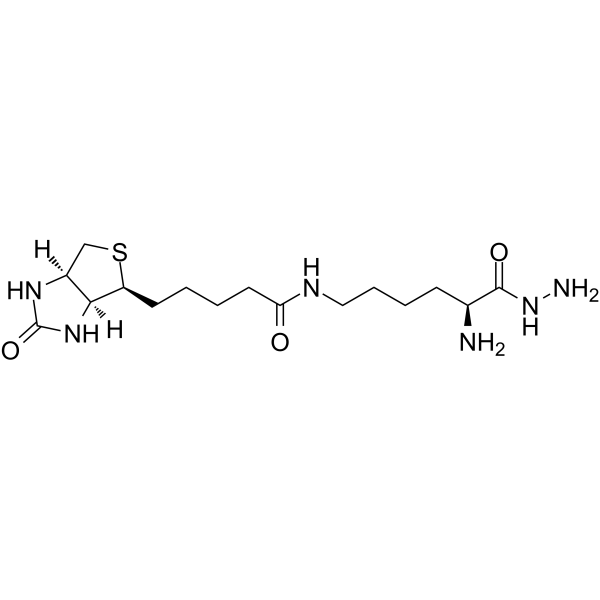
Biocytin hydrazide is a long-chain biotin-containing hydrazide, serving as a biotin-derived active coupling reagent, selective labeling agent and biotinylating reagent. Biocytin hydrazide targets aldehyde, carboxyl, amino and guanidino groups to biotinylate glycoconjugates, K99 lectin, peptides and proteins through its hydrazide moiety, and achieves nonradioactive detection of sialic acid- and galactose-containing glycoconjugates via the avidin–biotin system .
loading...
    loading...
Cat. No.: HY-158253
Helix pomatia lectin, biotin conjugate, is a carbohydrate-binding protein that is widely found in fungi, plants, and animals. Helix pomatia lectin, biotin conjugate is commonly used for characterizing, imaging, or targeting glycoconjugates, and is also a very useful tool for glycomics analysis .
loading...
    loading...
Cat. No.: HY-NP0144
Synonyms: WGA (Fluorescein)
Succinylated Wheat Germ Agglutinin (Fluorescein) (WGA (Fluorescein)) is a fluorescent lectin that acts as a probe to specifically bind biomolecules. Succinylated Wheat Germ Agglutinin (Fluorescein) binds to cell surface glycoconjugates containing N-acetylglucosamine. Succinylated Wheat Germ Agglutinin (Fluorescein) is a selective agglutinating agent targeting specific red blood cells, thymocytes, splenocytes and lymphocytes. Succinylated Wheat Germ Agglutinin (Fluorescein) binds to fibroblasts and lymphocytes via dual binding sites in a temperature-dependent, saturable manner. Succinylated Wheat Germ Agglutinin (Fluorescein) can be used for quantitative studies of cell surface receptor glycoconjugates (Ex=495 nm, Em=515 nm) .
loading...
    loading...
Cat. No.: HY-175472
Target:  

Phosphatase Apoptosis

Research Areas:  

Cancer

(GalNAc)3-CPT is a glycoconjugate prodrug that targets the asialoglyco-protein receptor (ASGR) overexpressed on hepatocytes. (GalNAc)3-CPT exhibits significant antitumor activity (IC50 value of 3.07 μM in HepG2 cells) by activating the cGAS-STING pathway and promoting CD8+ T cell infiltration into tumors, thereby inducing tumor cell apoptosis .
loading...
    loading...
Cat. No.: HY-NP186
Helix pomatia Agglutinin is a N-acetylgalactosamine (GalNAc) binding lectin, found in the reproductive gland of a Roman snail. Helix pomatia Agglutinin binds with high affinity (kD = 1.9-2.4 μM) steroid hormones: testosterone and progesterone. Helix pomatia Agglutinin interacts with adenine (kD = 5.4 μM) and arylaminonaphthalene sulfonate TNS (kD = 12 μM). Helix pomatia Agglutinin is commonly used for characterizing, imaging, or targeting glycoconjugates, and is also a very useful tool for glycomics analysis . Helix pomatia Agglutinin can be used for cancer prognosis study .
loading...
    loading...
Cat. No.: HY-D3581
Target:  

Fluorescent Dye

Research Areas:  

Others

AF594 Picolyl Azide is a composite fluorescent probe formed by covalent linkage of the Alexa Fluor 594 fluorophore and the Picolyl Azide functional group via chemical bonds. AF594 Picolyl Azide contains a copper chelation domain, and through the copper-catalyzed azide-alkyne cycloaddition click chemistry reaction, it can covalently label alkyne-bearing target molecules and generate fluorescent detection signals. AF594 Picolyl Azide can be used for the detection of alkyne-modified sialylated glycoconjugates, and can also label nascent bacterial polypeptides to determine bacterial protein synthesis rates .
loading...
    loading...

