



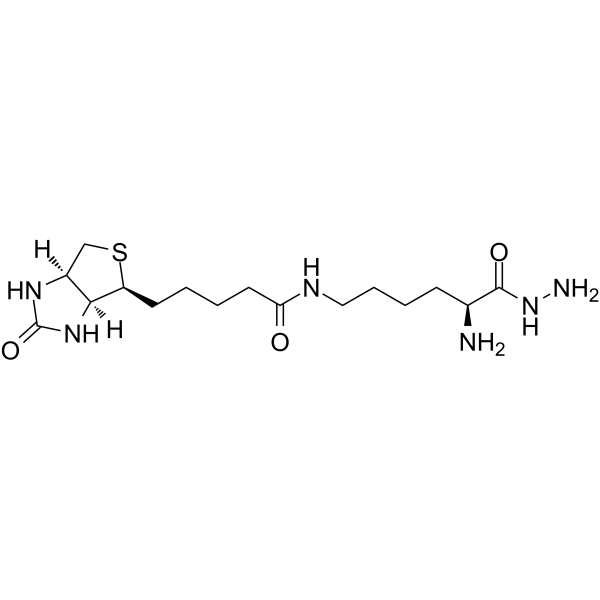
Biocytin hydrazide

Based on 1 Customer Validation
Biocytin hydrazide is a long-chain biotin-containing hydrazide, serving as a biotin-derived active coupling reagent, selective labeling agent and biotinylating reagent. Biocytin hydrazide targets aldehyde, carboxyl, amino and guanidino groups to biotinylate glycoconjugates, K99 lectin, peptides and proteins through its hydrazide moiety, and achieves nonradioactive detection of sialic acid- and galactose-containing glycoconjugates via the avidin–biotin system.
For research use only. We do not sell to patients.
- Purity : 99.24%
- CAS No.: 102743-85-1
- Formula: C16H30N6O3S
- Molecular Weight:386.51
-
Storage:Powder -20°C, 3 years ; In solvent -80°C, 6 months , -20°C, 1 month

To place orders, for customer services and technical support, please contact: MedChemExpress USA
Tel: 609-228-6898 E-mail: [email protected] [email protected]


-
 Biological Activity
-
Chemical Information
-
Solvent & Solubility
- Purity & Documentation
- References
-
 Help & FAQs




Biological Activity
Description
In Vitro
Biocytin hydrazide (0.3-30 μg/mL) optimally labels oxidized fetuin and asialofetuin on dot blots at a concentration of 3 μg/mL[1].
Biocytin hydrazide (3 μg/mL; 1 h, 2 h) labels human erythrocyte membrane glycoproteins on blots via both periodate oxidation (3 μg/mL, 1 h) and NAGO oxidation (3 μg/mL, 2 h), producing similar banding patterns with NAGO requiring higher protein input[1].
Biocytin hydrazide (10-100 μg/mL; 1 h, 2 h) labels human erythrocyte membrane glycoproteins via periodate oxidation (10-100 μg/mL, 1 h), NAGO oxidation (10-100 μg/mL, 2 h), or GO oxidation (10-100 μg/mL, 2 h); GO treatment selectively labels the Band 3 glycoprotein, while periodate treatment alters membrane protein electrophoretic mobility[1].
Biocytin hydrazide achieves site-specific biotinylation of K99 lectin via carboxyl groups. The obtained biotinylated K99 lectin can specifically bind to sialic acid-containing receptors on HeLa cells and recapitulate the adhesion pattern of intact K99-expressing E. coli B80. Meanwhile, biotinylated K99 lectin retains specific recognition capacity toward NeuGc-GM3 ganglioside with a detection limit of 90 ng, showing equivalent sensitivity to intact K99-expressing bacteria[2].
Biocytin hydrazide (0.01-1 M; 5-96 h) directly biotinylates peptides including human angiotensin I, P14R, ACTH fragment 1-13, and proteins including bovine insulin, horse heart cytochrome c, hen egg white lysozyme, soybean trypsin inhibitor, and bovine serum albumin via its hydrazide moiety, binding to arginine side chains along with other residues, with efficiency increasing with higher temperature, higher concentration, and longer incubation time, and optimal activity at neutral pH[3].
MedChemExpress (MCE) has not independently confirmed the accuracy of these methods. They are for reference only. .


Chemical Information
-
CAS No. 102743-85-1
-
Appearance Solid
-
Molecular Weight 386.51
-
Formula C16H30N6O3S
-
Color White to light yellow
-
SMILES
NNC([C@@H](N)CCCCNC(CCCC[C@H]1[C@]2([H])[C@](NC(N2)=O)([H])CS1)=O)=O
-
Shipping
Room temperature in continental US; may vary elsewhere.
-
Storage
Powder -20°C 3 years In solvent -80°C 6 months -20°C 1 month


Solvent & Solubility
In Vitro:
DMSO : 83.33 mg/mL (215.60 mM; Need ultrasonic; Hygroscopic DMSO has a significant impact on the solubility of product, please use newly opened DMSO)
Please refer to the solubility information to select the appropriate solvent. Once prepared, please aliquot and store the solution to prevent product inactivation from repeated freeze-thaw cycles.
Storage method and period of stock solution: -80°C, 6 months; -20°C, 1 month. When stored at -80°C, please use it within 6 months. When stored at -20°C, please use it within 1 month.
Please refer to the solubility information to select the appropriate solvent. Once prepared, please aliquot and store the solution to prevent product inactivation from repeated freeze-thaw cycles.
Storage method and period of stock solution: -80°C, 6 months; -20°C, 1 month. When stored at -80°C, please use it within 6 months. When stored at -20°C, please use it within 1 month.
Concentration (start) × Volume (start) = Concentration (final) × Volume (final)


Purity & Documentation
-
Data Sheet (271 KB)
-
SDS (394 KB)
- English - EN (394 KB)
- Français - FR (394 KB)
- Deutsch - DE (394 KB)
- Norwegian - NO (394 KB)
- Español - ES (394 KB)
- Swedish - SV (394 KB)
- Italian - IT (394 KB)
- Korean - KR (394 KB)
- Portuguese - PT (394 KB)
-
Handling Instructions (2659 KB)
References
[1]. Bayer EA, et al. Biocytin hydrazide--a selective label for sialic acids, galactose, and other sugars in glycoconjugates using avidin-biotin technology. Anal Biochem. 1988;170(2):271-281. [Content Brief]
[2]. Ouadia A, et al. Detection of the ganglioside N-glycolyl-neuraminyl-lactosyl-ceramide by biotinylated Escherichia coli K99 lectin. Glycoconj J. 1992;9(1):21-26. [Content Brief]


Complete Stock Solution Preparation Table
Please refer to the solubility information to select the appropriate solvent. Once prepared, please aliquot and store the solution to prevent product inactivation from repeated freeze-thaw cycles.
Storage method and period of stock solution: -80°C, 6 months; -20°C, 1 month. When stored at -80°C, please use it within 6 months. When stored at -20°C, please use it within 1 month.
| Optional Solvent | Concentration Solvent Mass | 1 mg | 5 mg | 10 mg | 25 mg |
|---|---|---|---|---|---|
| DMSO | 1 mM | 2.5873 mL | 12.9363 mL | 25.8726 mL | 64.6814 mL |
| 5 mM | 0.5175 mL | 2.5873 mL | 5.1745 mL | 12.9363 mL | |
| 10 mM | 0.2587 mL | 1.2936 mL | 2.5873 mL | 6.4681 mL | |
| 15 mM | 0.1725 mL | 0.8624 mL | 1.7248 mL | 4.3121 mL | |
| 20 mM | 0.1294 mL | 0.6468 mL | 1.2936 mL | 3.2341 mL | |
| 25 mM | 0.1035 mL | 0.5175 mL | 1.0349 mL | 2.5873 mL | |
| 30 mM | 0.0862 mL | 0.4312 mL | 0.8624 mL | 2.1560 mL | |
| 40 mM | 0.0647 mL | 0.3234 mL | 0.6468 mL | 1.6170 mL | |
| 50 mM | 0.0517 mL | 0.2587 mL | 0.5175 mL | 1.2936 mL | |
| 60 mM | 0.0431 mL | 0.2156 mL | 0.4312 mL | 1.0780 mL | |
| 80 mM | 0.0323 mL | 0.1617 mL | 0.3234 mL | 0.8085 mL | |
| 100 mM | 0.0259 mL | 0.1294 mL | 0.2587 mL | 0.6468 mL |


Biocytin hydrazide Related Classifications
HY-147168 Related Classifications
 Powered by Bioz