1. Search Result
Search Result
Results for "

two-photon imaging

" in MedChemExpress (MCE) Product Catalog:

15

Inhibitors & Agonists

11

Fluorescent Dye

1

Click Chemistry

Cat. No. Product Name Target Research Areas Chemical Structure
  • HY-D2344

    3-Benzothiazole-daphnetin

    Fluorescent Dye Others
    3-BTD (3-Benzothiazole-daphnetin) is a Catechol-O-methyltransferase (COMT) two-photon fluorescence probe. 3-BTD can also be used for biological imaging of endogenous COMT in living cells and tissue sections .
    3-BTD
  • HY-115853

    Biochemical Assay Reagents Others
    Pyclen forms kinetically and thermodynamically stable nine-coordinate Ln (III) complexes, as well as Mn (II)-based MRI contrast agents. Pyclen-Based Mn(II) Complexes can be used for liver-specific MRI .
    Pyclen
  • HY-139337

    Fluorescent Dye Others
    SMCy5.5 is a SMCy dye (ex. 638 nm; em. 705 nm). The high brightness of SMCy5.5 allows for effective tracking and imaging of lipid droplet exchange between adipocytes. SMCy5.5 can be used for lipid droplet labeling studies .
    SMCy5.5
  • HY-D2971

    Fluorescent Dye Autophagy Neurological Disease
    NCIC-VIS is a lysosome-targeted, viscosity-sensitive two-photon near-infrared fluorescent probe. NCIC-VIS has a rigid structure that can restrict molecular torsion, thereby increasing the fluorescence quantum yield and two-photon absorption cross-section. NCIC-VIS enables real-time imaging of the autophagy process in cells .
    NCIC-VIS
  • HY-D1637

    Fluorescent Dye Others
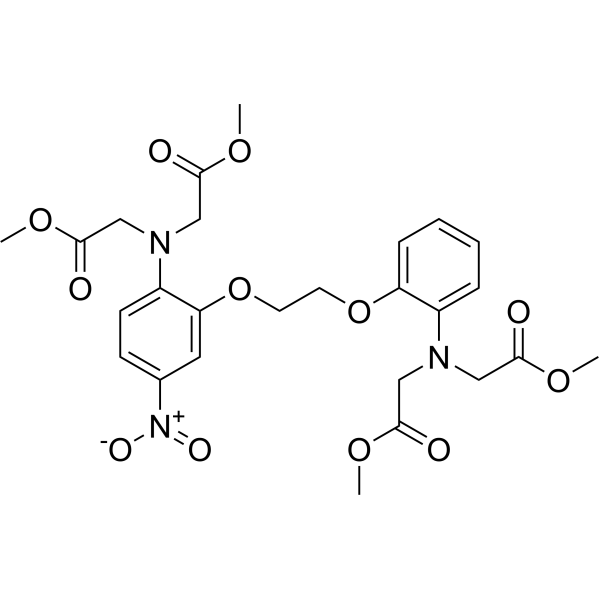
    5-Nitro BAPTA tetramethyl ester is a calcium chelator. 5-Nitro BAPTA tetramethyl ester involves in the two-photon probe synthesis, and is used for real-time imaging of intracellular calcium ions, calcium waves monitoring at a depth of 100-300 μm in liver tissues for 1100-4000 s. 5-Nitro BAPTA tetramethyl ester, together with fluorescent compound 2-Me-substituted TM, can be used to form a red fluorescent probe (CaTM-2 AM) .
    5-Nitro BAPTA tetramethyl ester
  • HY-136675

    Fluorescent Dye Others
    ASMI is a ratiometric, two-photon excited fluorescent probe, composed of a highly two-photon active and biocompatible merocyanine fluorophore and an acrylate moiety as a thiol reactive site. ASMI is able to selectively detect and monitor mitochondrial Cys with rapid responsiveness, imaging living cells and intact tissues with high contrast and brightness at a depth of 150 μm. The two-photon action cross section (Φσmax) of ASMI is 65.2 GM, corresponding to an excitation wavelength (λex) of 740 nm.
    ASMI
  • HY-161476

    Fluorescent Dye Cancer
    Ir-ImNO is a mitochondria-targeted two-photon probe with excellent cell membrane permeability, capable of detecting both endogenous and exogenous cell membrane permeability. Ir-ImNO can monitor different immune response states of macrophages through various imaging techniques, including one-photon and two-photon phosphorescence imaging as well as phosphorescence lifetime imaging. Ir-ImNO can be utilized in the research to assist in the clinical monitoring of immunotherapy .
    Ir-ImNO
  • HY-D3267

    Fluorescent Dye Others
    ACu1 is a copper (I)-selective two-photon fluorescent probe that enables the visual imaging of Cu + distribution in living cells and tissues .
    ACu1
  • HY-D2968

    Fluorescent Dye Neurological Disease
    DCM-ONOO is a near-infrared two-photon fluorescence probe specifically designed for real-time monitoring of the dynamic fluctuations of peroxynitrite (ONOO⁻) in epilepsy models. DCM-ONOO exhibits excellent optical properties, with a single photon excitation (Ex) of 520 nm; a single photon emission (Em) of 685 nm; a two-photon excitation of 820 nm; and a Stokes shift of 165 nm. When DCM-ONOO is combined with ONOO⁻, it shifts from 460 nm to 512 nm, and only generates a significant fluorescence response to ONOO⁻. DCM-ONOO has been successfully applied to rat epilepsy models .
    DCM–ONOO
  • HY-D3224

    Fluorescent Dye Neurological Disease
    HCP is a two-photon fluorescent probe capable of crossing the blood-brain barrier, which is specifically designed for real-time detection of hypochlorous acid (HClO/ClO -) produced by myeloperoxidase (MPO). Chlorination of the quinoline skeleton of HCP generates HCP-Cl, which eliminates intramolecular charge transfer (ICT) quenching and thereby produces fluorescence. HCP is suitable for in vivo dynamic imaging of HClO in the brains of epileptic mice and high-throughput screening of antiepileptic drugs (HCP-Cl: Ex/Em = 800 nm/495 nm) .
    HCP
  • HY-D3171

    Fluorescent Dye Cholinesterase (ChE) Neurological Disease
    AD-BChE/HClO is a dual-target two-photon fluorescent probe. AD-BChE/HClO can release 4-methylumbelliferone via butyrylcholinesterase-mediated hydrolysis of the ester bond at position 7, as well as hypochlorous acid-mediated thiocarbonyl oxidation. AD-BChE/HClO enables two-photon imaging in nerve cells and mouse brain tissues via tail vein injection. AD-BChE/HClO can be used for the research of Alzheimer's disease .
    AD-BChE/HClO
  • HY-D2942

    Fluorescent Dye Others
    BDP-V BG-BODIPY is a SNAP tag fluorescent probe labeled with a BODIPY molecular motor. BDP-V BG-BODIPY contains a BODIPY molecular rotor that functions as a viscosity-sensitive fluorophore, which is highly responsive to local viscosity changes and enables the specific monitoring of the local microviscosity of proteins. BDP-V BG-BODIPY supports one-photon and two-photon imaging, with an excitation wavelength (Ex) of 488 nm (for one-photon excitation) and 850 nm (for two-photon excitation), and an emission wavelength (Em) of 500-600 nm .
    BDP-V BG-BODIPY
  • HY-D3221

    Fluorescent Dye Monoamine Oxidase Amyloid-β Neurological Disease
    MAO Probe 1 is a reactive two-photon fluorescent probe capable of crossing the blood-brain barrier, which is used to detect the activity of monoamine oxidases (MAO-A/MAO-B), with Km values of 70 μM (MAO-A) and 75 μM (MAO-B), respectively. IBC 2 (benzo[g]imino-coumarin 2), the enzymatic product of MAO Probe 1, can further specifically bind to and image plaques, enabling in vivo two-photon co-monitoring of MAO activity and Aβ plaques. MAO Probe 1 can be used in Alzheimer's disease research (IBC 2: Ex/Em = 850 nm/570-620 nm) .
    MAO Probe 1
  • HY-D3166

    Fluorescent Dye Others
    CEMT is a carboxylesterase (CE) substrate and a ratiometric two-photon fluorescent reporter probe. CEMT can be hydrolyzed by CE to generate HMT, which is used for mitochondrial pH sensing. After activation by CE, CEMT exhibits ratiometric fluorescence changes in response to pH variations. CEMT targets and covalently binds to mitochondria, and can avoid leakage during acidification, thus enabling in situ imaging .
    CEMT
  • HY-D3173

    TPG-456

    Fluorescent Dye GCGR Metabolic Disease
    TP-α is a glucagon-selective two-photon fluorescent probe with a Kd of 65 μM. TP-α directly interacts with glucagon to produce significant fluorescence enhancement. TP-α selectively stains viable glucagon-secreting α cells in pancreatic islets, enabling visualization of their localization, distribution and availability. TP-α is applicable to diabetes research .
    TP-α

Inquiry Online

Your information is safe with us. * Required Fields.

Salutation


Country or Region *

Applicant Name *


Organization Name *

Department *


Email Address *


Product Name *

Cat. No.


Requested quantity *

Phone Number *


Remarks

Inquiry Online

Inquiry Information

Product Name:
Cat. No.:
Quantity:
MCE Japan Authorized Agent:

