10 Results for "

writhing response

" in MedChemExpress (MCE) Product Catalog:
Products (10)

10 Results for "writhing response" in MCE Product Catalog:

2
2 Cited Publications
Cat. No.: HY-N0745
CAS No.: 94596-28-8
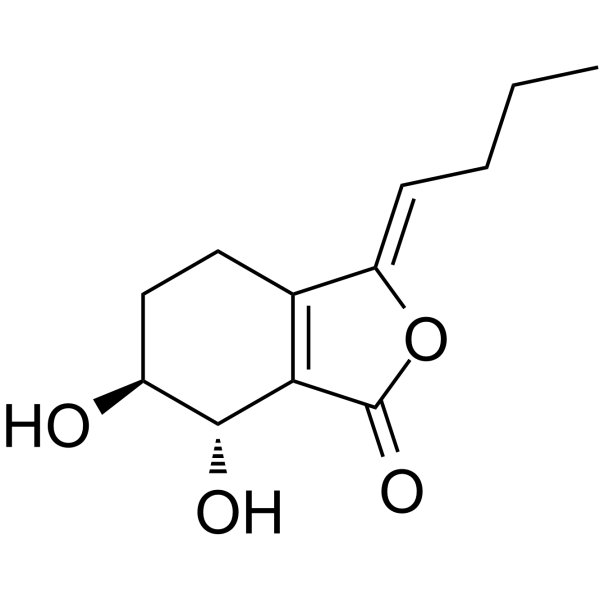
Senkyunolide I is an orally active, blood-brain barrier-permeable metabolite of Z-ligustilide (HY-N0401A) . Senkyunolide I is isolated from Ligusticum chuanxiong. Senkyunolide I upregulates p-Erk1/2 and Nrf2/HO-1, and inhibits Caspase 3. Senkyunolide I alleviates Apoptosis. Senkyunolide I increases the pain threshold in mice and reduces acetic acid-induced writhing responses in mice. Senkyunolide I improves neurological deficits, reduces infarct volume and alleviates cerebral edema in rats with focal cerebral ischemia-reperfusion injury. Senkyunolide I protects renal function and structural integrity in a mouse model of renal ischemia-reperfusion injury. Senkyunolide I is applicable to research related to focal cerebral ischemia-reperfusion injury, migraine, and renal ischemia-reperfusion injury .
loading...
    loading...
Cat. No.: HY-N3558
CAS No.: 21302-79-4
Synonyms: Emmolic acid
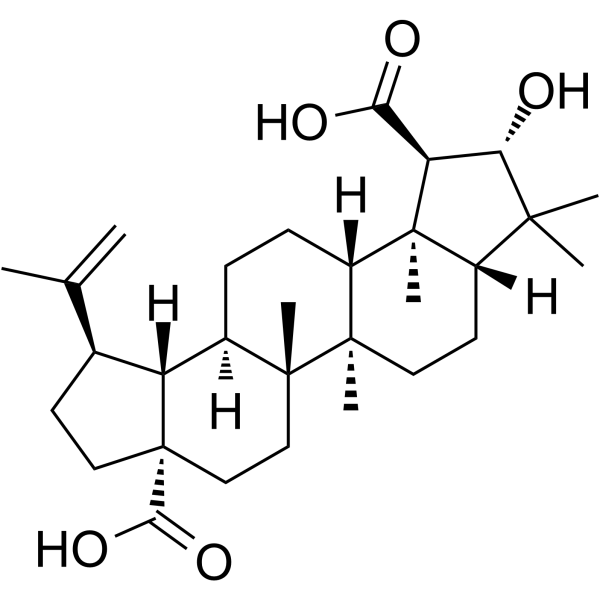
Ceanothic acid (Emmolic acid) is an orally active pentacyclic triterpenoid. Ceanothic acid inhibits the growth of various oral bacteria, including Streptococcus mutans, Actinomyces viscosus, Porphyromonas gingivalis, and Prevotella intermedia. Ceanothic acid scavenges DPPH and H2O2 free radicals. Ceanothic acid inhibits acetic acid (HY-Y0319)-induced writhing response, xylene-induced ear swelling, and carrageenan-induced paw swelling in mice. Ceanothic acid can be used in research related to oral bacterial infections, ovarian cancer, liver cancer, and liver injury .
loading...
    loading...
Cat. No.: HY-N11072
CAS No.: 29836-40-6
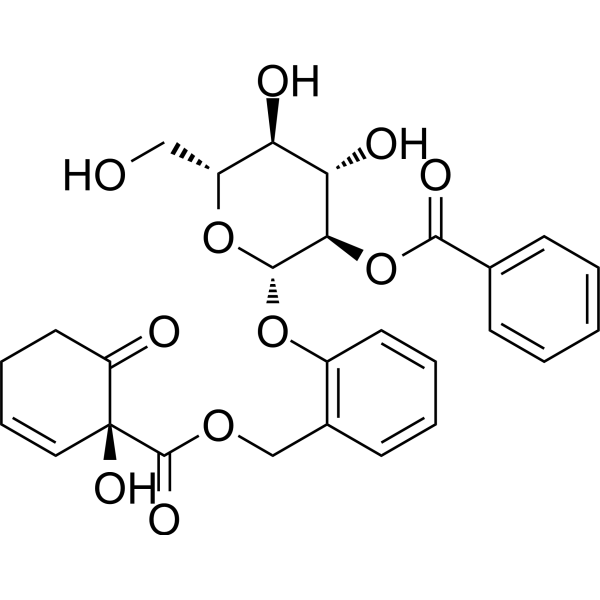
Tremulacin is a 5-LOX inhibitor. Tremulacin reduces the biosynthesis of LTB4 and slow-reacting substances of anaphylaxis. Tremulacin alleviates carrageenan-induced paw edema in rats, croton oil-induced ear edema in mice, and acetic acid-induced writhing response in mice. Tremulacin inhibits TNF-α-stimulated ROS production and MMP-1 expression, and promotes collagen secretion in human dermal fibroblasts. Tremulacin is investigated for studies on inflammation-related diseases .
loading...
    loading...
Cat. No.: HY-14343
CAS No.: 1125746-49-7
Target:  

NO Synthase

Research Areas:  

Neurological Disease

KLYP961 is a selective and orally active dual inhibitor of inducible and neuronal NO synthase (IC50 = 50-400 nM). KLYP961 can inhibit endotoxin-evoked plasma nitrates increases and attenuate pain behaviors in a mouse formalin model. KLYP961 can attenuate carrageenin-induced edema and inflammatory hyperalgesia and writhing response elicited by Phenylbenzoquinone (HY-W275039). KLYP961 can be used for the research of neurological disease .
loading...
    loading...
Cat. No.: HY-P1617
CAS No.: 105496-35-3
Target:  

Endogenous Metabolite

Research Areas:  

Neurological Disease

LY 190388 is a penicillamine-containing enkefa peptide analog with μ receptor agonist activity. LY 190388 showed analgesic effect in inhibiting the writhing response in mice after intracerebroventricular administration. The analgesic effect of LY 190388 is not caused by its δ receptor agonist action, but by its μ receptor agonist activity. When LY 190388 is used together with the δ receptor antagonist ICI 174864, an additive analgesic effect is produced .
loading...
    loading...
Cat. No.: HY-N18124
CAS No.: 122688-84-0
1-O-Tigloyl-1-O-debenzoylohchinal is an orally active limonoid-type triterpenoid anti-inflammatory and peripheral analgesic agent isolated from the fruits of Melia toosendan. 1-O-Tigloyl-1-O-debenzoylohchinal significantly inhibits acetic acid (HY-Y0319)-induced increase in vascular permeability, λ-Carrageenan (HY-N9470)-induced paw edema, and acetic acid-induced writhing response in mice. 1-O-Tigloyl-1-O-debenzoylohchinal shows no significant analgesic effect in the hot-plate test, and acts mainly on the peripheral rather than the central nervous system. 1-O-Tigloyl-1-O-debenzoylohchinal can be widely used in the research of acute or chronic inflammation, stomachache and other related diseases .
loading...
    loading...
Cat. No.: HY-182782
CAS No.: 1179703-17-3
Target:  

Adenosine Receptor

Research Areas:  

Neurological Disease

Analgesic agent-4 is an adenosine A3AR ligand with analgesic/antinociceptive activity. Analgesic agent-4 inhibits writhing responses in mice and exhibits dose-dependent activity in the acetic acid (HY-Y0319)-induced mouse writhing model. Analgesic agent-4 can be used in the research of pain-related diseases .
loading...
    loading...
Cat. No.: HY-182584
CAS No.: 153607-45-5
Target:  

5-HT Receptor

Research Areas:  

Neurological Disease

S 15931 is a 5-HT1A receptor inhibitor. S 15931 inhibits the late-phase hindpaw licking response induced by formalin and the abdominal writhing response induced by acetic acid in Mus musculus. S 15931 abolishes the spontaneous tail-flick response induced by 8-OH-DPAT in Rattus norvegicus and potentiates the analgesic effect of morphine. S 15931 is applicable for pain-related research .
loading...
    loading...
Cat. No.: HY-182783
CAS No.: 862248-40-6
Synonyms: NTM-006
NTM-006 is a selective and brain-penetrant adenosine A3 receptor (A3AR) agonist. NTM-006 selectively interacts with adenosine A3AR via π-π stacking with Phe168 and π-alkyl interactions receptor residues. NTM-006 inhibits Acetic acid (HY-Y0319)-induced writhing responses in mice. NTM-006 can be used for the research of chronic neuropathic pain, cancer-related pain, osteoarthritis-associated pain .
loading...
    loading...
Cat. No.: HY-N21746
CAS No.: 798558-82-4
Rhodomollein XI is a naturally occurring grayanane diterpenoid with anti-inflammatory and analgesic activities. Rhodomollein XI inhibits LPS-induced NO production in RAW264.7 mouse macrophages. Rhodomollein XI exhibits analgesic effects in the mouse acetic acid-induced writhing test. Rhodomollein XI can be used for pain- and inflammation-related research .
loading...
    loading...

