



Sialyl-Lewis X
Based on 1 publication(s) in Google Scholar
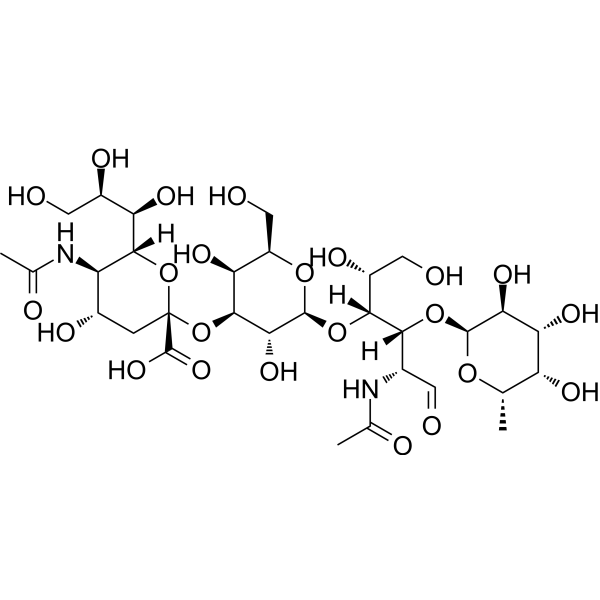
Sialyl-Lewis X (sLeX) is a sialylated fucosylated tetrasaccharide, an endogenous antigen. Sialyl-Lewis X is a high-affinity ligand for selectins (E-, P-, and L-selectin). Sialyl-Lewis X binds to ELAM-1 and CD62 and has the ability?to inhibits CD62-mediated neutrophil recruitment to sites of inflammation.
Nur für Forschungszwecke. Wir verkaufen nicht an Patienten.
- Reinheit : 98.56%
- CAS. Nr.: 98603-84-0
- Formel: C31H52N2O23
- Molecular Weight:820.74
-
Speicherung:
-20°C, stored under nitrogen
* In solvent : -80°C, 6 months; -20°C, 1 month (stored under nitrogen)

To place orders, for customer services and technical support, please contact: MedChemExpress USA
Tel: 609-228-6898 E-mail: [email protected] [email protected]


-
 Biologische Aktivität
-
Chemical Information
-
Lösungsmittel & Löslichkeit
- Protokoll
- Reinheit & Dokumentation
- Verweise
-
 Help & FAQs



Publications Citing Use of MedChemExpress (MCE) Sialyl-Lewis X
MoreAlle Endogenous Metabolite Isoform-spezifische Produkte anzeigen
More

Biologische Aktivität
Beschreibung
IC50 & Target
|
Human Endogenous Metabolite |
Cellular Effect
|
Cell Line

|
Type | Value | Description | References |
|---|---|---|---|---|
| HL-60 | IC50 |
3.4 mM
Compound: sLex
|
Inhibition of P-selectin in human HL-60 cells
Inhibition of P-selectin in human HL-60 cells
|
[PMID: 20718494] |
| HL-60 | IC50 |
2 mM
Compound: sLex
|
In vitro inhibitory activity against sialyl Lewis X expressing HL60 cell binding Selectin L
In vitro inhibitory activity against sialyl Lewis X expressing HL60 cell binding Selectin L
|
[PMID: 8544173] |
| HL-60 | IC50 |
2 mM
Compound: sLex
|
In vitro inhibitory activity against sialyl Lewis X expressing HL60 cell binding Selectin P
In vitro inhibitory activity against sialyl Lewis X expressing HL60 cell binding Selectin P
|
[PMID: 8544173] |
| HL-60 | IC50 |
3 mM
Compound: sLex
|
In vitro inhibition of HL60 (human leukemia) cell binding to human recombinant e-selectin.
In vitro inhibition of HL60 (human leukemia) cell binding to human recombinant e-selectin.
|
[PMID: 8544173] |
| HL-60 | IC50 |
3.3 mM
Compound: sLex
|
Tested in vitro for the concentration to inhibit sLex bearing HL-60 cells binding to Selectin E-IgG fusion proteins by 50%.
Tested in vitro for the concentration to inhibit sLex bearing HL-60 cells binding to Selectin E-IgG fusion proteins by 50%.
|
[PMID: 9544210] |
| HL-60 | IC50 |
3.4 mM
Compound: sLex
|
Tested in vitro for the concentration to inhibit sLex bearing HL-60 cells binding to Selectin P-IgG fusion proteins
Tested in vitro for the concentration to inhibit sLex bearing HL-60 cells binding to Selectin P-IgG fusion proteins
|
[PMID: 9544210] |
| HL-60 | IC50 |
3.5 mM
Compound: sLex
|
Tested in vitro for the concentration to inhibit sLex bearing HL-60 cells binding to Selectin L-IgG fusion proteins
Tested in vitro for the concentration to inhibit sLex bearing HL-60 cells binding to Selectin L-IgG fusion proteins
|
[PMID: 9544210] |
| HL-60 | IC50 |
0.3 mM
Compound: 1
|
Ability to inhibit the binding to Selectin E immobilized on SPA beads of radiolabeled HL-60 cell membrane was determined
Ability to inhibit the binding to Selectin E immobilized on SPA beads of radiolabeled HL-60 cell membrane was determined
|
10.1016/0960-894X(95)00469-A |
| HL-60 | IC50 |
0.3 mM
Compound: 1 (sLex)
|
Compound was tested for its ability to inhibit the binding to recombinant human Selectin E immobilized on SPA beads of radiolabeled HL60 cell membrane containing sLex.
Compound was tested for its ability to inhibit the binding to recombinant human Selectin E immobilized on SPA beads of radiolabeled HL60 cell membrane containing sLex.
|
10.1016/0960-894X(96)00008-X |
| HL-60 | IC50 |
2 mM
Compound: sLex (sialyl LewisX)
|
Compound was tested for its ability to inhibit sialyl Lewis X dependent binding of HL-60 cells to P-selectin fusion protein
Compound was tested for its ability to inhibit sialyl Lewis X dependent binding of HL-60 cells to P-selectin fusion protein
|
10.1016/0960-894X(96)00071-6 |
| HL-60 | IC50 |
3 mM
Compound: sLex (sialyl LewisX)
|
Compound was tested for its ability to inhibit sialyl Lewis X dependent binding of HL-60 cells to Selectin E fusion protein
Compound was tested for its ability to inhibit sialyl Lewis X dependent binding of HL-60 cells to Selectin E fusion protein
|
10.1016/0960-894X(96)00071-6 |
In Vitro
Sialyl-Lewis X is a high-affinity ligand of CD62, Antibodies [mAb CSLEX (IgM; anti-sLeX)] to sLeX inhibit CD62-mediated binding of HL-60 cells to activated platelets[1].Liposomes containing glycolipids with the sLeX structure prevents adhesion of HL-60 cells and human neutrophils. HL-60 cell adhesion is partially inhibited (50%) by liposomes containing Lex at 5 μg/ml. However, sLeX liposomes give maximal inhibition at only 1 ug/ml. sLeX liposomes inhibits adhesion with a 10-fold higher affinity than Lex liposomes[1].CD62 binding of neutrophils to activated platelets is inhibited a soluble human milk oligosaccharide that contains the LeX structure. the sLeX sugar is a 30-fold more potent inhibitor than the nonsialylated Lex sugar, which requires 2 μg/ml and 54 μg/ml to achieve 50% inhibition of neutrophil adhesion, respectively[1].
MedChemExpress (MCE) has not independently confirmed the accuracy of these methods. They are for reference only. Further protocols information, click here.


Chemical Information
-
CAS. Nr. 98603-84-0
-
Appearance Solid
-
Molecular Weight 820.74
-
Formel C31H52N2O23
-
Color White to off-white
-
SMILES
OC([C@](O[C@@]([C@@H]1NC(C)=O)([H])[C@H](O)[C@H](O)CO)(C[C@@H]1O)O[C@@H]([C@H]([C@H]2CO)O)[C@H]([C@@H](O2)O[C@@]([C@H](O)CO)([H])[C@]([C@H](C=O)NC(C)=O)([H])O[C@H](O[C@H]3C)[C@H]([C@@H]([C@@H]3O)O)O)O)=O
-
Synonyms
sLeX
-
Structure Classification
-
Initial Source
-
Versand
Room temperature in continental US; may vary elsewhere.
-
Speicherung
-20°C, stored under nitrogen
* In solvent : -80°C, 6 months; -20°C, 1 month (stored under nitrogen)


Publications (1)
-
Journal Impact Factor
-
Most Recent
-
J Nanobiotechnology
Silk-based biomimetic nanocomposite for precision eradication of Helicobacter pylori and gut microbiome preservation. [Abstract]2026 Jan 27;24(1):181. PMID: 41588522


Lösungsmittel & Löslichkeit
In Vitro:
H2O : 125 mg/mL (152.30 mM; Need ultrasonic)
Please refer to the solubility information to select the appropriate solvent. Once prepared, please aliquot and store the solution to prevent product inactivation from repeated freeze-thaw cycles.
Storage method and period of stock solution: -80°C, 6 months; -20°C, 1 month (stored under nitrogen). When stored at -80°C, please use it within 6 months. When stored at -20°C, please use it within 1 month.
* Note: If you choose water as the stock solution, please dilute it to the working solution, then filter and sterilize it with a 0.22 μm filter before use.
Please refer to the solubility information to select the appropriate solvent. Once prepared, please aliquot and store the solution to prevent product inactivation from repeated freeze-thaw cycles.
Storage method and period of stock solution: -80°C, 6 months; -20°C, 1 month (stored under nitrogen). When stored at -80°C, please use it within 6 months. When stored at -20°C, please use it within 1 month.
* Note: If you choose water as the stock solution, please dilute it to the working solution, then filter and sterilize it with a 0.22 μm filter before use.
Konzentration (Stammlösung) × Volumen (Stammlösung) = Konzentration (Ziellösung) × Volumen (Ziellösung)

Protokoll
-
Zymosan-Induced Peritonitis
Zymosan-induced peritonitis is a sterile acute-inflammation model produced by intraperitoneal injection of zymosan, a yeast cell-wall particle preparation, followed by quantification of leukocyte recruitment and soluble inflammatory mediators in peritoneal lavage fluid. Low-dose zymosan peritonitis is commonly used as a self-resolving acute inflammation model in which neutrophil recruitment occurs early and monocyte/macrophage accumulation follows later. The assay readouts include total peritoneal leukocyte number, differential neutrophil and monocyte/macrophage counts, peritoneal cytokines and chemokines, plasma or peritoneal exudation, and optional lipidomic or metabolomic changes during inflammation and resolution. Early neutrophil recruitment after zymosan depends strongly on complement and mast-cell C5a receptor signaling, whereas later monocyte recruitment is linked to MCP-1/CCL2 production.
-
Research Protocol for Inflammation-related Diseases
The NLRP3 inflammasome is a cytosolic innate immune signaling platform that integrates priming signals and danger-signal activation to promote caspase-1 activation, maturation of IL-1β and IL-18, and gasdermin D-mediated pyroptotic cell death. The core experimental logic is to determine whether inflammatory disease phenotypes are driven by increased NLRP3 expression, ASC-containing inflammasome assembly, caspase-1 cleavage, GSDMD cleavage, and extracellular release of IL-1β/IL-18 rather than by nonspecific cell injury alone. The pathway is strongly linked to inflammation-related disease phenotypes because monosodium urate crystals activate NALP3/NLRP3 inflammasome signaling in gout-like crystal inflammation, cholesterol crystals activate NLRP3 inflammasomes in atherogenesis models, and DSS-induced intestinal inflammation has been reported to involve NLRP3 inflammasome activity. However, experimental colitis studies also show context-dependent protective effects of NLRP3 inflammasome co


Reinheit & Dokumentation
-
Data Sheet (278 KB)
-
SDS (393 KB)
- English - EN (393 KB)
- Français - FR (393 KB)
- Deutsch - DE (393 KB)
- Norwegian - NO (393 KB)
- Español - ES (393 KB)
- Swedish - SV (393 KB)
- Italian - IT (393 KB)
- Korean - KR (393 KB)
- Portuguese - PT (393 KB)
-
Handling Instructions (2659 KB)
Verweise
[1]. M J Polley, et al. CD62 and Endothelial Cell-Leukocyte Adhesion Molecule 1 (ELAM-1) Recognize the Same Carbohydrate Ligand, sialyl-Lewis X. Proc Natl Acad Sci U S A. 1991 Jul 15;88(14):6224-8. [Content Brief]
[2]. L A Lasky, et al. Selectins: Interpreters of Cell-Specific Carbohydrate Information During Inflammation. Science [Content Brief]


Complete Stock Solution Preparation Table
Please refer to the solubility information to select the appropriate solvent. Once prepared, please aliquot and store the solution to prevent product inactivation from repeated freeze-thaw cycles.
Storage method and period of stock solution: -80°C, 6 months; -20°C, 1 month (stored under nitrogen). When stored at -80°C, please use it within 6 months. When stored at -20°C, please use it within 1 month.
| Optional Solvent | Concentration Solvent Mass | 1 mg | 5 mg | 10 mg | 25 mg |
|---|---|---|---|---|---|
| H2O | 1 mM | 1.2184 mL | 6.0921 mL | 12.1841 mL | 30.4603 mL |
| 5 mM | 0.2437 mL | 1.2184 mL | 2.4368 mL | 6.0921 mL | |
| 10 mM | 0.1218 mL | 0.6092 mL | 1.2184 mL | 3.0460 mL | |
| 15 mM | 0.0812 mL | 0.4061 mL | 0.8123 mL | 2.0307 mL | |
| 20 mM | 0.0609 mL | 0.3046 mL | 0.6092 mL | 1.5230 mL | |
| 25 mM | 0.0487 mL | 0.2437 mL | 0.4874 mL | 1.2184 mL | |
| 30 mM | 0.0406 mL | 0.2031 mL | 0.4061 mL | 1.0153 mL | |
| 40 mM | 0.0305 mL | 0.1523 mL | 0.3046 mL | 0.7615 mL | |
| 50 mM | 0.0244 mL | 0.1218 mL | 0.2437 mL | 0.6092 mL | |
| 60 mM | 0.0203 mL | 0.1015 mL | 0.2031 mL | 0.5077 mL | |
| 80 mM | 0.0152 mL | 0.0762 mL | 0.1523 mL | 0.3808 mL | |
| 100 mM | 0.0122 mL | 0.0609 mL | 0.1218 mL | 0.3046 mL |
* Note: If you choose water as the stock solution, please dilute it to the working solution, then filter and sterilize it with a 0.22 μm filter before use.


Sialyl-Lewis X Related Classifications
HY-W020790 Related Classifications
 Powered by Bioz