



Silver nitrite

Based on 1 Customer Validation
Silver nitrite is an inorganic compound with the chemical formula AgNO2. Silver nitrite can inhibit cell division and bacterial growth by interfering with protein synthesis.
For research use only. We do not sell to patients.
- Assay : 99.85%
- CAS No.: 7783-99-5
- Formula: AgNO2
- Molecular Weight:153.87
-
Storage:
RT, protect from light.
In solvent -80°C, 1 year , -20°C, 6 months


To place orders, for customer services and technical support, please contact: MedChemExpress USA
Tel: 609-228-6898 E-mail: [email protected] [email protected]


-
 Biological Activity
-
Chemical Information
-
Solvent & Solubility
- Protocols
- Purity & Documentation
- References
-
 Help & FAQs


-
HY-N3025
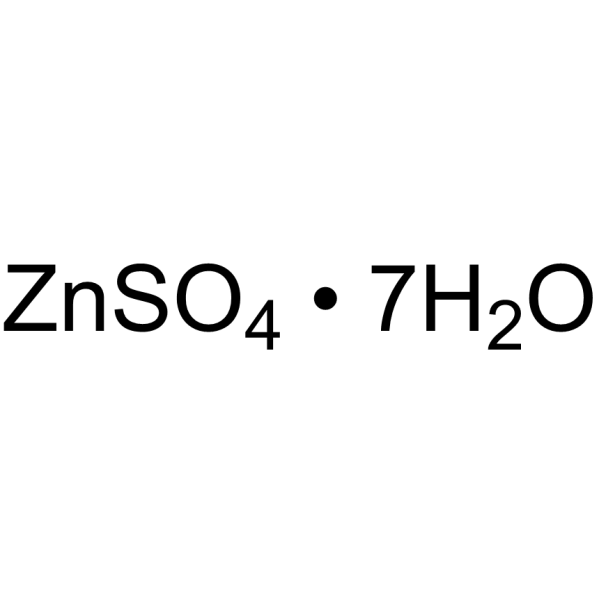
Zinc sulfate heptahydrateDietary Supplement -

HY-W019929
Silver chlorideAlcohol Oxidase Modulator -

HY-Y0975
Silver(I) fluorideDrug Intermediate -

HY-Y1269
Ammonium chloride, AR, 99.5%Autophagy Inhibitor/Ionic Compound -

HY-108775A
Sodium thiosulfate (99%, water≤1.0%)Antioxidant -

HY-Y1269C
Ammonium chloride, for cell cultureAutophagy Inhibitor -

HY-107754
Cesium chloridePotassium Channel Blocker -

HY-W094474
Lithium chloride hydrateNeuroprotective Agent -
HY-W019981B
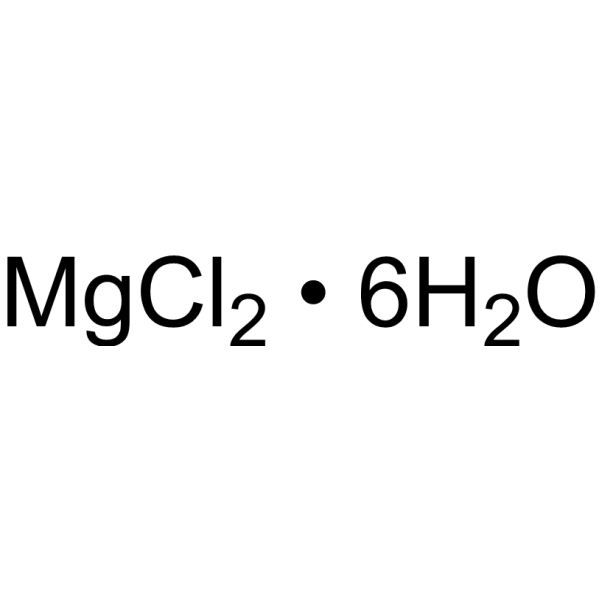
Magnesium chloride hexahydrate, for molecular biologySource of Magnesium Ion -

HY-W019894
Manganese chlorideContrast Agent


Biological Activity
Description
In Vitro


Chemical Information
-
CAS No. 7783-99-5
-
Appearance Solid
-
Molecular Weight 153.87
-
Formula AgNO2
-
Color White to light yellow
-
SMILES
[Ag][N+]([O-])=O
-
Shipping
Room temperature in continental US; may vary elsewhere.
-
Storage
RT, protect from light
In solvent -80°C 1 year -20°C 6 months


Solvent & Solubility
In Vitro:
DMSO : 100 mg/mL (649.90 mM; Need ultrasonic; Hygroscopic DMSO has a significant impact on the solubility of product, please use newly opened DMSO)
H2O : 2 mg/mL (13.00 mM; ultrasonic and warming and heat to 60°C)
Please refer to the solubility information to select the appropriate solvent. Once prepared, please aliquot and store the solution to prevent product inactivation from repeated freeze-thaw cycles.
Storage method and period of stock solution: -80°C, 1 year; -20°C, 6 months. When stored at -80°C, please use it within 1 year. When stored at -20°C, please use it within 6 months.
* Note: If you choose water as the stock solution, please dilute it to the working solution, then filter and sterilize it with a 0.22 μm filter before use.
Please refer to the solubility information to select the appropriate solvent. Once prepared, please aliquot and store the solution to prevent product inactivation from repeated freeze-thaw cycles.
Storage method and period of stock solution: -80°C, 1 year; -20°C, 6 months. When stored at -80°C, please use it within 1 year. When stored at -20°C, please use it within 6 months.
* Note: If you choose water as the stock solution, please dilute it to the working solution, then filter and sterilize it with a 0.22 μm filter before use.
Concentration (start) × Volume (start) = Concentration (final) × Volume (final)
In Vivo:
Select the appropriate dissolution method based on your experimental animal and administration route.
- For the following dissolution methods, please ensure to first prepare a clear stock solution using an In Vitro approach and then sequentially add co-solvents:
- To ensure reliable experimental results, the clarified stock solution can be appropriately stored based on storage conditions. As for the working solution for In Vivo experiments, it is recommended to prepare freshly and use it on the same day.
- The percentages shown for the solvents indicate their volumetric ratio in the final prepared solution. If precipitation or phase separation occurs during preparation, heat and/or sonication can be used to aid dissolution.
In Vivo Dissolution Calculator
Please enter the basic information of animal experiments:
-
-
-
-
Recommended: Prepare an additional quantity of animals to account for potential losses during experiments.
Please enter your animal formula composition:
-
%DMSO +
Recommended: Keep the proportion of DMSO in working solution below 2% if your animal is weak.
-
%+
-
+%Tween-80 + +
-
%Saline +
The co-solvents required include: DMSO, . All of co-solvents are available by MedChemExpress (MCE). , Tween 80. All of co-solvents are available by MedChemExpress (MCE).
Working solution concentration: 0.22 mg/mL
Method for preparing stock solution: mg drug dissolved in μL DMSO. Stock solution concentration: mg/mL.
1. Take μL DMSO stock solution;
2. Add μL .
μL , mix evenly;
3. Then add μL Tween 80, mix evenly;
4. Then add μL
Please ensure that the stock solution in the first step is dissolved to a clear state, and add co-solvents in sequence. You can use ultrasonic heating (ultrasonic cleaner, recommended frequency 20-40 kHz), vortexing, etc. to assist dissolution.

Protocols
-
Aerobic Bacterial Batch Culture on Broth/Agar
Aerobic bacterial batch culture grows a closed inoculated population in broth or on agar without continuous medium replacement; growth readouts include turbidity/OD for total suspended biomass and colony-forming units for viable cells able to form colonies on agar. OD-based growth curves reflect light scattering by cells, but OD is instrument-, pathlength-, species-, cell-size-, and density-dependent, so OD should be calibrated or interpreted alongside viable counts when quantitative cell density is required.
-
CFSE Dye Dilution Proliferation Assay
The CFSE (carboxyfluorescein diacetate succinimidyl ester) dye dilution proliferation assay is based on the covalent labeling of intracellular proteins by a cell-permeant fluorescent dye that becomes fluorescent upon intracellular ester cleavage and then is stably retained within cells. As labeled cells divide, the dye is partitioned equally between daughter cells, resulting in a stepwise halving of fluorescence intensity that can be quantified by flow cytometry to determine the number of cell divisions undergone by each cell population. This fluorescence dilution approach enables quantitative tracking of lymphocyte proliferation at the single-cell level over multiple rounds of division. CFSE-based proliferation analysis has been widely applied to measure antigen-driven lymphocyte expansion in vitro, where discrete fluorescence peaks correspond to successive cell divisions and allow reconstruction of proliferative history within heterogeneous populations.
-
Dye-dilution cell tracking and proliferation staining
Dye-dilution cell tracking assays quantify cell proliferation by covalently labeling intracellular proteins with a stable fluorescent dye that is equally partitioned between daughter cells during mitosis, resulting in stepwise halving of fluorescence intensity with each cell division as measured by flow cytometry histograms. Carboxyfluorescein diacetate succinimidyl ester (CFSE) is a prototypical dye that diffuses into cells, is enzymatically converted into a fluorescent compound, and then covalently binds intracellular amine groups, producing long-lived fluorescence suitable for tracking multiple rounds of division in vitro and in vivo. Successive generations of dividing cells form discrete peaks of decreasing fluorescence intensity, enabling estimation of proliferation history, precursor frequency, and division index within heterogeneous populations. Alternative dyes such as CellTrace Violet (CTV) and far-red membrane dyes (e. g. , PKH26) follow the same dilution principle but differ


Purity & Documentation
-
Data Sheet (273 KB)
-
SDS (780 KB)
- English - EN (780 KB)
- Français - FR (780 KB)
- Deutsch - DE (780 KB)
- Norwegian - NO (780 KB)
- Español - ES (780 KB)
- Swedish - SV (780 KB)
- Italian - IT (780 KB)
- Korean - KR (780 KB)
- Portuguese - PT (780 KB)
-
Handling Instructions (2659 KB)
References


Complete Stock Solution Preparation Table
Please refer to the solubility information to select the appropriate solvent. Once prepared, please aliquot and store the solution to prevent product inactivation from repeated freeze-thaw cycles.
Storage method and period of stock solution: -80°C, 1 year; -20°C, 6 months. When stored at -80°C, please use it within 1 year. When stored at -20°C, please use it within 6 months.
| Optional Solvent | Concentration Solvent Mass | 1 mg | 5 mg | 10 mg | 25 mg |
|---|---|---|---|---|---|
| H2O / DMSO | 1 mM | 6.4990 mL | 32.4950 mL | 64.9899 mL | 162.4748 mL |
| 5 mM | 1.2998 mL | 6.4990 mL | 12.9980 mL | 32.4950 mL | |
| 10 mM | 0.6499 mL | 3.2495 mL | 6.4990 mL | 16.2475 mL | |
| DMSO | 15 mM | 0.4333 mL | 2.1663 mL | 4.3327 mL | 10.8317 mL |
| 20 mM | 0.3249 mL | 1.6247 mL | 3.2495 mL | 8.1237 mL | |
| 25 mM | 0.2600 mL | 1.2998 mL | 2.5996 mL | 6.4990 mL | |
| 30 mM | 0.2166 mL | 1.0832 mL | 2.1663 mL | 5.4158 mL | |
| 40 mM | 0.1625 mL | 0.8124 mL | 1.6247 mL | 4.0619 mL | |
| 50 mM | 0.1300 mL | 0.6499 mL | 1.2998 mL | 3.2495 mL | |
| 60 mM | 0.1083 mL | 0.5416 mL | 1.0832 mL | 2.7079 mL | |
| 80 mM | 0.0812 mL | 0.4062 mL | 0.8124 mL | 2.0309 mL | |
| 100 mM | 0.0650 mL | 0.3249 mL | 0.6499 mL | 1.6247 mL |
* Note: If you choose water as the stock solution, please dilute it to the working solution, then filter and sterilize it with a 0.22 μm filter before use.


Silver nitrite Related Classifications
HY-W034067 Related Classifications
 Powered by Bioz