



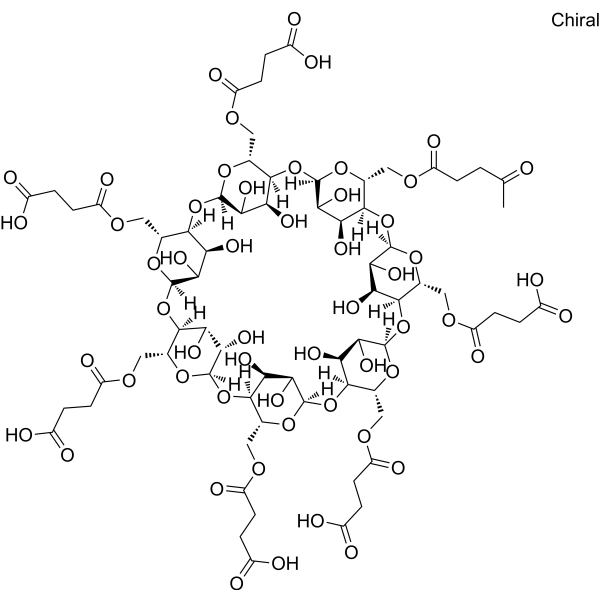
Succinyl-β-cycloaltrin
Succinyl-β-cycloaltrin is a modified cyclodextrin with unique chemical properties that make it an effective solubilizer and stabilizer for various compounds, especially in the pharmaceutical industry. Succinyl-β-cycloaltrin has a hydrophobic interior and a hydrophilic exterior, enabling it to form stable clathrates with hydrophobic molecules such as drugs and nutrients. This increases their solubility and bioavailability, making them more effective for recreational or nutritional purposes.
For research use only. We do not sell to patients.
- CAS No.: 957494-34-7
- Formula: C71H100O55
- Molecular Weight:1833.52
-
Storage:
Please store the product under the recommended conditions in the Certificate of Analysis.

To place orders, for customer services and technical support, please contact: MedChemExpress USA
Tel: 609-228-6898 E-mail: [email protected] [email protected]


-
 Biological Activity
-
Chemical Information
- Protocols
- Purity & Documentation
-
 Help & FAQs




Biological Activity
Description
In Vitro
Succinyl-β-cyclodextrin is a biochemical reagent that can be used as a biological material or organic compound for life science related research.
MedChemExpress (MCE) has not independently confirmed the accuracy of these methods. They are for reference only.


Chemical Information
-
CAS No. 957494-34-7
-
Molecular Weight 1833.52
-
Formula C71H100O55
-
SMILES
O=C(CCC(C)=O)OC[C@@H](O[C@@](O[C@]([C@H]1O)([H])[C@H](O[C@@](O[C@]([C@H]2O)([H])[C@H](O[C@@](O[C@]([C@H]([C@@H]3O)O)([H])[C@H]4COC(CCC(O)=O)=O)([H])[C@H]2O)COC(CCC(O)=O)=O)([H])[C@H]1O)COC(CCC(O)=O)=O)([H])[C@H]5O)[C@@]([C@H]5O)([H])O[C@@]([C@H]([C@@H]6O)O)([H])O[C@@H]([C@@]6([H])O[C@@]([C@H]([C@@H]7O)O)([H])O[C@@H]([C@@]7([H])O[C@@]([C@H]([C@@H]8O)O)([H])O[C@@H]([C@@]8([H])O[C@@]3([H])O4)COC(CCC(O)=O)=O)COC(CCC(O)=O)=O)COC(CCC(O)=O)=O
-
Shipping
Room temperature in continental US; may vary elsewhere.
-
Storage
Please store the product under the recommended conditions in the Certificate of Analysis.


Purity & Documentation

Calculators
Concentration (start) × Volume (start) = Concentration (final) × Volume (final)


Succinyl-β-cycloaltrin Related Classifications
HY-134924 Related Classifications
 Powered by Bioz