



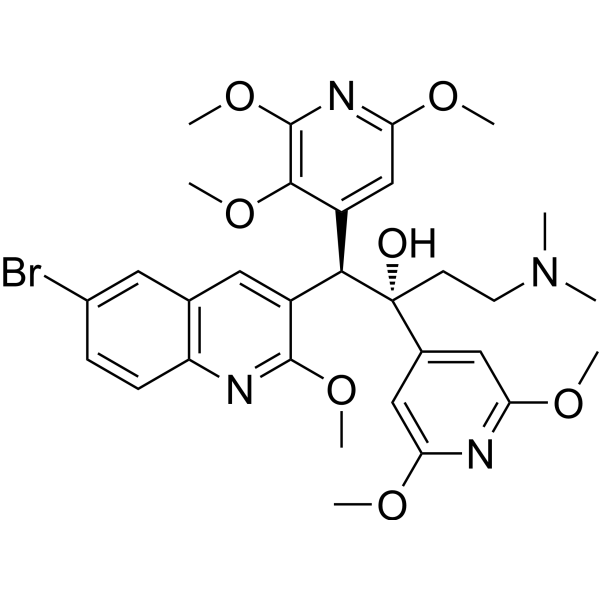
TBAJ-876
TBAJ-876 is an orally active diarylquinoline anti-Mycobacterium agent. TBAJ-876 regulates energy metabolism by targeting the c and ε subunits of Mycobacterium tuberculosis F-ATP synthase, exerts bactericidal activity against replicating Mycobacterium tuberculosis, and retains activity against strains carrying the Rv0678 mutation. TBAJ-876 undergoes N-demethylation in vivo to form its major active metabolite TBAJ-876-M3, which has lower lipophilicity and hERG potassium channel binding affinity. TBAJ-876 is well tolerated in BALB/c mice and significantly reduces the colony-forming units of Mycobacterium tuberculosis in the lungs. In addition, TBAJ-876 exhibits inhibitory activity against Mycobacterium abscessus, reduces bacterial loads in the lungs and spleens of infected mice, and shows no antagonistic effect when used in combination with common antibiotics. TBAJ-876 can be used in studies related to tuberculosis and Mycobacterium abscessus pulmonary diseases.
For research use only. We do not sell to patients.
- CAS No.: 2332841-25-3
- Formula: C31H37BrN4O7
- Molecular Weight:657.55
-
Storage:Powder -20°C, 3 years ; In solvent -80°C, 6 months , -20°C, 1 month

To place orders, for customer services and technical support, please contact: MedChemExpress USA
Tel: 609-228-6898 E-mail: [email protected] [email protected]


-
 Biological Activity
-
Chemical Information
- Protocols
- Purity & Documentation
- References
-
 Help & FAQs




Biological Activity
Description
Cellular Effect
|
Cell Line

|
Type | Value | Description | References |
|---|---|---|---|---|
| Vero | IC50 |
>10 μg/mL
Compound: 3; TBAJ-876
|
Cytotoxicity against African green monkey Vero cells assessed as reduction in cell viability incubated for 72 hrs by MTS-PBS assay
Cytotoxicity against African green monkey Vero cells assessed as reduction in cell viability incubated for 72 hrs by MTS-PBS assay
|
[PMID: 31810890] |
| Vero | IC50 |
>10 μg/mL
Compound: 46; TBAJ-876
|
Cytotoxicity against African green monkey Vero cells measured after 72 hrs by MTT assay
Cytotoxicity against African green monkey Vero cells measured after 72 hrs by MTT assay
|
[PMID: 30803745] |
In Vitro
TBAJ-876 (0.004-0.016 mg/L) has potent in vitro bacteriostatic activity against Mycobacterium tuberculosis H37Rv (MIC 0.008-0.016 mg/L) and Mycobacterium tuberculosis Beijing VN 2002-1585 (MIC 0.004 mg/L)[1].
TBAJ-876 (0.0001-0.016 mg/L; 10 days) shows no interaction with its metabolite M3 when tested against Mycobacterium tuberculosis Beijing VN 2002-1585[1].
TBAJ-876 (0.00025-0.063 mg/L; 1-6 days) demonstrates time- and concentration-dependent bactericidal activity against actively replicating Mycobacterium tuberculosis H37Rv, with the highest tested concentration (0.063 mg/L) reducing bacterial load to undetectable levels by day 6[1].
TBAJ-876 (0.00025-0.063 mg/L; up to 21 days) has limited activity against nonreplicating Mycobacterium tuberculosis H37Rv, with only the highest tested concentration (0.063 mg/L, 16× MIC) reducing bacterial load by ~1.6 log10 CFU/mL over 3 weeks[1].
TBAJ-876 (1.38-138 μM; 5 days) exerts bacteriostatic activity against M. abscessus Bamboo in vitro at concentrations of 3x, 30x, and 300x its MIC, inhibiting growth without reducing bacterial counts below the initial inoculum[2].
TBAJ-876 (0-2 μM; 3 days) exhibits additive or synergistic in vitro interactions with commonly used anti-M. abscessus antibiotics against M. abscessus Bamboo, with no observed antagonism[2].
MedChemExpress (MCE) has not independently confirmed the accuracy of these methods. They are for reference only. Further protocols information, click here.
Parmacokinetics
In Vivo
TBAJ-876 (10-30 mg/kg; p.o.; once daily; 10 consecutive days) reduces Mycobacterium abscessus bacterial loads in the lungs and spleen of infected NOD SCID mice, with efficacy comparable to bedaquiline at the 10 mg/kg dose[2].
MedChemExpress (MCE) has not independently confirmed the accuracy of these methods. They are for reference only.
-
Animal Model:NOD.CB17-Prkdcscid/NCrCrl (NOD SCID) (8-week-old female, intranasal infection with Mycobacterium abscessus subsp. abscessus K21)[2]
-
Dosage:10 mg/kg; 30 mg/kg
-
Administration:p.o.; once daily; 10 consecutive days
-
Result:Achieved in vivo efficacy against M.
abscessus comparable to bedaquiline, reducing bacterial loads in the lungs and spleen relative to untreated controls at 10 mg/kg.
Demonstrated increased efficacy in reducing bacterial loads in both lungs and spleen compared to the 10 mg/kg dose at 30 mg/kg, though this difference was not statistically significant.
Clinical Trial
| NCT Number | Sponsor | Condition | Start Date |
Phase
|
|---|---|---|---|---|
| NCT01329991 | Plexxikon| | 2011-05 | PHASE1 |


Chemical Information
-
CAS No. 2332841-25-3
-
Appearance Solid
-
Molecular Weight 657.55
-
Formula C31H37BrN4O7
-
Color White to off-white
-
SMILES
COC1=NC(OC)=C(OC)C([C@H](C2=CC(C=C(Br)C=C3)=C3N=C2OC)[C@@](C4=CC(OC)=NC(OC)=C4)(O)CCN(C)C)=C1
-
Shipping
Room temperature in continental US; may vary elsewhere.
-
Storage
Powder -20°C 3 years In solvent -80°C 6 months -20°C 1 month

Protocols
-
Bacterial live/dead nucleic-acid viability staining
The LIVE/DEAD bacterial viability staining method is based on differential permeability of nucleic-acid-binding fluorescent dyes, most commonly SYTO 9 and propidium iodide (PI), which enables discrimination of bacterial populations with intact versus compromised cytoplasmic membranes. SYTO 9 penetrates both intact and damaged bacterial membranes and binds nucleic acids to produce green fluorescence, whereas propidium iodide penetrates only cells with compromised membranes and fluoresces red while also reducing SYTO 9 signal through competitive binding and fluorescence interactions. The resulting fluorescence pattern is interpreted as a proxy for membrane integrity, which is widely used as an indicator of bacterial viability in microscopy, flow cytometry, and spectroscopic platforms. However, mechanistic studies show that SYTO 9 and PI interactions involve displacement and fluorescence resonance energy transfer effects, which can influence signal interpretation depending on dye ratios a
-
Genotoxicity/Mutagenicity Study
The bacterial reverse mutation assay detects point mutations that restore amino-acid prototrophy in auxotrophic Salmonella typhimurium or Escherichia coli tester strains; after exposure to a test article, mutagenic activity is read out as an increased number of revertant colonies on minimal agar compared with the vehicle control. The assay uses tester strains with different mutation targets so that base-substitution and frameshift mutagens can be detected, and testing is performed with and without exogenous mammalian metabolic activation because some chemicals require biotransformation to become mutagenic.


Purity & Documentation
-
Data Sheet (280 KB)
-
SDS (252 KB)
- Français - FR (252 KB)
- Deutsch - DE (252 KB)
- Norwegian - NO (252 KB)
- Español - ES (252 KB)
- Swedish - SV (252 KB)
- Italian - IT (252 KB)
- Korean - KR (252 KB)
- Portuguese - PT (252 KB)
-
Handling Instructions (2659 KB)
References
[1]. Mudde SE, et al. Relative Contributions of the Novel Diarylquinoline TBAJ-876 and its Active Metabolite to the Bactericidal Activity in a Murine Model of Tuberculosis. J Infect Dis. 2024;230(6):e1366-e1374. [Content Brief]
[2]. Sarathy JP, et al. TBAJ-876, a 3,5-Dialkoxypyridine Analogue of Bedaquiline, Is Active against Mycobacterium abscessus. Antimicrob Agents Chemother. 2020;64(4):e02404-19. Published 2020 Mar 24. [Content Brief]

Calculators
Concentration (start) × Volume (start) = Concentration (final) × Volume (final)


TBAJ-876 Related Classifications
HY-128866 Related Classifications
 Powered by Bioz
Keywords
- TBAJ-876
- 2332841-25-3
- TBAJ876
- TBAJ 876
- Bacterial
- Mycobacterium tuberculosis
- Mycobacterium abscessus
- ATP synthase
- Mycobacterium tuberculosis F-ATP synthase subunits c
- Rv0678 mutations
- BALB/c mice
- hERG potassium channels
- Mycobacterium tuberculosis Beijing VN2002-1585
- Mycobacterium tuberculosis F-ATP synthase subunits ε
- NOD SCID mice
- Inhibitor
- inhibitor
- inhibit